Reference
How many bird species are in Nevada?
Nevada has 496 bird species on its official list (Nevada Bird Records Committee, October 29, 2026), the 13th highest count of the 49 states with a verified count. It counts game birds released here that now live wild, such as the Himalayan Snowcock, and keeps one warbler record apart as a species pair.
Nevada’s state bird is the Mountain Bluebird: our Nevada state bird page tells how it was chosen.
Updated
What are the most common birds in Nevada?
In summer, the 25 most common birds in Nevada are led by the Sagebrush Sparrow, at about 134 birds per survey route, then the Horned Lark and the Western Meadowlark, by the USGS Breeding Bird Survey’s counts for 2021–2025. Together these 25 made up 75% of all the birds counted on Nevada’s 30 survey routes. USGS rates most of these Nevada estimates as less precise, so read the order as a rough guide.
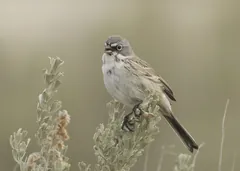
Photo: RJ Baltierra, CC BY 4.0 1 Sagebrush Sparrowabout 134 per routeon 63% of routesno clear trend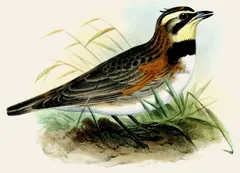
Joseph Wolf, Proceedings of the Zoological Society of London (1855) 2 Horned Larkabout 60 per routeon 97% of routesno clear trend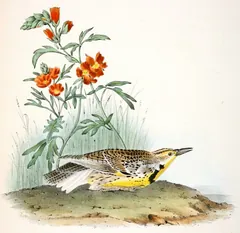
John James Audubon, The Birds of America (1840–44) 3 Western Meadowlarkabout 53 per routeon 80% of routesno clear trend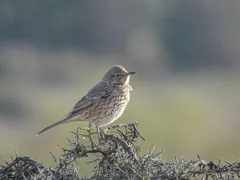
Photo: Pedro Guevara, CC BY 4.0 4 Sage Thrasherabout 49 per routeon 63% of routesno clear trend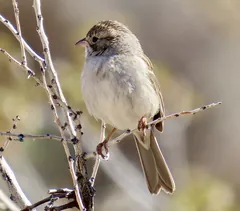
Photo: an iNaturalist contributor, CC0 1.0 5 Brewer's Sparrowabout 47 per routeon 80% of routesfalling since 2015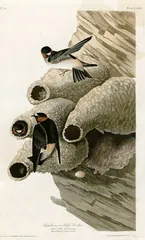
John James Audubon, The Birds of America (1827–38) 6 Cliff Swallowabout 38 per routeon 40% of routesno clear trend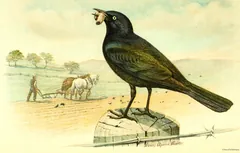
Louis Agassiz Fuertes, Bulletin, Biological Survey (1908) 7 Brewer's Blackbirdabout 37 per routeon 73% of routesno clear trend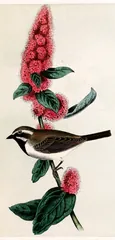
William E. Hitchcock, John Cassin’s Illustrations of the Birds of California, Texas, Oregon, British and Russian America (1853–56) 8 Black-throated Sparrowabout 32 per routeon 80% of routesno clear trend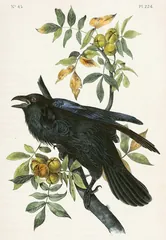
John James Audubon, The Birds of America (1840–44) 9 Common Ravenabout 19 per routeon 100% of routesno clear trend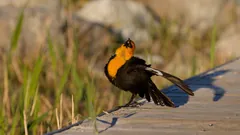
Photo: Daughter Dad, CC BY 4.0 10 Yellow-headed Blackbirdabout 15 per routeon 53% of routesno clear trend
Show all 25
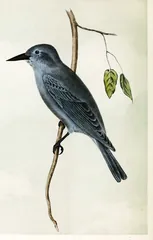
William E. Hitchcock, John Cassin’s Illustrations of the Birds of California, Texas, Oregon, British and Russian America (1853–56) 11 Pinyon Jayabout 13 per routeon 27% of routesno clear trend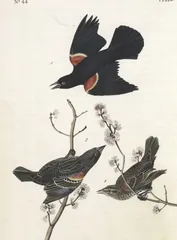
John James Audubon, The Birds of America (1840–44) about 10 per routeon 67% of routesno clear trend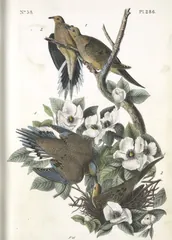
John James Audubon, The Birds of America (1840–44) about 10 per routeon 93% of routesno clear trend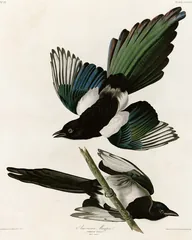
John James Audubon, The Birds of America (1827–38) 14 Black-billed Magpieabout 7.7 per routeon 57% of routesno clear trend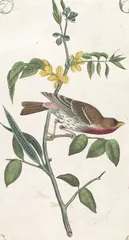
John James Audubon, The Birds of America (1840–44) 15 House Finchabout 5.8 per routeon 80% of routesno clear trend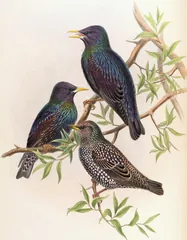
John Gould and Henry Constantine Richter, The Birds of Asia, vol. 5 (1850–83) 16 European Starlingabout 5.5 per routeon 57% of routesno clear trendintroduced species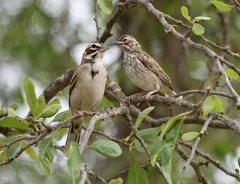
Photo: Cody Stricker, CC BY 4.0 17 Lark Sparrowabout 4.2 per routeon 73% of routesno clear trend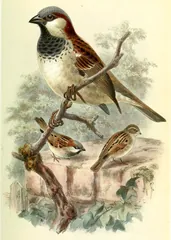
John Gerrard Keulemans, Lord Lilford’s Coloured Figures of the Birds of the British Islands (1885–97) 18 House Sparrowabout 4.1 per routeon 43% of routesno clear trendintroduced species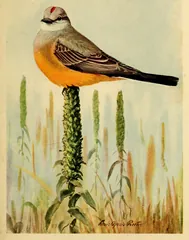
Louis Agassiz Fuertes, Food of Our More Important Flycatchers (1912) 19 Western Kingbirdabout 4.1 per routeon 70% of routesno clear trend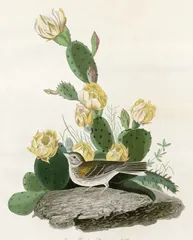
John James Audubon, The Birds of America (1827–38) 20 Vesper Sparrowabout 4.1 per routeon 40% of routesno clear trend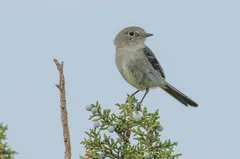
Photo: Rolf Lawrenz, CC BY 4.0 21 Gray Flycatcherabout 4.1 per routeon 37% of routesno clear trend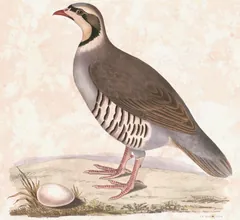
Benjamin Waterhouse Hawkins, J. E. Gray’s Illustrations of Indian Zoology (1830–34) 22 Chukarabout 4.0 per routeon 30% of routesno clear trendintroduced species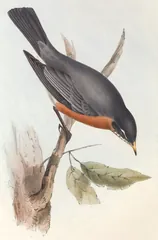
John and Elizabeth Gould, The Birds of Europe (1832–37) about 3.1 per routeon 53% of routesno clear trend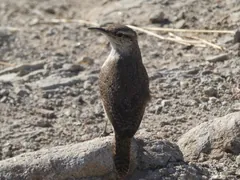
Photo: Eric Johnson, CC BY 4.0 24 Rock Wrenabout 2.9 per routeon 60% of routesno clear trend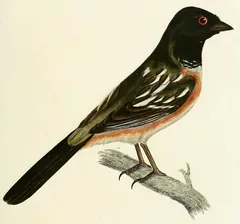
Artist unrecorded, Illustrations of Ornithology (1826) 25 Spotted Towheeabout 2.8 per routeon 57% of routesno clear trend
These 25, led by the Sagebrush Sparrow and the Horned Lark, are a small part of the 496 species on Nevada’s official list; to name the rest, our comparison of the best bird books of 2026 shows which field guide suits a beginner.
What is the most common bird in Nevada?
The Sagebrush Sparrow leads Nevada’s summer survey: about 134 a route on average in 2021–2025, more than twice the Horned Lark’s 60, seen on 63% of the 30 routes. USGS finds no clear rise or fall in its Nevada numbers since 2015.
How was this list made?
Each of Nevada’s 30 routes is a roadside count, 50 stops along about 25 miles, run once a year in early summer by a volunteer. We took USGS’s yearly estimate for each species in Nevada, the number of birds a typical route records, averaged it over the five latest survey years (there was no survey in 2020) and ranked the birds by it. To keep the list to birds you’re likely to meet across Nevada, we left out species recorded on fewer than one in five of its routes, and those USGS can only estimate very roughly, which usually means big flocks or colonies on a few routes.
For Nevada that left out the White-faced Ibis, the Canada Goose and the California Gull.
The share of routes is our own count from USGS’s route data for Nevada, using only counts that met the survey’s standards; “rising” and “falling” are USGS’s trends for the state since 2015, named only where it finds a clear change. Roadside counts on early-summer mornings miss most of Nevada’s owls and waterbirds, and its winter visitors aren’t here at all.
Nevada’s counts come from two USGS data releases, the North American Breeding Bird Survey Analysis Results 1966–2025 (Hostetler et al., 2026) and its Dataset 1966–2025 (Ziolkowski et al., 2026), gathered by volunteer observers and free for anyone to use; Birdfolio isn’t connected with the USGS.
How many bird species are in Nevada?
| Official count | 496 species |
|---|---|
| List’s date | October 29, 2026 |
| Kept by | Nevada Bird Records Committee (Great Basin Bird Observatory) |
| Species pair | 1, not counted: an Arctic Warbler or Kamchatka Leaf Warbler |
| Review list | 139 species and 3 subspecies at the end of 2024 |
| Records committee | Founded 1994; six voting members |
| Among US states | 13th highest of the 49 states with a verified count |
| Official list | Official Checklist of the Birds of Nevada |
What does Nevada’s count include?
- Every species the Nevada Bird Records Committee has endorsed for the state (its word for accepted).
- Introduced birds now living wild, such as the Eurasian Collared-Dove and the Himalayan Snowcock. Once a population is established, the committee stops reviewing sightings of it.
- Birds recorded long before the committee began in 1994, such as the Passenger Pigeon: it still reviews old records.
- Not counted: one bird identified only as an Arctic Warbler or a Kamchatka Leaf Warbler, kept apart as a species pair.
- Not counted: two forms printed on lines of their own, the Eurasian Green-winged Teal and the Thayer's form of the Iceland Gull.
Why do other sources give a different number?
Nevada's total moves by a species or two at a time, and the committee's own reports give these older counts:
- 495. The count at the end of 2024. Five species were added in 2021-2024, among them Hutton's Vireo and Royal Tern, and one came off in 2023 when the Pacific-slope and Cordilleran Flycatchers were merged back into the Western Flycatcher. Source: Nevada Bird Records Committee Report for 2021-2024 (Western Birds 56:154-175, 2025).
- 492. The total at the end of 2020, which still counted the Arctic Warbler record, a bird identified only to a group of three look-alike warblers, as a species. Set that record apart as a pair and it makes 491, the figure older lists from 2021 still show. Source: Nevada Bird Records Committee Report for 2019-2020 (Western Birds 52:3, 2021).
- 489. The total at the end of 2018, a year with no new species, when the committee also cut its review list from 141 species to 108. Source: Nevada Bird Records Committee Annual Report 2018 (Western Birds 51:1, 2020).
Nevada’s list follows its own committee’s rules, and so does every other state’s: see why the counts differ from state to state.
Nevada records, from a one-footed gull to a pigeon collected in 1867
- A Royal Tern stopped at Mason Valley Wildlife Management Area in Lyon County on October 8 and 9, 2023: Nevada's first. The species nests on the coast of southern California and, the committee notes, rarely wanders inland. Source: Nevada Bird Records Committee Report for 2021-2024 (Western Birds 56:154-175, 2025), read October 8, 2026.
- Nevada's first Hutton's Vireo turned up at Virginia Lake in Reno on December 19, 2020, and was photographed during the local Christmas Bird Count. It stayed until December 23, although the species nests within about 70 kilometers (43 miles) of the state line. Source: Nevada Bird Records Committee Report for 2021-2024 (Western Birds 56:154-175, 2025), read October 8, 2026.
- The first Nelson's Sparrows came in October 2021, in Lake Mead National Recreation Area, and October 2023, at Primm. The species has been known as a visitor to the California coast since 1891, but inland it is much rarer: Arizona had a single accepted record. Source: Nevada Bird Records Committee Report for 2021-2024 (Western Birds 56:154-175, 2025), read October 8, 2026.
- A Yellow-footed Gull spent March 20 to April 17, 2022, at Las Vegas Wash, and the ones seen in 2023 at Hemenway Harbor and again at the wash may all have been the same bird. Nevada's only earlier Yellow-footed Gull stayed 7 years. Known as "Old one foot," it had a physical defect that settled who it was. Source: Nevada Bird Records Committee Report for 2021-2024 (Western Birds 56:154-175, 2025), read October 8, 2026.
- The committee still reviews records far older than itself. Among those it received in 2025 and endorsed is a Passenger Pigeon from September 10, 1867: a young bird taken in the West Humboldt Mountains by the Fortieth Parallel survey, a government expedition whose bird report Robert Ridgway wrote. It was the only one the party saw in the whole exploration, he noted, and it had been eating the berries of a small dogwood. The species has been extinct since the last captive bird died on September 1, 1914. Sources: Nevada Bird Records Committee, Complete List of All Records as of September 29, 2026 (Great Basin Bird Observatory); Ornithology, by Robert Ridgway: Report of the Geological Exploration of the Fortieth Parallel, vol. 4, part 3 (U.S. Army Engineer Department, 1877; U.S. Geological Survey); Passenger Pigeon Extinction, state historical marker (Indiana Historical Bureau), read October 4, 2026.
Questions people ask about Nevada’s birds
What types of birds are native to Nevada?
Nevada's native birds are mostly birds of sagebrush, mountains, desert lakes and marshes. In Great Basin National Park, five life zones lie between the town of Baker, at 5,280 feet, and the end of the Wheeler Peak Scenic Drive at 10,000 feet. The Park Service lists Golden Eagles, Horned Larks, Black-throated Sparrows and Western Meadowlarks in the sagebrush on the way up, and Clark's Nutcrackers, Steller's Jays and Townsend's Solitaires among the aspens and limber pines near the top.
In the far south, more than 240 kinds of birds have been recorded at Lake Mead National Recreation Area, a desert where the only water was the Colorado River and its tributaries until Hoover and Davis Dams created Lakes Mead and Mohave. In the north, the Lahontan Valley wetlands, fed by the Carson River and so by the Sierra Nevada snowpack, became in 1988 only the fourth site in the Western Hemisphere Shorebird Reserve Network; they once held 250,000 shorebirds a year, with more than 100,000 Long-billed Dowitchers counted on a single day. Not every bird on the list is native, though: the committee counts introduced species such as the Himalayan Snowcock, released as a game bird, and the Eurasian Collared-Dove, which it groups with escaped cage birds.
Sources: Birds, Great Basin National Park (National Park Service); Birds, Lake Mead National Recreation Area (National Park Service); Lahontan Wetlands Celebrates 30 Years as Internationally Important Site (National Audubon Society, May 12, 2018); Nevada Bird Records Committee Frequently Asked Questions (Great Basin Bird Observatory), read October 8, 2026.
What is the most common bird to see in Las Vegas?
No count names a single most common bird in Las Vegas, but the City of Henderson's Bird Viewing Preserve, nine ponds at its water reclamation plant, shows what to expect: thousands of migrating ducks and geese in winter, such as Northern Shovelers, teal and pintails; nesting American Avocets and Black-necked Stilts in summer; and desert birds such as the Verdin, Abert's Towhee, Crissal Thrasher and Greater Roadrunner all year. More than 270 species have been seen there since it was dedicated on May 20, 1998.
For the state as a whole, one early verdict is Robert Ridgway's. Writing up the birds of the Fortieth Parallel survey in 1877, he judged that no bird of the interior was more widespread than the Mourning Dove, "and certainly none is more abundant," and he found it around the corrals of stage stations in the middle of the deserts.
Sources: Henderson Bird Viewing Preserve (City of Henderson; Internet Archive copy, September 17, 2026); Ornithology, by Robert Ridgway: Report of the Geological Exploration of the Fortieth Parallel, vol. 4, part 3 (U.S. Army Engineer Department, 1877; U.S. Geological Survey), read October 8, 2026.
What is the top 1 rarest bird?
No one can name the world's single rarest bird, but Nevada's rarest are the species with one accepted record each, such as the Royal Tern of 2023 and the Hutton's Vireo of 2020. The one no one will see again is the Passenger Pigeon, extinct since 1914, whose only record in the committee's files dates from 1867. At the end of 2024, 139 species were on the committee's review list, rare enough that it asks for a report on each sighting.
Sources: Nevada Bird Records Committee Report for 2021-2024 (Western Birds 56:154-175, 2025); Nevada Bird Records Committee, Complete List of All Records as of September 29, 2026 (Great Basin Bird Observatory); Passenger Pigeon Extinction, state historical marker (Indiana Historical Bureau); Nevada Bird Records Committee Review List, revised July 24, 2024 (Great Basin Bird Observatory), read October 8, 2026.
How did seabirds from the tropical Pacific end up in the Nevada desert?
A hurricane brought them. Hurricane Hilary moved north from the Pacific off western Mexico and came ashore in Baja California in August 2023, and in the days after, seabirds were seen far inland in California, Arizona and Nevada. On August 21 one was photographed at Roach Dry Lake in Clark County: a Wedge-rumped Storm-Petrel, a bird that nests on islands off South America. It was Nevada's first and joined the list in 2024.
The same day a Least Storm-Petrel, the other seabird Hilary swept inland in large numbers, was photographed at the Avi Resort and Casino at Laughlin, on the Colorado River. Arizona documented at least 37 of them after the storm. Nevada had only two before, both on Lake Mohave after Hurricane Kathleen in 1976, which made the casino bird the state's third.
Source: Nevada Bird Records Committee Report for 2021-2024 (Western Birds 56:154-175, 2025), read October 8, 2026.
Why is a bird from the Himalayas on Nevada's list?
Because it was released here and stayed. The Himalayan Snowcock, a large grouse from the mountains of southern Asia, was introduced as a game bird in the Ruby Mountains of northern Nevada beginning in 1963. It lives on steep, bare slopes above the tree line: small flocks move uphill through the day, feeding on roots, tubers and seeds, then glide back down in the evening. Birders reach them only with a major effort.
The committee's rules explain why it counts. Game birds planted by wildlife agencies, and escaped cage birds, go on the checklist once they form an established population, as the snowcock and the Eurasian Collared-Dove have, and after that sightings aren't reviewed. Birds established in other states but not here, such as the Mute Swan, stay off until the committee votes them on.
Sources: Himalayan Snowcock, Guide to North American Birds (National Audubon Society); Nevada Bird Records Committee Frequently Asked Questions (Great Basin Bird Observatory), read October 8, 2026.
Where is the official Nevada bird list, and how often is it updated?
On the Great Basin Bird Observatory's website, gbbo.org, home of the Nevada Bird Records Committee: the Official Checklist of the Birds of Nevada, next to the review list (revised July 24, 2024), the bylaws and every report back to 1994-96. A table lists every record the committee has considered, endorsed or not; the copy we read was dated September 29, 2026. The committee's page also carries a warning for anyone who finds a banded bird: a band marked NBRC isn't its own but the National Birmingham Roller Club's, a group that breeds and flies Birmingham Roller pigeons.
The committee began in 1994 and has six voting members, who serve three-year terms, and a secretary who doesn't vote on records. A record is endorsed when no more than one member votes against it and fails with four or more votes against out of six; anything in between goes round again. From 1994 through 2024 it reviewed 1,638 reports and endorsed 1,415 of them, 86.3 percent. Its reports have appeared in Western Birds, the journal of Western Field Ornithologists, since the one for 2011.
Sources: Nevada Bird Records Committee Review List, revised July 24, 2024 (Great Basin Bird Observatory); Bylaws of the Nevada Bird Records Committee, last revised August 2024 (Great Basin Bird Observatory); NBRC Annual Reports (Nevada Bird Records Committee, Great Basin Bird Observatory); Nevada Bird Records Committee, Complete List of All Records as of September 29, 2026 (Great Basin Bird Observatory); Nevada Bird Records Committee (NBRC), overview (Great Basin Bird Observatory); Nevada Bird Records Committee Report for 2021-2024 (Western Birds 56:154-175, 2025), read October 8, 2026.
How do you count your own Nevada list?
Your Nevada list is every species you’ve seen in Nevada. eBird can filter your life list to Nevada, and your eBird data download gives the state of every sighting. On paper, count the species you’ve seen in Nevada; what is a life list? explains how birders keep their lists.
To print your whole list, Nevada birds and all, see how to print your bird life list, or let Birdfolio make it a hardcover book.
Nevada’s state bird
Nevada’s state bird is the Mountain Bluebird, the state bird since 1967. Its story, the state flower and animal, and a free picture card for a report are on our Nevada state bird page.
Christmas Bird Count in Nevada
Nevada had 18 Christmas Bird Count circles on Audubon’s map last winter, each counted on a single day between December 14 and January 5. Our guide shows where to find Nevada’s counts and lists 6 Nevada count dates already announced for this winter; it’s free, and beginners are welcome.
More about bird counts
- How many bird species are in each state: Nevada beside all 50 states, DC and Canada.
- Bird lists of nearby states: Arizona, California, Idaho, Oregon and Utah.
- State birds of all 50 states, Nevada’s Mountain Bluebird among them
- How many bird species are in the US and Canada
- Bird splits and lumps
If you’re shopping for a birder in Nevada, our gift guide for birders and our pick of coffee table bird books are good places to start.