Reference
How many bird species are in Montana?
Montana has 452 bird species on its official list (Montana Bird Records Committee, November 1, 2026), the 31st highest count of the 49 states with a verified count. It counts 91 review species, rare enough to need a written report, and keeps 9 more birds on a separate supplemental list, the Passenger Pigeon among them.
Montana’s state bird is the Western Meadowlark: our Montana state bird page tells how it was chosen.
Updated
What are the most common birds in Montana?
In summer, the 25 most common birds in Montana are led by the Western Meadowlark, at about 202 birds per survey route, then the Cliff Swallow and the Horned Lark, by the USGS Breeding Bird Survey’s counts for 2021–2025. Together these 25 made up 69% of all the birds counted on Montana’s 95 survey routes.
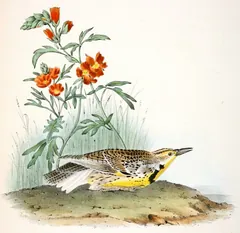
John James Audubon, The Birds of America (1840–44) about 202 per routeon 88% of routesrising since 2015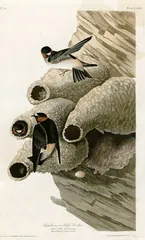
John James Audubon, The Birds of America (1827–38) 2 Cliff Swallowabout 109 per routeon 76% of routesno clear trend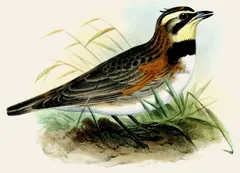
Joseph Wolf, Proceedings of the Zoological Society of London (1855) 3 Horned Larkabout 102 per routeon 75% of routesno clear trend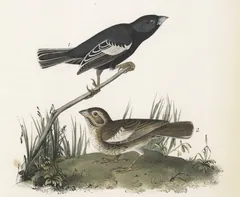
John James Audubon, The Birds of America (1840–44) 4 Lark Buntingabout 83 per routeon 46% of routesno clear trend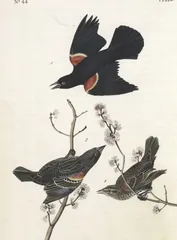
John James Audubon, The Birds of America (1840–44) about 59 per routeon 93% of routesrising since 2015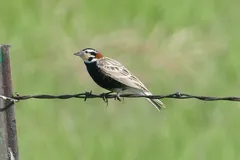
Photo: InAweofGod'sCreation, CC BY 4.0 6 Chestnut-collared Longspurabout 51 per routeon 32% of routesno clear trend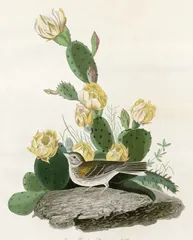
John James Audubon, The Birds of America (1827–38) 7 Vesper Sparrowabout 49 per routeon 87% of routesfalling since 2015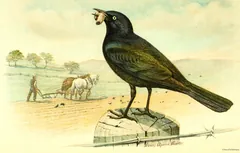
Louis Agassiz Fuertes, Bulletin, Biological Survey (1908) 8 Brewer's Blackbirdabout 42 per routeon 91% of routesno clear trend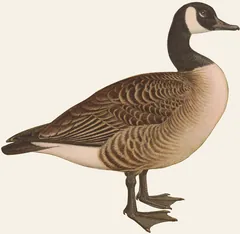
Marinus Adrianus Koekkoek, E. D. van Oort's Ornithologia Neerlandica (1922) about 36 per routeon 71% of routesno clear trend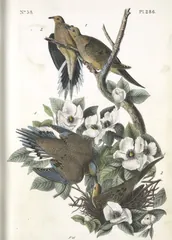
John James Audubon, The Birds of America (1840–44) about 23 per routeon 88% of routesrising since 2015
Show all 25
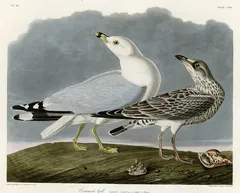
John James Audubon, The Birds of America (1827–38) 11 Ring-billed Gullabout 23 per routeon 31% of routesno clear trend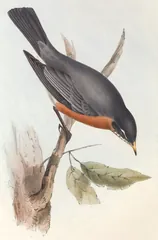
John and Elizabeth Gould, The Birds of Europe (1832–37) about 19 per routeon 99% of routesfalling since 2015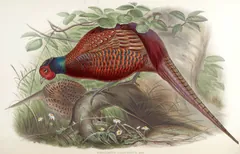
Joseph Wolf and Henry Constantine Richter, in John Gould's The Birds of Asia, part XXI (1869) 13 Ring-necked Pheasantabout 18 per routeon 64% of routesno clear trendintroduced species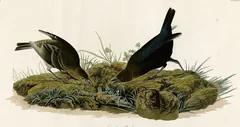
John James Audubon, The Birds of America (1827–38) 14 Brown-headed Cowbirdabout 18 per routeon 96% of routesno clear trend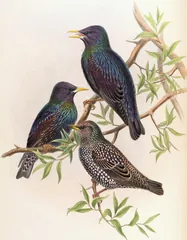
John Gould and Henry Constantine Richter, The Birds of Asia, vol. 5 (1850–83) 15 European Starlingabout 15 per routeon 84% of routesno clear trendintroduced species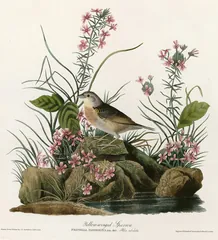
John James Audubon, The Birds of America (1827–38) 16 Grasshopper Sparrowabout 15 per routeon 63% of routesno clear trend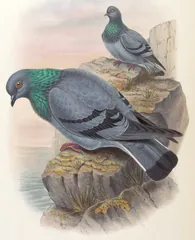
John Gould and William Matthew Hart, The Birds of Asia (1850–83) 17 Rock Pigeonabout 13 per routeon 72% of routesrising since 2015introduced species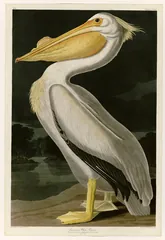
John James Audubon, The Birds of America (1827–38) about 12 per routeon 26% of routesno clear trend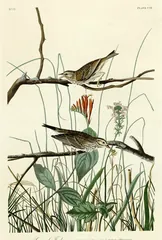
John James Audubon, The Birds of America (1827–38) 19 Savannah Sparrowabout 12 per routeon 77% of routesfalling since 2015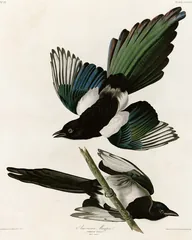
John James Audubon, The Birds of America (1827–38) 20 Black-billed Magpieabout 11 per routeon 71% of routesno clear trend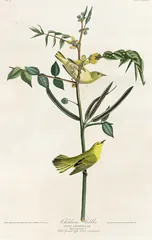
John James Audubon, The Birds of America (1827–38) 21 Northern Yellow Warblerabout 10 per routeon 88% of routesno clear trend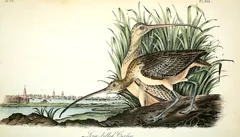
John James Audubon, The Birds of America (1840–44) 22 Long-billed Curlewabout 9.4 per routeon 64% of routesno clear trend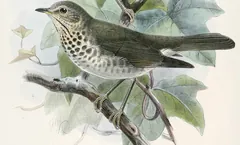
John Gerrard Keulemans, H. E. Dresser’s A History of the Birds of Europe (1871–96) 23 Swainson's Thrushabout 7.6 per routeon 28% of routesno clear trend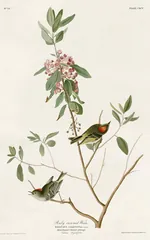
John James Audubon, The Birds of America (1827–38) 24 Ruby-crowned Kingletabout 7.3 per routeon 35% of routesno clear trend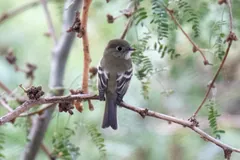
Photo: Kevin Floyd, CC BY 4.0 25 Hammond's Flycatcherabout 7.2 per routeon 23% of routesno clear trend
In winter, the Canada Goose and the Mallard. Montana's 31 Christmas Bird Counts of 2024-25 tallied 73,625 Canada Geese and 45,649 Mallards, and the European Starling was the only other species above 10,000, with 10,924. The Bald Eagle was the most widespread, found on every count, and the Mallard and Black-billed Magpie on all but one.
Source: The 125th Christmas Bird Count in Montana (National Audubon Society, November 11, 2025), read October 8, 2026.
A field guide to North America covers the Cliff Swallow, the Horned Lark and most of the 452 species on Montana’s list; we compared the best bird books of 2026 to find the one that suits a beginner.
What is the most common bird in Montana?
The Western Meadowlark leads Montana’s summer survey: about 202 a route on average in 2021–2025, ahead of the Cliff Swallow at about 109, seen on 88% of the 95 routes. USGS’s estimate has its Montana numbers rising since 2015.
How was this list made?
Each of Montana’s 95 routes is a roadside count, 50 stops along about 25 miles, run once a year in early summer by a volunteer. We took USGS’s yearly estimate for each species in Montana, the number of birds a typical route records, averaged it over the five latest survey years (there was no survey in 2020) and ranked the birds by it. To keep the list to birds you’re likely to meet across Montana, we left out species recorded on fewer than one in five of its routes, and those USGS can only estimate very roughly, which usually means big flocks or colonies on a few routes.
For Montana that left out the Franklin's Gull and the Thick-billed Longspur.
The share of routes is our own count from USGS’s route data for Montana, using only counts that met the survey’s standards; “rising” and “falling” are USGS’s trends for the state since 2015, named only where it finds a clear change. Roadside counts on early-summer mornings miss most of Montana’s owls and waterbirds, and its winter visitors aren’t here at all.
Montana’s counts come from two USGS data releases, the North American Breeding Bird Survey Analysis Results 1966–2025 (Hostetler et al., 2026) and its Dataset 1966–2025 (Ziolkowski et al., 2026), gathered by volunteer observers and free for anyone to use; Birdfolio isn’t connected with the USGS.
How many bird species are in Montana?
| Official count | 452 species |
|---|---|
| List’s date | November 1, 2026 |
| Kept by | Montana Bird Records Committee (Montana Bird Advocacy) |
| Review species | 91, marked R (our count) |
| Supplemental list | 9 species, not counted |
| Earlier total | 448 after the committee's 2025 meeting |
| Among US states | 31st highest of the 49 states with a verified count |
| Official list | Official Montana State List |
What does Montana’s count include?
- Every species the Montana Bird Records Committee has accepted, named as in the American Ornithological Society's supplements through October 2026.
- An R on the 91 review species, documented 20 or fewer times in Montana; a sighting of one needs a written report the committee accepts (our count).
- One entry for a pair of species, the Eastern/Mexican Whip-poor-will, counted once.
- Not counted: 9 species on a separate supplemental list, among them the Passenger Pigeon and a Gyrfalcon that may have been a falconer's bird.
Why do other sources give a different number?
Montana's total changes after each yearly round of decisions, and one count you may see isn't the state list at all:
- 448. The list after the committee's 2025 meeting, which added the Mexican Violetear and counted the American Ornithological Society's split of the Warbling Vireo. The update of September 25, 2026, brought it to 451. Source: Minutes of the Montana Bird Records Committee, 2025.
- 451. The list of September 25, 2026. Its update of November 1, 2026, names both the Eastern and the Western Marsh-Wren, which the American Ornithological Society split on October 20, 2026, and the total is now 452. Source: Official State List of Montana Birds, 452 species as of 1 November 2026 (Montana Bird Records Committee, Montana Bird Advocacy).
- 221. The species ever found on Montana's Christmas Bird Counts, a winter tally much smaller than the state list. Source: The 124th Christmas Bird Count in Montana (National Audubon Society, November 8, 2024).
Montana’s list follows its own committee’s rules, and so does every other state’s: see why the counts differ from state to state.
Montana records, from a violetear to a stilt that split the committee
- A Mexican Violetear photographed on September 6, 2024, joined the list when the committee accepted it in 2025, the only new species of that year's decisions. Sources: Montana Rare Bird Reports 2025 (Montana Bird Records Committee); Minutes of the Montana Bird Records Committee, 2025, read October 8, 2026.
- In 2024 two more birds joined the list by unanimous votes of 15 to 0: a Pacific Golden-Plover photographed on May 15 and a Eurasian Tree Sparrow on June 26. Source: Montana Rare Bird Reports 2024 (Montana Bird Records Committee), read October 8, 2026.
- A Black-winged Stilt photographed on May 3, 2024, divided the committee 8 to 7. It asked outside experts for their views, then took no further action: the bird isn't on the list, and the experts' opinions are archived. Sources: Montana Rare Bird Reports 2024 (Montana Bird Records Committee); Minutes of the Montana Bird Records Committee, 2025, read October 8, 2026.
- A Gyrfalcon photographed on July 9, 2017, sits on the supplemental list instead of the official one: it may have been a falconer's bird, or one kept from migrating by an injury. Source: Supplemental List (Montana Bird Records Committee, Montana Bird Advocacy), read October 8, 2026.
Questions people ask about Montana’s birds
What U.S. state has the most bird species?
California, with 696 species on its October 27, 2026, checklist; Texas follows with 682. Montana's official 452 date from November 1, 2026, the committee's latest update of its list.
Sources: Official California Checklist, 696 species, updated 27 October 2026 (California Bird Records Committee, Western Field Ornithologists); Texas State List, 682 species, last updated October 24, 2026 (Texas Bird Records Committee, Texas Ornithological Society); Official State List of Montana Birds, 452 species as of 1 November 2026 (Montana Bird Records Committee, Montana Bird Advocacy), read November 19, 2026.
What big birds are in Montana?
The biggest is the Trumpeter Swan, North America's largest wild waterfowl, with wings up to eight feet across, the National Park Service says. By 1930 it was nearly gone from the lower 48 states; about 70 survived in the Greater Yellowstone area and seeded its recovery, and North America had about 63,000 by 2015.
Montana's list also has the Whooping and Sandhill Cranes and both the Golden and the Bald Eagle. The state's Christmas Bird Counts of 2024-25 found 1,098 Bald Eagles, on all 31 counts.
Sources: Trumpeter Swan, Yellowstone National Park (National Park Service); Official State List of Montana Birds (Montana Bird Records Committee, Montana Bird Advocacy); The 125th Christmas Bird Count in Montana (National Audubon Society, November 11, 2025), read October 8, 2026.
What are some rare birds that can be found in Montana?
The list marks 91 review species, each documented 20 or fewer times in the state, such as the Baikal Teal, Stejneger's Scoter, Ivory Gull, Ross's Gull, Fieldfare and Siberian Accentor. One of the latest additions is the Mexican Violetear, photographed in September 2024 and accepted in 2025.
Sources: Official State List of Montana Birds (Montana Bird Records Committee, Montana Bird Advocacy); Montana Rare Bird Reports 2025 (Montana Bird Records Committee), read October 8, 2026.
What is the black and white bird I keep seeing in Montana?
If it has a long black tail, it's the Black-billed Magpie, a big, eye-catching black-and-white bird whose tail is what first draws the eye, Flathead Audubon says. It is one of the state's most widespread birds in winter, found on 30 of Montana's 31 Christmas Bird Counts in 2024-25.
Sources: Black-billed Magpie, Bird of the Month (Flathead Audubon Society, July 8, 2014); The 125th Christmas Bird Count in Montana (National Audubon Society, November 11, 2025), read October 8, 2026.
Which birds live in Montana?
A wide mix. In Glacier National Park alone, 279 species have been documented and 144 nest, the National Park Service says. Its list marks the White-tailed Ptarmigan as a nester above treeline, present all year, and 38 of the park's birds, among them the Common Loon, Harlequin Duck, Great Gray Owl and Clark's Nutcracker, are Montana Species of Concern.
The state list adds more grouse, from the Greater Sage-Grouse and Sharp-tailed Grouse to the Spruce Grouse and Dusky Grouse, and the Trumpeter Swan, which nearly vanished from the lower 48 states by 1930 and survived in the Greater Yellowstone area.
Sources: Birds, Glacier National Park (National Park Service); Official State List of Montana Birds (Montana Bird Records Committee, Montana Bird Advocacy); Trumpeter Swan, Yellowstone National Park (National Park Service), read October 8, 2026.
Why isn't the Passenger Pigeon on Montana's list, though Lewis and Clark saw it?
Because no Montana specimen survives. Lewis and Clark reported Passenger Pigeons at least nine times in 1805 and 1806, and birds were reportedly collected in 1856, 1860 and 1874, but none of those specimens exists today, the records committee notes. So the pigeon sits on its supplemental list, outside the official 452.
The rules are strict on purpose. A new species needs a specimen, an unequivocal photo, video or sound recording, or written reports from at least two independent observers; a bird seen well by one person alone goes to the supplemental list, and adding or removing a species takes a unanimous vote. Eight other birds wait there, such as a Common Crane seen by one observer in 1999 and a Barnacle Goose photographed in 2022 that may have escaped from a waterfowl breeder.
The same explorers did get one western bird to the East alive: over the winter of 1804-05 they kept four Black-billed Magpies in a cage, and in spring sent them, with a live prairie dog, to President Jefferson.
Sources: Supplemental List (Montana Bird Records Committee, Montana Bird Advocacy); Bylaws of the Montana Bird Records Committee, adopted October 24, 2003, last amended October 23, 2023; Black-billed Magpie, Bird of the Month (Flathead Audubon Society, July 8, 2014); Official State List of Montana Birds, 452 species as of 1 November 2026 (Montana Bird Records Committee, Montana Bird Advocacy), read November 19, 2026.
Where is the official Montana bird list, and how often is it updated?
On Montana Bird Advocacy's website, montanabirdadvocacy.org, under MT Bird Records Committee: the official state list as a web page and an Excel file, with the date of its latest update, plus the review list, the supplemental list, the committee's bylaws and its yearly minutes and rare bird reports back to 2012. The list is updated each time the committee publishes its decisions, and accepted rare records go into the Montana Natural Heritage Program's Montana Bird Distribution database.
The committee was formed in 1991. With its usual 14 or 15 members, a record is accepted unless four or more of them vote against it or are undecided, and the evidence is archived by the Montana Historical Society. In 2025 it reviewed 21 new reports of 17 species, 18 of them with photos, and turned down four.
Sources: Official State List of Montana Birds, 452 species as of 1 November 2026 (Montana Bird Records Committee, Montana Bird Advocacy); Minutes and Reports (Montana Bird Records Committee, Montana Bird Advocacy); About the Montana Bird Records Committee (Montana Bird Advocacy); Bylaws of the Montana Bird Records Committee, adopted October 24, 2003, last amended October 23, 2023; Minutes of the Montana Bird Records Committee, 2025, read October 8, 2026.
How do you count your own Montana list?
Your Montana list is every species you’ve seen in Montana. eBird can filter your life list to Montana, and your eBird data download gives the state of every sighting. On paper, count the species you’ve seen in Montana; what is a life list? explains how birders keep their lists.
To print your whole list, Montana birds and all, see how to print your bird life list, or let Birdfolio make it a hardcover book.
Montana’s state bird
Montana’s state bird is the Western Meadowlark, the state bird since 1931. Its story, the state flower and animal, and a free picture card for a report are on our Montana state bird page.
Birding festivals in Montana
Our birding festivals calendar lists one festival in Montana, with dates from its own website:
- Wings Across the Big Sky, Moves each year (2026: Kalispell): dates not announced yet; expected in June 2027 (2026 festival: June 12–14, 2026)
Christmas Bird Count in Montana
Montana had 37 Christmas Bird Count circles on Audubon’s map last winter, each counted on a single day between December 14 and January 5. Our guide shows where to find Montana’s counts and lists 1 Montana count date already announced for this winter; it’s free, and beginners are welcome.
More about bird counts
- How many bird species are in each state: Montana beside all 50 states, DC and Canada.
- Bird lists of nearby states: Idaho, North Dakota and South Dakota.
- State birds of all 50 states, Montana’s Western Meadowlark among them
- How many bird species are in the US and Canada
- Bird splits and lumps
If you’re shopping for a birder in Montana, our gift guide for birders and our pick of coffee table bird books are good places to start.