2025 split
Warbling Vireo split into Eastern and Western
Warbling Vireo is now two species: the American Ornithological Society (AOS) split it on August 14, 2025, and eBird followed in October 2025. Birds that nest east of the Rocky Mountains are now the Eastern Warbling Vireo, and those from the Rockies west the Western Warbling Vireo; AviList, the shared world checklist, followed on October 20, 2026. If you have seen Warbling Vireos on both sides of the Rockies, your eBird list goes up by one.
Updated
What changed
Nests east of the Rocky Mountains, from the Great Plains to the East Coast.
Nests from the Rocky Mountains west to the Pacific coast, and north to southeastern Alaska.
Has Warbling Vireo been split?
Yes, on all the main checklists. The AOS split it on August 14, 2025, the American Birding Association (ABA) followed on September 11, 2025, and eBird made the change in its October 2025 update. The AOS and the ABA write the names with a hyphen, Eastern Warbling-Vireo and Western Warbling-Vireo; Audubon and others leave it out. The ABA's four-letter codes are EAWV and WEWV.
AviList, the shared world checklist, followed last, in its edition of October 20, 2026; its June 2026 edition still had one. See what changed in AviList 2026.
Surprising facts about the Eastern and Western Warbling Vireos
Dad sings on the nest. The male Eastern Warbling Vireo often sings while sitting on the eggs, says Audubon's field guide. It can cost him: cowbirds seem to home in on that singing, and nests where the parents sing more are more likely to get a cowbird egg, says the American Bird Conservancy.
The eastern one throws cowbird eggs out. Eastern Warbling Vireos puncture Brown-headed Cowbird eggs and get rid of them 90 to 100 percent of the time, says the Conservancy. Western Warbling Vireos accept them, the AOS proposal notes.
The split was predicted in 1858. Spencer Baird wrote then that if the western birds “really prove distinct,” they could be named Vireo swainsonii, honoring the naturalist William Swainson, who had written about a specimen from the Columbia River. The AOS made it a species, as swainsoni, 167 years later. Swainson himself named the Painted Whitestart, in 1829.
Audubon heard a music box. In Camden, New Jersey, a courting male poured out “a low warble so sweet and mellow that I can compare it only to the sounds of a good musical box,” he wrote in 1834.
Its song has been called the elevator music of birding. Rebecca Heisman wrote for Audubon in 2022 that once the Merlin app, which identifies songs by machine learning, pointed it out, she heard it everywhere: at the playground, at the plant nursery, even, she was pretty sure, behind an old TV show.
Why it changed
Genes, songs, molt and migration. The two “are separate species based on differences in a suite of characters,” and “these differences are maintained” where their ranges meet, the AOS committee's chair, Terry Chesser, explained; there they mostly pair with their own kind. The proposal, by the committee's co-chair Carla Cicero, cites a 4 percent difference in their mitochondrial DNA. The American Bird Conservancy dates their parting to about 2 million years ago, when ice-age glaciers kept them apart.
They keep different calendars. Eastern adults replace their flight feathers in about 38 days, before leaving the breeding grounds; Western adults take about 55 days and keep molting on migration, the proposal notes. In Alberta, Eastern birds weighed about 30 percent more.
AviList, the shared world checklist, followed on October 20, 2026, citing the same case: genes, looks, song, molt and migration all line up.
Who decided, and when
- American Ornithological Society (AOS): the 66th Supplement to its Check-list of North American birds, after its committee passed proposal 2025-C-3
- American Birding Association (ABA): followed the AOS on the ABA Checklist
- eBird and the Clements Checklist: its 2025 taxonomy update
- AviList, the shared world checklist: its 2026 edition, v2026, with the same names
What is a warbling vireo?
A small, plain songbird of leafy trees: 4.7 to 5.9 inches long and about half an ounce, gray and white with tinges of yellow and olive, says Audubon's field guide. It has no wing bars, so its wings look plain, and a white eyebrow sets off its dark eye.
It sings its long warble even on hot summer days, when most birds have gone quiet. Because it avoids solid tracts of mature forest, it is probably more common today than when the Pilgrims landed.
How do you tell Eastern and Western Warbling Vireos apart?
Mostly by where they nest. “In practice virtually all will be identified presumptively by range,” David Sibley wrote in November 2025, and a silent bird can't be identified for sure.
The song helps. The Eastern's phrases are lower, mostly between 2 and 4 kilohertz, and its song usually ends with an emphatic high note; the Western's is higher, burrier and more varied and only occasionally ends high, Sibley writes. It often ends on a buzzy falling note, adds Michael Retter of the ABA. The Western also tends to have a darker crown, a longer white eyebrow and a smaller bill. Even song can mislead: in one study, 12 percent of birds sang like the other species.
How to tell vireos apart?
Start with the face and the wings. Some vireos wear “spectacles” and have white wing bars, like the Blue-headed and White-eyed Vireos; others have plain wings and an eyebrow stripe, like the Red-eyed Vireo, whose white eyebrow is set off by black stripes, and the warbling vireos, says Audubon's field guide.
The look-alike to watch for is the Philadelphia Vireo: warbling vireos never have dark lores, the spot between the eye and the bill, and their yellow is never brightest down the center of the belly, Retter notes.
Are there vireos in the eastern US?
Yes, several. The Red-eyed Vireo is one of the most numerous summer birds of eastern woods; the Yellow-throated sings in leafy eastern forests, especially among tall oaks; the White-eyed is most common in the Southeast; and the Blue-headed nests in mixed forest, says Audubon's field guide. The Eastern Warbling Vireo nests from Alberta south to Oklahoma and east to the Atlantic coast, though not in the Deep Southeast, says the American Bird Conservancy.
Can you find vireos in Arizona?
Yes. The checklist of the birds of Cochise County, in southeast Arizona, from the Arizona Field Ornithologists lists Bell's, Gray, Hutton's, Western Warbling and Plumbeous and Cassin's Vireos, once Solitary Vireos, among others. At Grand Canyon National Park, the Park Service lists the western warbling vireo as a common summer resident of mixed conifer forests.
Where can you see Eastern and Western Warbling Vireos?
The Eastern often lives in isolated groves near water, says Audubon's field guide. Where both nest, as in South Dakota's Black Hills, the Eastern favors riverside cottonwoods in the lowlands and the Western aspen thickets in the foothills and mountains, Retter writes. At Rocky Mountain National Park, warbling vireos live in aspen and streamside forests up to 10,500 feet.
In winter the Western goes almost entirely to Mexico, and the Eastern mostly farther south, as far as Costa Rica, Retter writes. Eastern birds migrate around the Gulf of Mexico, all passing through Texas, says Sibley.
Which one did you see?
Mostly by where the bird nested. In summer, Warbling Vireos from the Rockies west are Western; those on the Great Plains and in the East are Eastern. Their nesting ranges overlap just east of the Rockies, from Alberta to Colorado, says Sibley.
They look almost the same, so the song helps most: see above.
A bird seen on migration, away from where it nests, is hard to place. Sibley suggests listing such birds as “Warbling Vireo sp.”; eBird's “Eastern/Western Warbling Vireo” keeps the sighting but doesn't count as a species.
What it does to your list
If you have seen Warbling Vireos on only one side of the Rockies, nothing changes but the name. If you have seen them on both sides, eBird now counts two species, so your total goes up by one. Birders call a species gained from a split, without a new sighting, an “armchair lifer.”
When eBird can't tell which of the new species an old record was, it keeps the sighting as a “one or the other” record. Those stay in your records but don't count as a species.
Birdfolio books use AviList's October 2026 edition, which also splits Warbling Vireo: if your list has both, your book counts both.
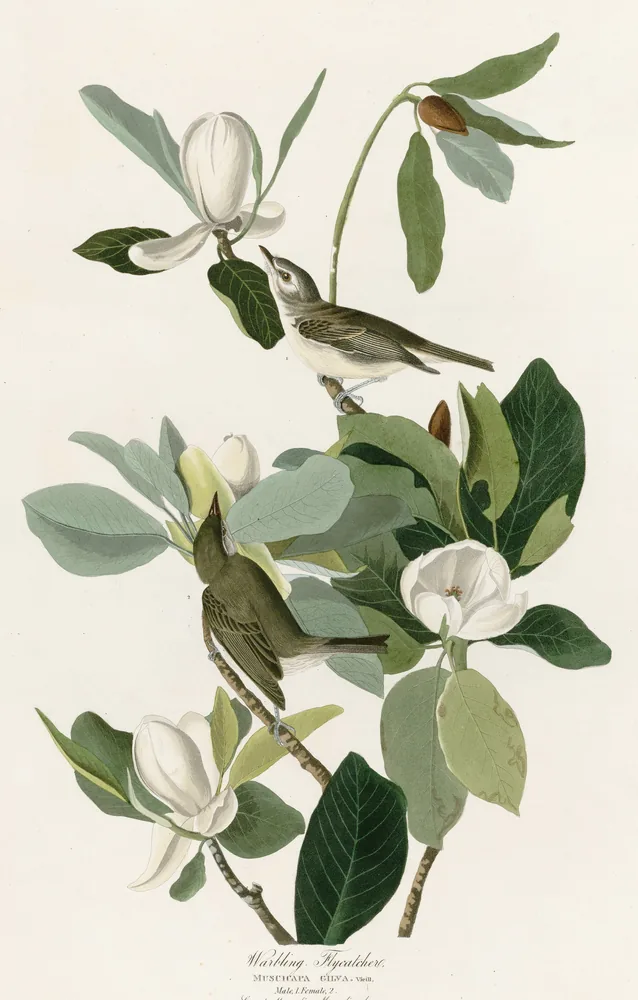
The painting at the top is Audubon's plate 118, his Warbling Flycatcher, from Camden: an Eastern bird. Other splits that year: the Yellow Warbler and the Whimbrel.
Seen them on both sides of the Rockies? Once your list shows the new names, here's how to print your updated life list.
Check your own list. Drop your eBird download or type your birds: the free checker shows which of them this and other recent changes touched.
Check my list