2025 split
Whimbrel split: Hudsonian and Eurasian
The Hudsonian Whimbrel is the Whimbrel of the Americas, now a species of its own: eBird and its Clements Checklist split the Whimbrel in October 2025, after the AviList world checklist did in June 2025, and the American Ornithological Society (AOS) followed on October 20, 2026. The Old World bird is the Eurasian Whimbrel. For most US birders it's a new name, not a new bird: your total goes up only if you have also seen a Eurasian Whimbrel.
Updated
What changed
The Whimbrel of the Americas. It nests in Alaska and northern Canada.
The Whimbrel of Europe, Africa and Asia. In North America it turns up regularly only around the Bering Sea; it is rare in Atlantic Canada and the Northeast, and very rare in Hawaii.
Did the Whimbrel get split?
Yes. In October 2025 eBird and the Clements Checklist split Whimbrel into Hudsonian Whimbrel and Eurasian Whimbrel. The AviList world checklist had done the same in June 2025, and on January 29, 2026, the American Birding Association (ABA) added both to its official list of the birds of the US and Canada. The IOC World Bird List and BirdLife International treat them as two species too, says the International Wader Study Group.
The American Ornithological Society (AOS), which keeps the official list of North American birds, came last: it split the Whimbrel on October 20, 2026, in the 67th Supplement to its Check-list, with the same names. So every major checklist now agrees. When the ABA added both, the AOS still had one Whimbrel; that's why the ABA kept the old four-letter code WHIM for Hudsonian Whimbrel and gave Eurasian Whimbrel a new one, EUWH.
Did the Hudsonian Whimbrel change its name?
Yes. The bird North American birders called simply Whimbrel is now the Hudsonian Whimbrel, Numenius hudsonicus: the same bird under a new name, in eBird since October 2025.
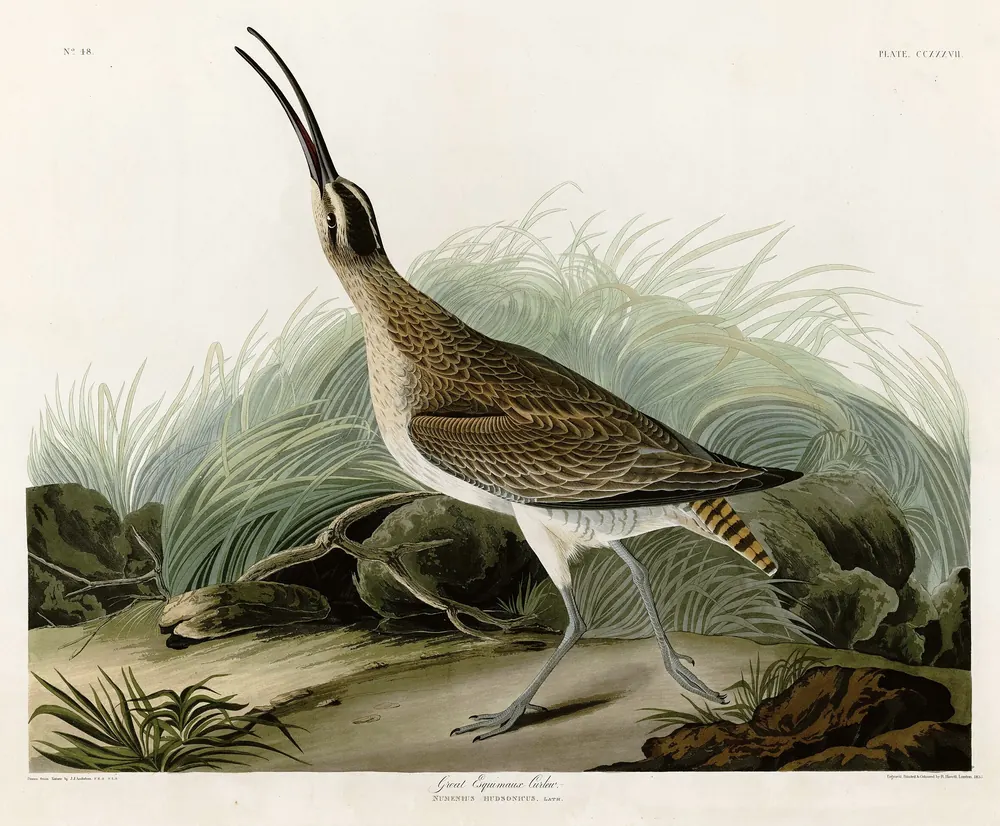
The name Hudsonian isn't new. The painting at the top of this page, plate 237 of Audubon's The Birds of America, is titled "Hudsonian Curlew." The word Whimbrel itself began in England, says Audubon's field guide, apparently as a loose imitation of the bird's call.
Surprising facts about the Hudsonian Whimbrel
One flew through a hurricane and came out fine. In August 2011 a satellite-tagged Hudsonian Whimbrel named Chinquapin left upper Hudson Bay and flew into the most dangerous part of Hurricane Irene, its northeast quadrant. Two days later, researchers found it alive and well on Eleuthera Island in the Bahamas, William & Mary reported.
Another fought a storm for 27 hours. That same month a whimbrel named Hope flew through Tropical Storm Gert off Nova Scotia, battling headwinds for 27 hours at an average of only 9 miles per hour. Once through, tail winds pushed her to more than 90 miles per hour, back to Cape Cod.
It breaks crabs before it swallows them. On the coast it eats many crabs, and it may break off the legs and crush the shell before swallowing the body, says Audubon's field guide.
It fuels up on berries. On the tundra it eats insects at first, but crowberries and cranberries become a major part of its diet by late summer, and Houston Audubon says the berries help fuel its migration south.
Parents dive-bomb intruders. Adults attack predators flying over the nest and will fly straight at people, swerving aside at the last moment.
A college student won the official split. The proposal the AOS's committee passed in 2026 came from Martin Freeland, an undergraduate at Stanford University, who pointed to differences in courtship and threat displays, in size and shape, and in genes. A similar proposal had failed in 2022. The committee then invited him into its group of early-career scientists, the AOS said.
Why it changed
For at least two decades, experts debated whether the American bird was a species of its own or only a subspecies, Numenius phaeopus hudsonicus, Manomet Conservation Sciences notes.
Genetics settled it for most checklists. AviList cites deep differences in the birds' DNA, along with differences in looks. The International Wader Study Group points to studies from 2020 and 2023 that found the two have been apart a long time, with little interbreeding.
Their voices are another matter: AviList notes that they seem similar, and that no formal study of their sounds has been done yet.
The name Hudsonian is old. John Latham described the American bird as Numenius hudsonicus in 1790, from Hudson Bay, according to AviList.
Who decided, and when
- AviList, the shared world checklist: agrees, with the same names
- eBird and the Clements Checklist: its 2025 taxonomy update
- American Birding Association (ABA): added both to the ABA Checklist
- American Ornithological Society (AOS): the 67th Supplement to its Check-list, after its committee passed proposal 2026-A-9, by a Stanford University undergraduate, Martin Freeland
Why does the split matter for the Hudsonian Whimbrel?
Because counted on its own, the American bird is in trouble. As one worldwide species, the Whimbrel looked safe, largely thanks to big numbers in Eurasia, Manomet explains. Evidence gathered for the Convention on Migratory Species suggests the Hudsonian population alone may have declined by nearly 70 percent.
In March 2026, at the convention's meeting in Campo Grande, Brazil, governments added the Hudsonian Whimbrel to Appendix I, its list of migratory species threatened with extinction, which calls for strict protection, Manomet reported.
It has been hit before: market hunters seriously depleted its numbers in the late 1800s, and it has recovered only somewhat since, says Audubon's field guide.
What are the key differences between the Eurasian Whimbrel and the Hudsonian Whimbrel?
The rump and back. A Hudsonian Whimbrel's rump is dark brown, matching its back. A Eurasian Whimbrel has a white or white-barred rump and lower back, which shows in flight as a white diamond on its back, says Manomet.
Side by side the difference is easy; a lone bird is harder. The Hudsonian is a large gray-brown shorebird, 17 to 18 inches long, with a down-curved bill and strong black head stripes, and it looks very plain in flight, says Audubon's field guide.
Their homes differ too. Hudsonian Whimbrels nest in Alaska and northern Canada and winter from the coasts of California and the Southeast to southern South America. Eurasian Whimbrels nest from Iceland and northern Scotland to Siberia and winter in Africa, southern Asia and as far as Australia, according to AviList.
A similar bird in the US is the Long-billed Curlew. It is bigger, with a much longer bill and no stripes on its crown, says Houston Audubon.
Can Whimbrels be found in California?
Yes. Hudsonian Whimbrels from Alaska and northwestern Canada spend the winter along the coast from central California south to southern Chile, according to AviList. Look on mudflats, beaches, rocky shores and salt marshes, says Audubon's field guide.
A Eurasian Whimbrel would be a real rarity there: Michael Retter of the ABA lists California among the western places with records, along with the Yukon and Washington.
Is the Whimbrel a sandpiper?
Yes. Whimbrels are curlews, genus Numenius, and curlews belong to the sandpiper family: AviList places both whimbrels there, and Audubon's field guide files the Hudsonian Whimbrel under sandpipers. Its call is a series of five to seven loud, clear whistles: pip-pip-pip-pip-pip.
Where can you see a Hudsonian Whimbrel?
On coasts in spring and fall migration, and in winter on the southeastern and Pacific coasts. It gathers in flocks at a few favored places on migration, so you tend to see either many or very few, says Audubon's field guide.
Virginia's Eastern Shore is a hub: whimbrels rest there for a few weeks on the way north and south, feeding on the crabs of its tidal creeks and marshes, says William & Mary. On the Texas Gulf Coast you can see them in all seasons, most often in spring and early fall, says Houston Audubon.
Which one did you see?
Go by continent. A Whimbrel seen in the Americas is almost always Hudsonian Whimbrel.
If you get a good look as it flies off: Hudsonian has a dark brown rump, and Eurasian a white one.
In North America, Eurasian Whimbrel is regular only around the Bering Sea. Retter calls it rare in Atlantic Canada and the Northeast, and lists records as far afield as Texas, Ohio, Michigan, Ontario and Quebec.
What it does to your list
For most birders it's a new name only: your Whimbrel is now Hudsonian Whimbrel.
If you have also seen a Whimbrel in Europe, Africa or Asia, or a rare Eurasian Whimbrel in North America, your total goes up by one. Birders call a species gained from a split, without a new sighting, an "armchair lifer."
Other familiar birds split the same year: see the Yellow Warbler split and the Warbling Vireo split. The AOS's 2026 changes split another shorebird, the Willet. And read more about how bird splits and lumps work.
Saved your Whimbrel in Merlin? Birds you save there while signed in go to your eBird account, and here's how to export your Merlin life list.
Check your own list. Drop your eBird download or type your birds: the free checker shows which of them this and other recent changes touched.
Check my list