In short: an "original" Audubon print usually means a plate from The Birds of America printed in the 1800s, in one of three editions: the huge Havell plates (1827–38), the small octavo plates (first issued 1840–44), or the Bien chromolithographs (begun in 1858). Anything printed later is a reproduction or a later printing, and can still be lovely. Before you pay for an original, ask the seller which edition it is, its exact size, how it was printed, its condition and where it came from. For anything expensive, get an independent appraiser to look at it in person.
"Audubon print" can mean anything from an 1830s plate to a poster printed last year. Neither is wrong to buy. The only mistake is paying an original's price for a reproduction, or not knowing which one you're giving.
Key facts
- The Havell edition has 435 plates, printed from 1827 to 1838 on Whatman paper about 26 by 38 inches. Each was engraved, printed and colored by hand (University of Pittsburgh).
- The first octavo edition (1840–44) has 500 hand-colored lithographs by John T. Bowen of Philadelphia, about 10 by 6 inches (LSU Libraries; Skinner).
- The Bien edition, begun in 1858, was printed in color from stones, one stone per color. Only 150 species on 105 sheets were finished before printing stopped as the Civil War approached (American Antiquarian Society).
- In 1985, six plates were printed again from original Lizars and Havell copper plates held at the American Museum of Natural History (LSU Libraries).
- The Library of Congress doesn't appraise or authenticate objects. It points people to professional appraisers instead.
Facts checked: October 2, 2026.
The three original editions at a glance
| Edition | Dates | How it was printed | Size | Plates |
|---|---|---|---|---|
| Havell (the big "double elephant folio") | 1827–38 | Engraving and aquatint on copper, colored by hand | Sheets about 26 × 38 in | 435 |
| First octavo | 1840–44 | Lithographs by J. T. Bowen, colored by hand | About 10 × 6 in | 500 |
| Bien | Begun 1858, stopped by 1860 | Chromolithography: printed in color, one stone per color | Nearly as large as Havell | 150 species on 105 sheets |
Sources: University of Pittsburgh, LSU Libraries, the American Antiquarian Society and Skinner, all read October 2, 2026.
The Havell edition
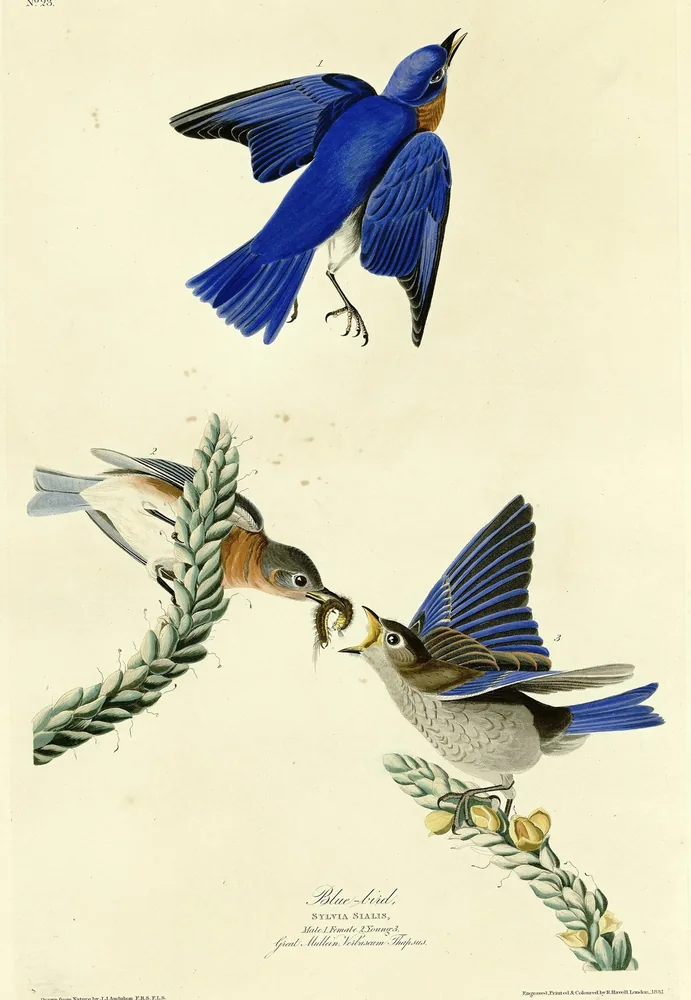
This is the famous one. Audubon had his birds printed on the largest paper of the day. The University of Pittsburgh, which owns a complete set, describes Whatman "double elephant folio" paper, 26 by 38 inches. The first ten plates were engraved by William Lizars in Scotland, and Robert Havell of London did the rest.
LSU Libraries explains the method: copperplate engraving combined with aquatint (a way of etching soft tones), and each print colored by hand by a team working under Havell. Yale reports that up to 150 colorists worked on the project at its height. Pittsburgh's library says it's thought that no more than 120 complete sets exist today.
The octavo editions
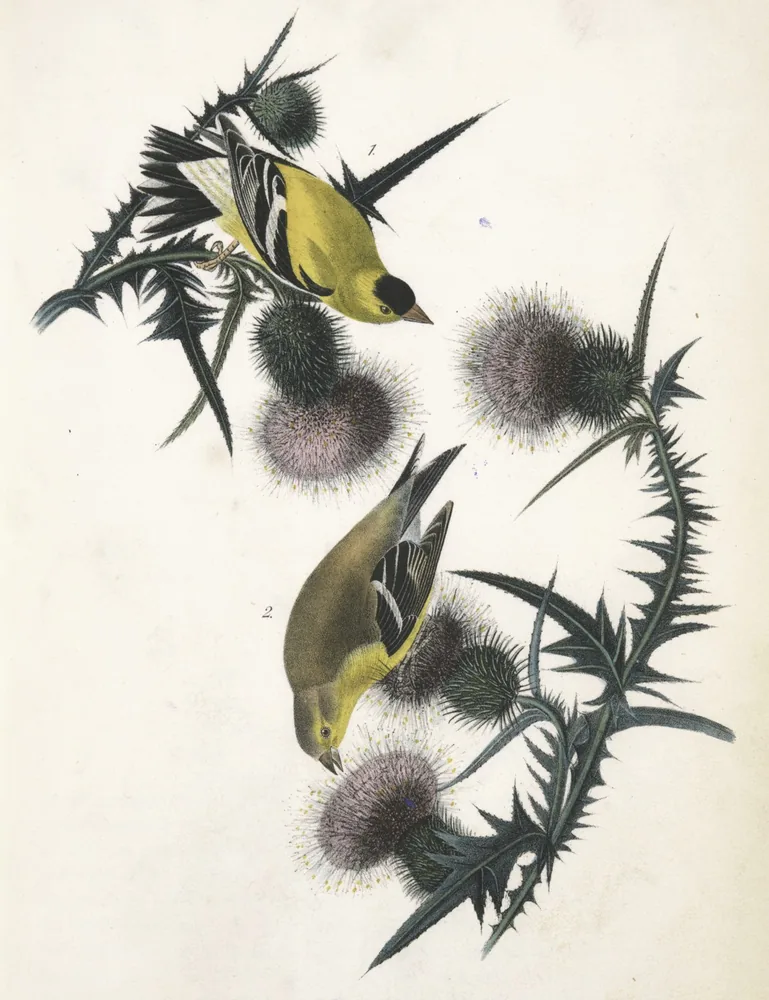
From 1840 to 1844 Audubon published a much smaller edition, sold by subscription in 100 parts. LSU Libraries describes 500 plates, reduced and modified from the big ones, printed as hand-colored lithographs by John T. Bowen's firm in Philadelphia. Skinner, the auction house, gives their size as about 10 by 6 inches.
LSU's catalog also lists later octavo issues from 1856, 1859 and 1860. They're 19th-century prints too, but a seller should tell you which issue a plate comes from.
The Bien edition
In 1858, Audubon's son John Woodhouse Audubon started a new large edition with the New York printer Julius Bien. It used chromolithography: instead of coloring each print by hand, every color was printed from its own stone, and the American Antiquarian Society notes that many images needed six or more colors.
By 1860, many Southern subscribers had backed out as the Civil War approached, and printing stopped after 15 of the planned 45 parts: 150 species on 105 sheets. Skinner notes that Bien prints are nearly the size of Havell's, but on different paper and with a different imprint (the printed lines of text below the picture).
Reproductions: many kinds, made for many years
Audubon's birds have been reproduced again and again. LSU's own catalog of editions shows how varied they are:
- Books of reproductions, such as a 1937 edition and a 1981 edition of the big plates edited by Roger Tory Peterson.
- Reproductions of the big plates, such as a 2012 edition.
- New prints from the old copper plates. In 1985, six plates were printed from original Lizars and Havell copper plates held at the American Museum of Natural History.
That last one matters. A print pulled in 1985 comes off the same copper plate as an 1830s one, yet it isn't an 1830s print.
Why one clue is never proof
You'll sometimes see a single test offered as proof. None of them is enough on its own:
- Dots under a magnifier. Some reproductions are printed with a halftone screen: tiny dots of ink. Under low magnification, a color halftone shows a regular "rosette" pattern of dots, according to a University of Illinois preservation guide. Halftone printing didn't appear until the 1880s, so a rosette pattern rules out the Havell, octavo and Bien editions. But no dots doesn't prove it's old: the 1985 copperplate prints have none.
- A printed date or "Engraved by R. Havell". The words are part of the printed plate, so a reproduction made from a photograph of the plate copies them too.
- A plate mark (the dent left by the edges of a printing plate). A later print from an original copper plate, like the 1985 ones, can have one too.
- A pencil number or an embossed seal. Some modern limited editions have these. Audubon House in Key West, a museum that also sells prints, describes one modern edition as pencil-numbered and embossed with its publisher's seal. They tell you about the edition, not that the print is old.
- The size. Helpful for spotting a mismatch, but size alone can't prove age.
Put together, though, the clues add up: the right edition, the right size, the right printing method, the right paper, and a history of where the print has been.
What to ask the seller
Before you buy something described as original, ask for:
- The edition and plate number, in writing: Havell, which octavo issue, or Bien.
- The exact size of the sheet and of the image.
- The printing method, as the seller understands it.
- The paper: whether there's a watermark, and what it says.
- The condition: any fading, browning, stains, tears, folds or trimmed margins. Skinner warns that prints should never be mounted onto board, because acid can seep into the paper and affect the color, and that direct sunlight fades the colors and can brown the paper.
- Photos of the whole sheet, front and back if it's unframed, and close-ups.
- Provenance: where the print has been, with any old receipts or auction records.
- The return terms, in case an independent expert disagrees.
A good seller will be glad you asked. Don't take a print out of its frame or mount yourself to look for marks. That's a job for a framer or a conservator.
Get an expert to look in person
For anything costly, have it looked at, in person, by an appraiser who isn't the seller. The Library of Congress says it doesn't appraise or authenticate objects, and suggests looking for a professional through groups such as the American Society of Appraisers or the Antiquarian Booksellers' Association of America.
Skinner's guide adds that the subject affects value too: larger birds tend to bring higher prices than small songbirds. We don't give prices here. They change, and they depend on the individual print.
A reproduction can be the right gift
For most gifts, a good reproduction is a fine choice. You can choose the bird they love, and if it fades one day, it can be replaced. Just buy it as what it is.
If you do buy an original, frame it with care: our guide on how to frame a classic bird print explains what to ask the framer. More about the man and his book is in our guide to John James Audubon, and you can see every plate free online through the libraries listed in where to find vintage bird illustrations. For other ideas, browse our gifts for birders.