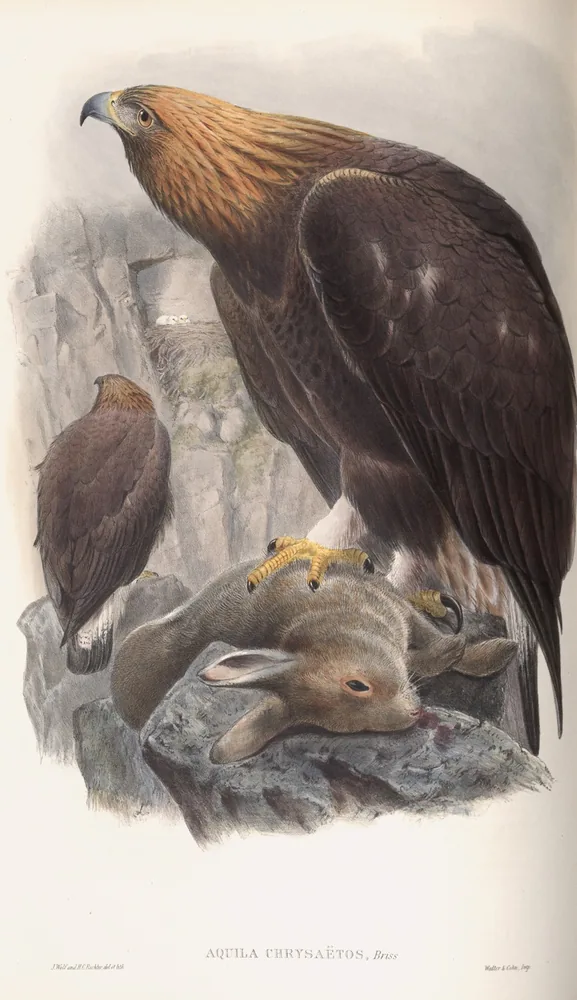
Two eagles nest in the United States and Canada, the Bald Eagle and the Golden Eagle, and two giant sea-eagles from Asia and Europe turn up as rare visitors. Worldwide, 69 birds carry the name "eagle" on the AviList checklist for 2026, by our count. The pair below are Golden Eagles, painted in Britain in the 1860s.
Eagles of North America at a glance
The four eagles on the American Birding Association's checklist for the US and Canada. Code 1 is a regular, widespread bird; Code 4 is a stray "not recorded annually."
| Eagle | Length | Wingspan | Weight | Where | ABA code |
|---|---|---|---|---|---|
| Bald Eagle | 28–38 in | 6–7½ ft | 7–14 lb | Alaska, Canada, the lower 48, northern Mexico; near water | 1 |
| Golden Eagle | 30–40 in | 6½–7½ ft | 7–13 lb | Mostly the West; open country and mountains | 1 |
| White-tailed Eagle | 29–36 in | 6 ft 4 in–8 ft | 7–15 lb | Europe and Asia; a stray in Alaska | 4 |
| Steller's Sea-Eagle | 34–41 in | Up to 8 ft | Sources differ | Russia's Far East and Japan; a stray | 4 |
The first three rows are The Peregrine Fund's figures. Steller's length is the San Diego Zoo's and its wingspan the Los Angeles Zoo's; its weight is argued over below.
How many types of eagles are there?
Between about 60 and 70, depending on who is counting: BirdLife International says 68, the National Eagle Center "over 60," and AviList's 2026 checklist names 69, by our count. Audubon Rockies puts it at 59.
The counts differ because "eagle" is a name, not one branch of the family tree. All eagles sit in the hawk family, Accipitridae, which the ABA calls "Hawks, Kites, Eagles, and Allies." A bird gets called an eagle, BirdLife says, for its ability to hunt large prey "rather than because they are closely related." So the line between a small eagle and a big hawk is partly habit.
Sorted by the names on AviList's list (our count, with the 15 eagle-owls left out, since those are owls):
| Kind, by name | Species | Examples |
|---|---|---|
| Sea-eagles and fish-eagles | 10 | Bald Eagle, White-tailed Eagle, Steller's Sea-Eagle |
| Snake-eagles and serpent-eagles | 14 | Short-toed Snake Eagle, Crested Serpent Eagle |
| Hawk-eagles | 16 | Ornate Hawk-Eagle, Mountain Hawk-Eagle |
| All the others | 29 | Golden, Harpy, Philippine, Martial and Wedge-tailed Eagles |
Hawk Mountain Sanctuary also counts the Bald Eagle as one of ten "fish or sea eagles," birds that live near water and eat mostly fish. The snake-eagles earn their name: one grabs a snake, flies up with it and, still in the air, swallows it head first, says a BirdNote script on Audubon's site. Thick scales on their legs and toes help protect them from bites.
Eagles live on every continent except Antarctica, though most are in Africa and Asia. BirdLife's list gives the Americas a small share: "just two species" in the United States and Canada, nine more in Central and South America.
What eagles live in North America?
Two live here all year, the Bald Eagle and the Golden Eagle; the ABA checklist adds the White-tailed Eagle and Steller's Sea-Eagle as rare visitors, four in all. "North America" here means the US and Canada, the area the checklist covers. All 1,161 birds on it are tallied in our count of US and Canadian birds.
The Bald Eagle is a sea-eagle, a fish eater seldom far from a coast, river or large lake. It is "the only eagle species found solely in North America," Audubon magazine notes, from Canada to northern Mexico. The country's emblem since 1782, it was down to 417 nesting pairs in the lower 48 by 1963, says the Smithsonian's National Zoo. National Geographic now puts the population at about 316,700. Our Bald Eagle page tells how it came back, when it became the national bird and how big its nest gets.
The Golden Eagle is a land hunter of open, wild country, at home on four continents: it also lives across Europe, Asia and northern Africa. Here it is "far more common in the West than in the East," says Hawk Mountain. It lives mostly on mammals from ground squirrels to jackrabbits, and Audubon's guide adds foxes and cranes at the top end. Some Golden Eagles eat tortoises, The Peregrine Fund says: they carry one high over rocks and drop it to break the shell. It is the national bird of Mexico, the eagle on the Mexican flag.
Bald Eagle vs Golden Eagle: how do you tell them apart?
Adults are easy, a white head and tail against a brown head with a golden nape; the trap is a young Bald Eagle, dark-headed for years and often called a Golden. East of the prairies, Pete Dunne tells readers of Audubon magazine to "resist the temptation": the big brown eagle overhead is "likely a young Bald Eagle."
| Clue | Young Bald Eagle | Golden Eagle |
|---|---|---|
| Legs | Bare yellow ankles | Feathered to the foot |
| Bill | Very large, about a third of the head | Smaller; the head looks more like a hawk's |
| White below | Messy mottling on the body and under the wings | Young: neat white patches mid-wing and at the tail base. Adults: dark |
| Body with age | Fills in with whitish feathers after year one | Stays dark |
| As an adult | White head and tail | Brown head, golden nape |
| Habitat | Near open water with fish | Open rangeland and mountains, often far from water |
| East of the prairies | All year | Mostly October to December, on migration |
The legs come first when the bird is perched. A Golden Eagle hunts on land and wears feathers to its toes; a Bald Eagle's lower legs are bare, built for snatching fish, the National Eagle Center explains. The white is the best clue in flight. A young Bald Eagle looks "messy" until it is three or four, says Audubon Rockies, while a young Golden's white patches are tidy. A Bald Eagle of three or four also has a whitish face with a dark line through the eye, rather like an Osprey's.
One warning from Dunne: both eagles eat carrion, so a brown eagle on a dead deer is not a Golden by default. For the adults' other differences, see Bald Eagle or Golden Eagle; for the years a Bald Eagle spends in brown, see when the white head arrives.
Is a Golden Eagle bigger than a Bald Eagle?
No, they are about the same size: each weighs roughly 7 to 14 pounds and spans 6 to 7½ feet, by The Peregrine Fund's figures, and in both the female is larger. Where a bird lives matters more than which eagle it is. Female Bald Eagles in Alaska may reach 18 pounds, says the National Eagle Center, while Florida's can weigh as little as six to eight. Males weigh about a quarter less than females from the same area.
What sound does an eagle make?
A Bald Eagle makes thin, squeaky chatters and squeals, nothing like the scream in the movies; that hoarse cry usually belongs to a Red-tailed Hawk. Audubon's guide describes "squeaky cackling and thin squeals; weak, gull-like calls." The Peregrine Fund hears "high-pitched chirps" that sound as if they came from a much smaller bird, and the Smithsonian's National Zoo calls it "a rather wimpy voice."
| Bird | What you hear | In whose words |
|---|---|---|
| Bald Eagle | Squeaky cackles, thin squeals, short high squeaks | Audubon's guide; National Park Service |
| Golden Eagle | A high kee-kee-kee, a squeal, "but usually silent" | Audubon's guide |
| Steller's Sea-Eagle | "A deep barking cry," ra-ra-ra-raurau | San Diego Zoo |
| Red-tailed Hawk, the eagle of the movies | A hoarse, falling scream, keeeeer | Audubon's guide |
Hear the real thing in the National Park Service's recording of a Bald Eagle at Yellowstone; a raven caws twice in the background. Bald Eagles call most near the nest, the National Zoo says: a squeaky alarm call, often given with the head tossed straight up, and calls in flight. The hawk's side of the story, with a table of raptor calls, is under which hawk is screaming.
Why do movies use a hawk's scream for an eagle?
Because the hawk sounds the way people expect an eagle to: a Red-tail's "sustained, piercing screech" is far more intimidating than the eagle's "meek, high-pitched cries," says Audubon magazine. That makes the hawk, the magazine goes on, the "preferred avian voice actor for Hollywood sound editors" in films, television shows and commercials. The Peregrine Fund puts it more bluntly: "Even Hollywood isn't impressed by the Bald Eagle's call."
What is the biggest eagle in the world?
It depends on the measure, and the sources don't agree: Steller's Sea-Eagle is most often called the heaviest, the Harpy Eagle the most powerful, and two sea-eagles are credited with 8-foot wings.
| Eagle | Home | Length | Wingspan | Weight | The claim |
|---|---|---|---|---|---|
| Steller's Sea-Eagle | Russia's Far East, Japan | 34–41 in | Up to 8 ft | Up to about 15 lb, or 20 | "The heaviest known eagle" |
| Harpy Eagle | Rainforest, southern Mexico to Argentina | 3–3½ ft | Up to 6½ ft | 9–20 lb | Among the "largest and most powerful" |
| Philippine Eagle | Four islands of the Philippines | 2½–3.3 ft | 6½ ft | 10–18 lb | "One of the largest eagles in the world" |
| White-tailed Eagle | Europe and Asia | 29–36 in | Up to 8 ft | 7–15 lb | "The largest wingspan" |
Whose measure is whose:
- Steller's Sea-Eagle. "The heaviest known eagle" is the San Diego Zoo's phrase, and BirdLife agrees, at up to about 7 kilograms, some 15 pounds. The Los Angeles Zoo gives females 20 pounds and males 13, and an 8-foot wingspan. Audubon found it "about a foot longer and taller" than a Bald Eagle.
- Harpy Eagle. The Peregrine Fund's figures give it the top weight in the table, 20 pounds, on wings of only 6½ feet. Short wings and a long tail steer it between rainforest trees after sloths and howler monkeys.
- Philippine Eagle. The Peregrine Fund's phrase is in the table; the Philippine Eagle Foundation calls it one of the "largest and most powerful among forest raptors." It is Critically Endangered, and has been the Philippines' national bird since 1995.
- White-tailed Eagle. BirdLife gives it "the largest wingspan" among eagles, up to 8 feet, the same figure others give Steller's.
So no eagle wins every column, and we haven't picked one. No eagle has the widest wings of any bird, either: that record belongs to an albatross.
What is the biggest eagle in North America?
Of the two that live here, neither: the Bald and the Golden overlap in every measure. The biggest eagle seen here is the stray Steller's Sea-Eagle, which made nearby Bald Eagles look "like pigeons." The words are Nicholas Lund's, who watched one share a tree with two young Bald Eagles in Massachusetts in December 2021.
Which eagles are rare in the US?
Two, both ABA Code 4: Steller's Sea-Eagle and the White-tailed Eagle, sea-eagles from across the Bering Sea that reach Alaska now and then and almost never get farther. Code 4 is the checklist's word for a bird "not recorded annually" but with at least six records.
One Steller's Sea-Eagle broke the pattern. Only about 4,000 are left in the wild, Audubon reported, and they nest in far eastern Russia. Yet a single bird, known by the white pattern on its wings, has crossed the continent:
- August 2020: photographed along the Denali Highway in Alaska, far inland.
- March 2021: a Steller's photographed at a Texas reservoir, where no wild one had come near before. The photo lacked the detail to prove it was the same bird (the Texas record).
- June 28, 2021: found on Quebec's Gaspé Peninsula by Gerry Isaac, a ranger of the Listuguj Mi'gmaq First Nation. Wing photos matched the Alaska bird.
- Later in 2021: New Brunswick, then two days on Nova Scotia's Avon River.
- December 20, 2021: refound at Dighton Rock State Park in Massachusetts, before a crowd of about 200.
- December 30, 2021, to March 5, 2022: around Georgetown, Maine, and back there February 4 to 14, 2023 (Maine's records).
- Summers of 2022 and 2023: Trinity, Newfoundland, feeding on capelin beside Bald Eagles. In June 2024 it was seen building a nest there, with no mate on this side of the world.
- December 2024: Terra Nova National Park, Newfoundland, which opened a closed road for birders.
The park called it the only one of its kind known in the Western Hemisphere.
The White-tailed Eagle is Europe's sea-eagle and a close relative of the Bald Eagle; the young of the two were long confused, as John Gould noted in 1837. The first one recorded in the ABA Area landed on a ship at the Nantucket Lightship off Massachusetts on November 14, 1914. Alaska's first was reported on Attu Island, at the far end of the Aleutians, in March 1945, and a pair has since nested there. One spent days at St. Paul Island in the Bering Sea in May 2012. In Britain, where it was wiped out and brought back, birders call it the "flying barn door."
Is the Golden Eagle rare?
Not in the West, but in the East it is: Golden Eagles are seen there "with any frequency" only during fall migration, Pete Dunne writes. From October through December they pass hawk watches such as Hawk Mountain in Pennsylvania and Cape May in New Jersey, and a small number winter in the southern Appalachians.
The Midwest has its own winter Goldens. They come from northern Canada, as much as 2,000 miles away, to the bluffs of the Driftless Area where Minnesota, Wisconsin and Iowa meet, the National Eagle Center says. Its volunteers count them each January: more than 227 people on 97 routes in 2026.
Are there eagles in every state?
Every state but Hawaii: Bald Eagles "have been spotted in every U.S. state except Hawaii," says Audubon magazine, and Golden Eagles share the western states with them. Most Bald Eagles live in Alaska and Canada, National Geographic notes. Hawaii has a hawk of its own instead, the ʻIo (does Hawaii have a hawk?).
Winter is the easy season. Northern Bald Eagles move south to open water, and in places hundreds roost together in big trees, The Peregrine Fund says. Some starting points on our pages:
- Tennessee: why so many Bald Eagles winter at Reelfoot Lake.
- Texas: both eagles, by region and season, in birds of prey in Texas.
- Pennsylvania and the Midwest: winter eagle watching in birds in winter.
- Anywhere: the eagle days on our calendar of birding festivals.
The paintings on this page
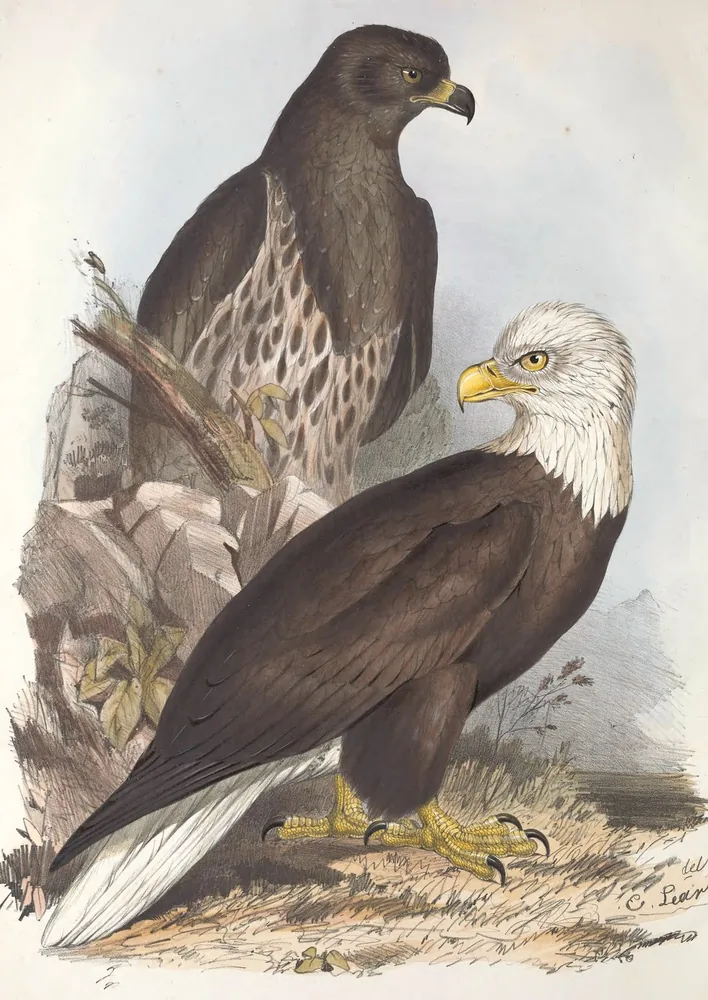
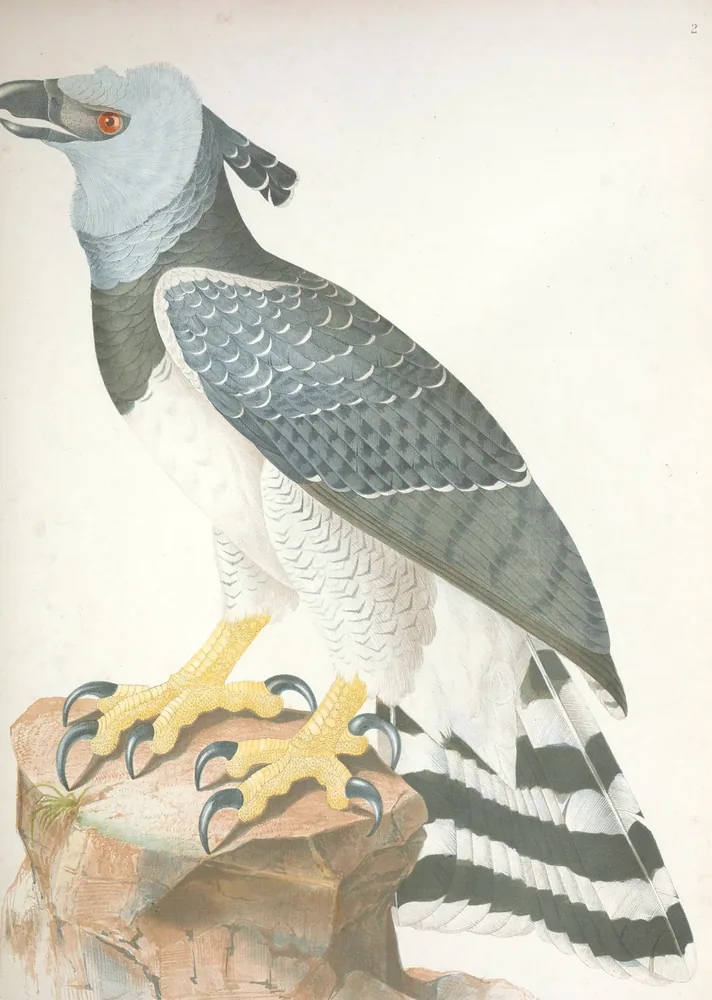
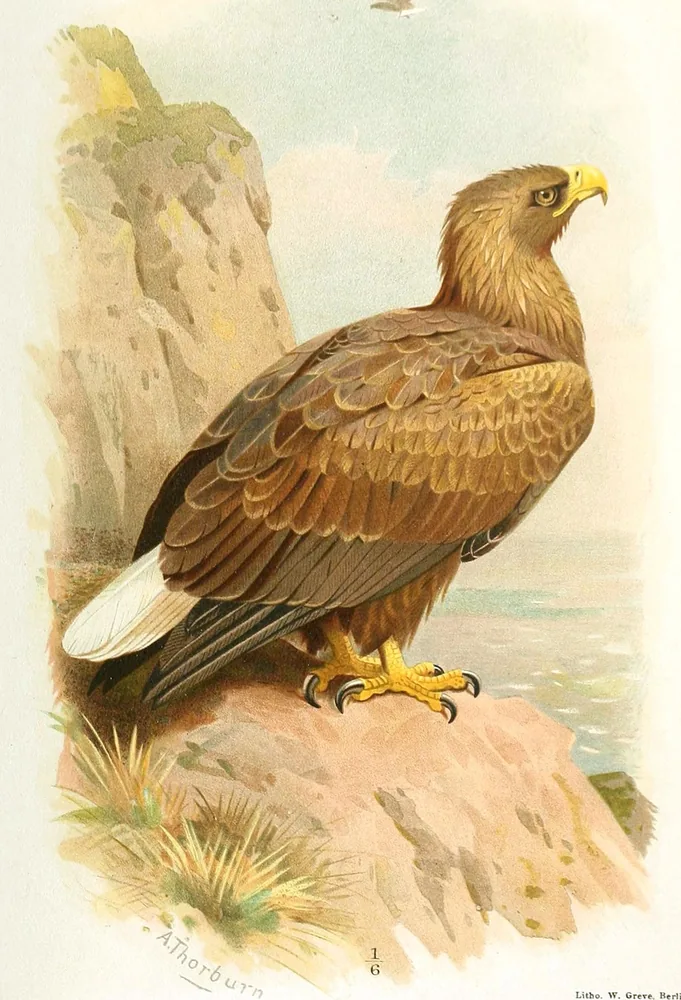
All four pictures come from books made outside the United States. Edward Lear drew his Bald Eagles for John Gould's The Birds of Europe; Gould counted the bird as European as well as American. Joseph Wolf's Golden Eagles are from Gould's later book on Britain, Archibald Thorburn's White-tailed Eagle from Lord Lilford's, and the Harpy Eagle from Jean-Théodore Descourtilz's book on the birds of Brazil. John James Audubon painted both American eagles; his Bald Eagle is plate 31 and his Golden Eagle plate 181 of The Birds of America (all 435 plates).
If an eagle is on your own life list, a Birdfolio prints it next to a painting of this kind, along with every other bird you have seen: open one and look.
Questions people ask
Is an eagle a type of hawk?
By family, yes: eagles, hawks and kites all belong to Accipitridae, and "eagle" is an everyday word for its biggest hunters, not a scientific rank. The sizes side by side are under hawk vs eagle.
How long do eagles live?
In the wild, Bald and Golden Eagles that reach adulthood can live 20 to 25 years, says the National Eagle Center, and more than 40 in human care. Other sources' figures, and the oldest wild Bald Eagle on record, are in how long Bald Eagles live.
What is a baby eagle called?
An eaglet. A Bald Eagle usually lays two eggs, Audubon's guide says, and the young birds then spend four or five years in brown before they look like their parents.
Can you keep an eagle feather you find?
No: the Bald and Golden Eagle Protection Act, passed in 1940, bars having any part of either eagle, feathers included, without a permit. Why the law is so strict, and who may have feathers, is under eagle feathers on our Bald Eagle page.