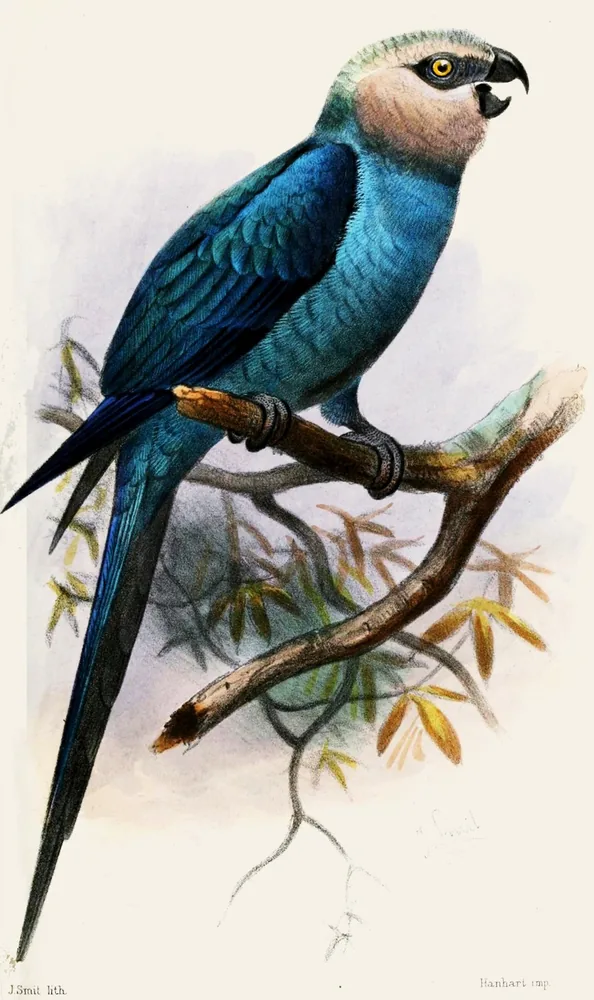
Most cartoon birds are drawn from real ones: Zazu is a hornbill, Mordecai a Blue Jay, Tweety a canary, the Road Runner a Greater Roadrunner, Rio's Blu and Jewel Spix's Macaws and Woody Woodpecker probably an Acorn Woodpecker; Woodstock and Big Bird belong to no real species, and Up's Kevin is partly a Himalayan Monal. Each answer below says how sure it is and who said so, from the studios and creators to zoos, museums and the press, all read on November 18, 2026. The characters belong to their studios, so this page shows none of them. It shows classic paintings of the real birds instead, starting with the Spix's Macaw, the blue parrot of Rio.
Famous cartoon birds and the real birds behind them
| Character | Real bird | How sure |
|---|---|---|
| Zazu, The Lion King | Red-billed hornbill | Studio-owned source; one report differs |
| Mordecai, Regular Show | Blue Jay | Creator said |
| Woodstock, Peanuts | No real species | Studio said |
| Tweety, Looney Tunes | Canary | Studio said |
| Big Bird, Sesame Street | No real species | No species named |
| Kevin, Up | Partly a Himalayan Monal | Zoo says Pixar's artists studied it |
| Blu and Jewel, Rio | Spix's Macaw | Named in the film |
| The Road Runner | Greater Roadrunner | Widely described |
| Woody Woodpecker | Probably an Acorn Woodpecker | Widely described |
| Iago, Aladdin | A parrot, no species | Makers said |
| Scuttle, The Little Mermaid | A gull; a gannet in the remake | Widely described |
| The eagle on Mexico's flag | Golden Eagle | Government's view; debated |
Studio said and creator said mean the studio, its artists or the creator named the bird, or said there is none. Widely described means no official word turned up, but museums, zoos, ornithologists or the press name it.
What bird is Zazu?
A hornbill: the red-billed hornbill "was the model for the character Zazu in The Lion King," says National Geographic, which Disney majority-owns. It is one of the hornbills with no casque, the hollow helmet some species wear on top of the bill, the magazine adds.
The species is a little less settled than the family. In 2024 a North Carolina news site, Randolph News Now, wrote that Disney's press office had told it Zazu is a yellow-billed hornbill, after its reporters noted that the Zazu of the 2019 remake looks more like a Von der Decken's Hornbill.
The real birds have a nesting habit worth retelling at dinner. In most hornbill species, once a pair finds a hole in a tree, "the male will seal the female inside using its own dung," mixed with soil or food, National Geographic says. He leaves a slit just wide enough to pass her meals through. She lays about two eggs and sits on them for roughly 42 days, and about a week before the chick is ready to leave, she breaks out.
What bird is Mordecai?
A Blue Jay, in his creator's own words: "Mordecai was a blue jay," J.G. Quintel told CBR in 2013. Quintel brought the character from his student films to Regular Show, which premiered on Cartoon Network in 2010, and voiced Mordecai himself. He didn't want the show to keep pointing it out; the characters, he said, are "real people, but they're also these other things."
The real Blue Jay is loud and clever, and a mimic. It can do "a remarkable imitation of the scream of a Red-shouldered Hawk," says National Audubon's guide. Its blue is no pigment at all: our Blue Jay painting page explains why a crushed blue feather loses its color.
What kind of bird is Woodstock?
No real kind: the official Peanuts site says Woodstock "doesn't even know what type of bird he is." Charles M. Schulz said much the same in a letter to the ornithologist Laura Erickson, who had asked him: Woodstock "and Snoopy have never been able to figure out what kind of bird he is." He added that Woodstock began as a girl bird, Snoopy's secretary.
The bird first turned up in the strip in 1967 and was named Woodstock in 1970, after the music festival, the Peanuts site says. The curator of the Charles M. Schulz Museum could picture Schulz saying, "That sounds like a bird species name," the Washington Post reported in 2019. Snoopy himself tried to settle the question over several strips, guessing everything "from a warbler to a yellow-billed cuckoo," USA TODAY recounts, before giving up and allowing that his friend might be a duck.
Erickson's own verdict, in her letter: plumage "rather like a Yellow Warbler's," and a flight like a Cedar Waxwing's after too many fermented berries. The bright little warbler she had in mind has since been split into two species.
What bird is Tweety?
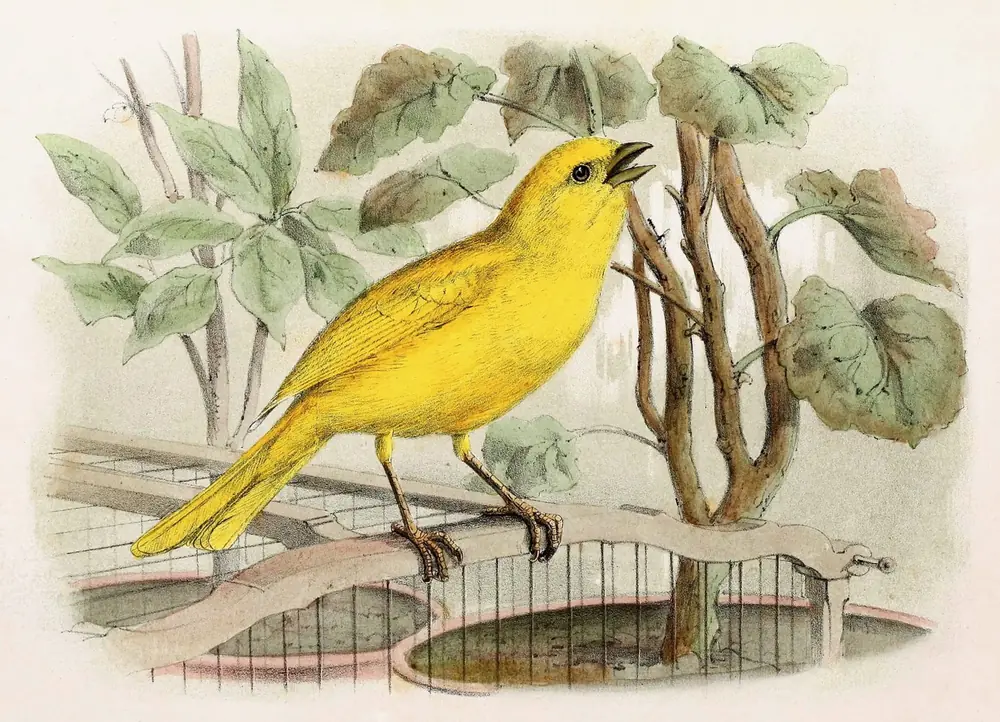
A canary, though he didn't start as one: in his first cartoons, from A Tale of Two Kitties (1942), he was "a flesh-colored newborn bird without feathers," Cartoon Research recounts. When censors reviewed Bob Clampett's A Gruesome Twosome (1945), they noted that "the little bird, in fact, appeared naked." Friz Freleng then took him over for Tweetie Pie, and Tweety "was given yellow feathers and became a canary and paired with Sylvester."
Real canaries once worked underground. For much of the 20th century, coal miners carried them into the pits: carbon monoxide has no color or smell, and "a canary's collapse let workers know there was poisonous gas in the air," Smithsonian magazine explains. Britain banned the practice only in December 1986, in favor of electronic gas detectors.
What bird is Big Bird?
No real one: Big Bird is 8 feet 2 inches tall, with "lemon-yellow feathers," and has lived on Sesame Street since 1969, BirdNote says, but no real species matches him. Two scientists have tried to place him, for fun, and they disagree.
In a 1986 radio piece, Laura Erickson called him "the only flightless bird endemic to North America" and put him among the ratites, the ostrich's relatives, perhaps nearest the rhea of South America (the ratites are the birds people most often liken to dinosaurs). In 2010 the biologist Mike Dickison went another way, Audubon reported. He ruled out a giant canary, since "songbirds almost never go flightless and scarcely increase in size." With that long neck and bill, he argued, Big Bird must be a giant flightless crane, and a young Whooping Crane's "golden orange fluffy" plumage looks a lot like his.
The real Whooping Crane is one of North America's rarest birds and one of its largest. It was "brought to the brink of extinction in the 1940s," says National Audubon's guide. The flock that winters on the Texas coast flies about 2,400 miles to nest in central Canada, and its nesting grounds weren't found until 1954.
What bird is Kevin from Up?
Kevin is an invented bird, but partly a real one: while making Up, Pixar's artists studied the Himalayan Monals at the Sacramento Zoo, and Kevin "is partially based on our birds," the zoo says. The artists "took pictures, made sketches, and observed the behavior" of the monals, a kind of pheasant and, the zoo says, one of the most colorful birds it keeps.
The real monal is a mountain bird of the Himalayas. In summer it lives at 16,000 feet, and as the weather cools it moves down as low as 6,500 feet, the zoo says. The males' head feathers are "a sought-out prize," and hunting for food keeps shrinking wild numbers.
What birds are in Rio?
Blu and Jewel are Spix's Macaws: in the 2011 film, Blu is the last living male of his species and Jewel the last female, CBS News recounts. The real bird's story has been harder than the film's:
- 2000: the last wild Spix's Macaw, a male, disappeared; the species was declared extinct in the wild in 2019, Smithsonian magazine reports.
- 2022: captive-bred birds went back to the dry Caatinga scrub of northeast Brazil, eight on June 11 and 12 more six months later, mentored by wild-caught Blue-winged Macaws. Some bred, hatching chicks "in their ancestral homeland for the first time in a generation."
- 2025: beak and feather disease, caused by a virus, turned up. In November, ICMBio, Brazil's environmental protection agency, recaptured the 11 released birds still alive. A São Paulo lab found the virus in all 11; the German group that ran the program, ACTP, says its own lab found it in only 2.
- 2026: after a police raid on the reintroduction center in May, the program is on hold. ACTP's center in Germany houses 204 Spix's Macaws, and in Brazil, the magazine writes, "Spix's macaws languish in cramped cages."
Before all that, the species left one strange love story. In the 1990s, the last wild male paired with a female of another species, a Blue-winged Macaw; her eggs never hatched, Smithsonian magazine notes.
What bird is the Road Runner?
The Greater Roadrunner, a real bird of the Southwest that National Audubon's guide calls "featured in folklore and cartoons." Chuck Jones created the Road Runner and Wile E. Coyote for Warner Brothers, and BirdNote gives the cartoon bird's mock Latin name as Accelerati incredibilus. New Mexico made the real one its state bird.
Three things to know about the real bird:
- It doesn't say "beep, beep." Its real voice is a soft cooing that "sounds rather like a lonely puppy," BirdNote says.
- It's a cuckoo. "Scientists group roadrunners with the cuckoos," the same episode notes.
- The coyote would win. A real coyote is faster, as question 12 of our bird trivia explains. The roadrunner walks and runs, "flying only when necessary," says Audubon's guide.
What bird is Woody Woodpecker?
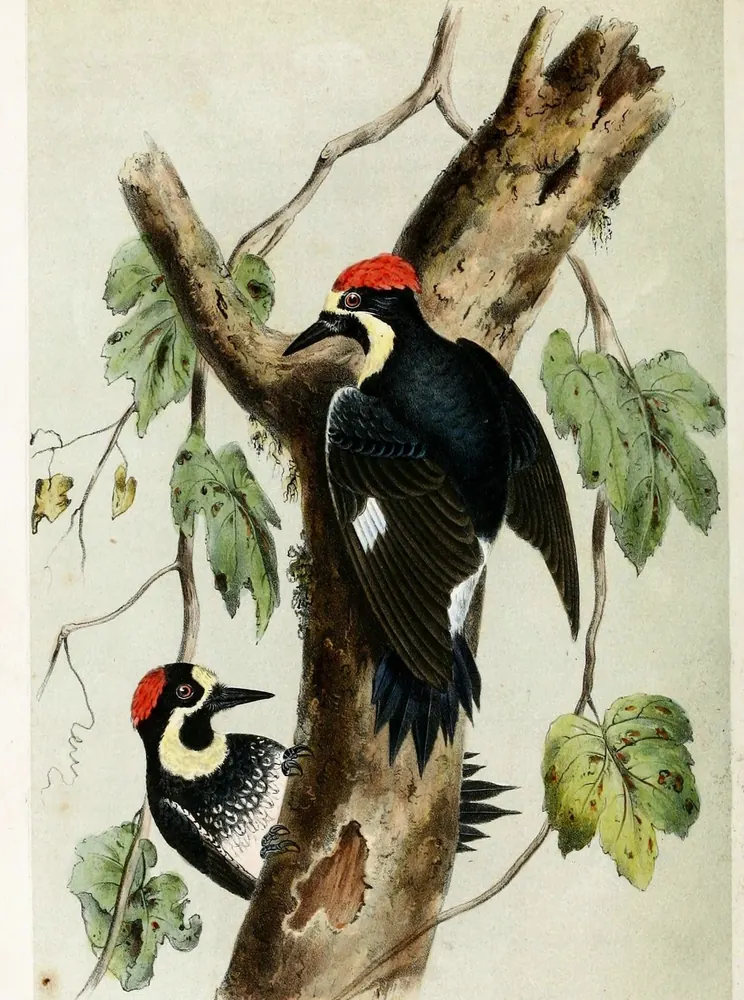
Probably an Acorn Woodpecker, a clown-faced woodpecker of the West's oak woods; BirdNote says it "was probably the model" for Woody. The story Walter Lantz liked to tell: on his honeymoon in a California cabin, a woodpecker hammered at the roof until he was ready to shoot it, and his bride, Grace, suggested he turn his annoyance into something creative instead.
The dates don't quite fit. Woody's first cartoon, Knock Knock, came out on November 25, 1940, and the film historian Leonard Maltin noted that "the honeymoon occurred one year after the production of the cartoon," Cartoon Research recounts. The romance in the story holds up, though: Grace Stafford became Woody's voice from 1950 to 1991.
The real Acorn Woodpecker is a hoarder. A family group drills small holes in a dead tree and stores an acorn in each one for winter; a "granary tree" may serve one family for generations, and a single tree can end up with as many as 50,000 holes, National Audubon's guide notes. Our woodpecker guide has more on the Acorn Woodpecker's pantry.
What bird is Iago?
A parrot, with no species named: in Aladdin (1992) he is "a parrot with teeth," as the codirector John Musker put it to The Ringer in 2022. The animator Will Finn drew Iago to look like his voice, the comedian Gilbert Gottfried, "giving him thick eyebrows and big teeth," The Ringer recounts. "Of course parrots don't have teeth," the other codirector, Ron Clements, told it.
Real parrots get their reds, yellows and greens from psittacofulvins, pigments "only parrots are known to produce," Smithsonian magazine says, and a 2011 study found that the pigments help feathers resist bacteria.
What bird is Scuttle?
A gull, with no species named: London's Natural History Museum says he "looks a lot like a Pacific gull" and most likely belongs to the genus Larus, one group among more than 50 gull species. So "seagull" names no single bird. In Disney's live-action remake, the museum notes, Scuttle changed "from gull to gannet."
Gannets are the more spectacular choice. They hunt by diving into the sea from as high as about 100 feet at up to about 60 miles an hour, the museum says, and their nostrils are inside the mouth, with air sacs in the body to soften the blow.
What bird is on the Mexican flag?
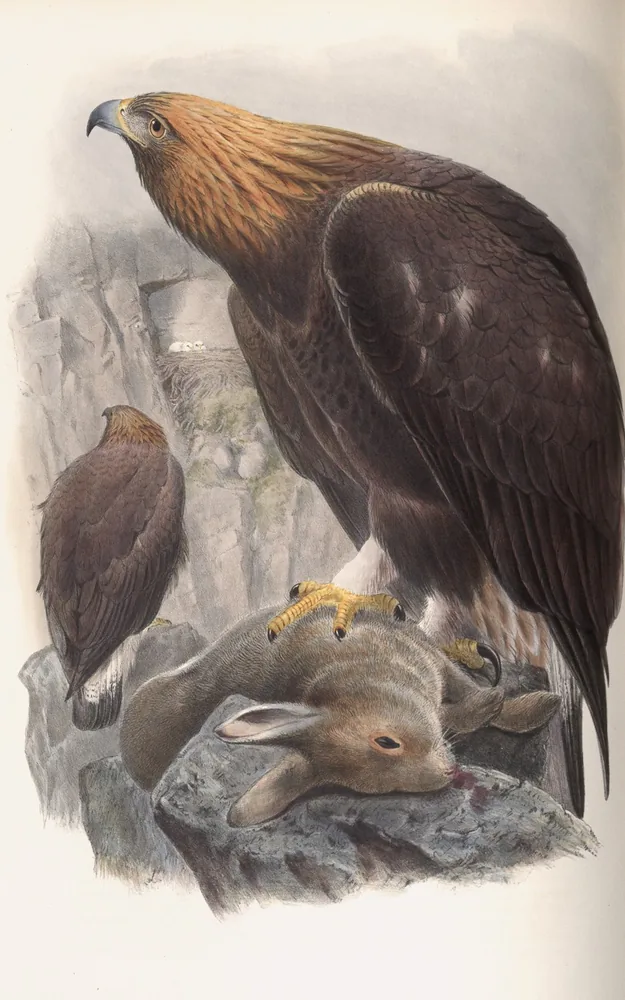
A Golden Eagle, in Mexico's official view: the 1984 law describes the coat of arms as "un águila mexicana," a Mexican eagle, and the Golden Eagle has been taken as that bird since colonial times, says SEMARNAT, Mexico's environment ministry. The eagle stands on a prickly pear cactus with a snake. In the legend BirdNote retells, the god Huitzilopochtli told the Mexica to settle where they saw that sign, and there they built Tenochtitlan, today's Mexico City.
Not everyone agrees on the species. Some ornithologists and historians argue that the Mexica's sacred bird was really the Crested Caracara, called quebrantahuesos, the "bone-breaker," and that the Spanish swapped in the Golden Eagle, the classic eagle of European heraldry, SEMARNAT itself acknowledges. The Mexican ornithologist Rafael Martín del Campo raised the idea in the 1960s, the Revista de la Universidad de México recounts, adding that caracaras are falcons, not eagles, and that in many 16th-century texts the eagle eats a smaller bird, not a snake. In the US, the Crested Caracara lives only near the Mexican border and in Florida, says National Audubon's guide.
The Golden Eagle is the more powerful bird, "regularly taking prey up to the size of foxes and cranes," the guide says. Mexico counted 70 breeding pairs in 2010 and 142 by 2018, SEMARNAT reports, and a center at the country's military college rehabilitates eagles for release. In 2015, at the French president's request, Mexico's armed forces sent three Golden Eagles to march in France's Bastille Day parade. For telling a Golden Eagle from a Bald Eagle, see our Bald Eagle page.
The paintings on this page
This page shows no cartoon characters, which belong to their studios; for pictures, it shows classic paintings of four of the real birds. Joseph Smit drew the Spix's Macaw for the Proceedings of the Zoological Society of London (1878); John Gerrard Keulemans painted the canary for Onze Vogels in Huis en Tuin (1869–76); George G. White drew the Acorn Woodpeckers, put on stone by William E. Hitchcock, for John Cassin's 1850s book on the birds of the American West; and Joseph Wolf and Henry Constantine Richter made the Golden Eagles for John Gould's The Birds of Great Britain (1862–73). Classic paintings of many more real birds, from the Blue Jay to the Bald Eagle, are on our bird painting pages, and the screen's real birders are in our best birding movies.
Grew up with these cartoons and now keep a list of the real birds you've seen? A Birdfolio turns that list into a hardcover that pairs each of your birds with its classic painting: look inside one.