A hummingbird is most often read as good luck, as a charm for love, or as a visit from someone who has died: beliefs, not biology. The oldest on record are Aztec, written down in the 1500s. The real bird's heart beats about 1,200 times a minute.
Hummingbird symbolism at a glance
In hummingbird symbolism, the bird stands for a warrior's soul, luck in love, a messenger or a loved one's visit, depending on who tells it: beliefs, not facts. The last column says what the record shows.
| Meaning | Who holds it | What the record shows |
|---|---|---|
| The souls of dead warriors | The Aztecs | A friar's account from the 1500s: bright birds that sip flowers, as hummingbirds do |
| A god's name | The Aztecs | Huitzilopochtli is built on huitzilin, hummingbird; the translation is debated |
| Luck in love | Some people in Mexico | Dried hummingbirds are sold as love charms; selling one is illegal in the United States |
| A visit from a loved one | Many people in the United States today | Readers' own accounts and a Day of the Dead story; we found no early source |
| The messenger who ends a drought | The Hopi of Oraibi | A story published by H. R. Voth in 1905 |
| The small, swift one who brings back the tobacco | The Cherokee | A story published by James Mooney in 1900 |
| The "God bird" | The Arawaks of Jamaica | Jamaica's information service, citing Frederic Cassidy |
| Joy, healing, a "spirit animal" | Websites that name no people and no story | No source we could find |
What does it mean when you see a hummingbird?
It depends on who is reading it: to different people a hummingbird is good luck, a charm for love, a messenger, or someone they have lost. Those are beliefs, held with real feeling, and nothing about the bird can prove them or rule them out.
No single meaning runs through them. The Aztec hummingbird belonged to war and the sun. The Hopi one carried corn to two hungry children. The Cherokee one stole back the tobacco, and lost a race to a crane. Jamaica's is on the list of national symbols.
One thing they share is a map. Hummingbirds "are only found in the western hemisphere," says the National Park Service, so the old hummingbird beliefs are all from the Americas.
What does it mean when a hummingbird visits you?
For many people a hummingbird that comes close is a greeting or a good sign; for the bird, the visit is about food. National Geographic, reporting from Mexico in 2018, wrote that there "hummingbirds are considered messengers from the heavens." That is a belief, and a well-loved one.
The bird has reasons of its own. A hummingbird "must eat almost constantly," says the Pennsylvania Game Commission, and Ruby-throated Hummingbirds are "especially attracted to bright red and orange blossoms."
The same bird may also be back. Banding, in which a numbered band goes on a bird's leg, has shown that hummingbirds "return to their breeding and feeding sites year after year," says the National Park Service. The hummingbird at your window this summer may be last summer's.
Is a hummingbird a sign from a loved one?
Many people take it as one, and no one can prove it either way: it is a matter of comfort and faith, not something the bird can confirm. In 2019 the Today show's website gathered readers' accounts of signs from people they had lost. One reader's late father used to sit in the gazebo and talk to the hummingbirds at his feeder. Three years after he died, one kept perching near her while she talked. "I felt it was my dad who sent her to check in," she wrote. Another reader said her lost babies come to her as hummingbirds and butterflies.
A story told at Mexico's Day of the Dead makes the same link. Claudia Santiago, writing for American Bird Conservancy in 2023, retold it as her grandmother told it beside the family altar. Huitzilin, a young man killed in war, comes back as a hummingbird to visit his beloved Xóchitl, who has become the cempasúchil, the marigold of the Day of the Dead. Her grandmother called it an Aztec legend. We found no early written source for it.
We also found no source that traces today's American belief in hummingbird visits to any older tradition. A very similar belief is held about another backyard bird, and our guide to the meaning of a red cardinal looks for its origin too.
What does the hummingbird mean in Aztec culture?
To the Aztecs the hummingbird belonged to war and the sun: their most powerful god, Huitzilopochtli, carries the bird in his name, and it was tied to the souls of the war dead. Huitzilin is the word for hummingbird in Nahuatl, the Aztecs' language, in the University of Oregon's Online Nahuatl Dictionary.
Scholars don't agree on what the whole name means. Davíd Carrasco, in the Encyclopedia of Religion, gives it as "hummingbird of the south." Louise Burkhart, in the Encyclopedia of Latin American History and Culture, reads "Hummingbird-Left," an allusion to the winter sun's path through the southern sky. The Nahuatl dictionary says only that "the translation of this name is debated."
In the story of his birth, as Carrasco tells it, his mother Coatlicue is made pregnant "by a ball of feathers" at Coatepec, Serpent Mountain. Her other children attack, and he is born fully grown and dressed for war. When the Spanish arrived, his shrine stood beside the rain god Tlaloc's on top of the Great Temple of Tenochtitlán.
The link to the dead is the part most often repeated, and it is usually simplified. Burkhart writes that hummingbirds were associated with the sun and "with the souls of those who died in war and in sacrifice." The fullest early account is by the friar Bernardino de Sahagún, who wrote down Aztec beliefs in the 1500s. Men killed in war, he wrote, and captives who died in enemy hands, went to the sky where the sun lives. After four years their souls turned into richly feathered birds of many kinds, and went sipping flowers in the sky and in this world "as hummingbirds do" (our translation, from the Spanish edition printed in Mexico in 1829).
So in the oldest text we could open, the warriors become bright birds that are compared to hummingbirds. Websites that say every fallen warrior came back as a hummingbird are tidying up the source.
Are hummingbirds good luck?
In Mexico they have long been counted lucky, above all in love, and that belief has a cost for the birds. Hummingbirds have been "associated with vitality, health, and good luck in Mexico since pre-Hispanic times," Pepper Trail, a retired federal forensic ornithologist, wrote in Audubon magazine in 2022. Out of that association, he wrote, came a traditional belief that a hummingbird has the power to bring love.
The charm is called a chuparosa, one of the bird's everyday names in Mexico. It is a dried hummingbird, usually wrapped in red paper and thread and sold with a printed prayer. National Geographic compared it to "a lucky rabbit's foot for good fortune in love."
In the United States the Migratory Bird Treaty Act forbids killing, keeping or selling any native hummingbird, so the charms are illegal here. Federal agents still recovered the remains of 905 hummingbirds from shops, Trail wrote. One was a female Ruby-throated Hummingbird with a research band on her leg. She had been banded near Carbondale, Illinois, in June 2016, and was bought in a charm packet in Laredo, Texas, in December 2017.
Trail quotes the Mexican hummingbird scientist Maria del Coro Arizmendi Arriaga on the luck itself: "A dead hummingbird does not serve to attract good luck or love." We found no study showing that a living one changes anyone's luck either.
What do hummingbirds mean in Native American cultures?
There is no single meaning: each nation has its own stories, and we repeat only those with a named people and a published source. Two of the best documented are Cherokee and Hopi.
The Cherokee hummingbird stories
In the Cherokee stories James Mooney published in 1900, the Hummingbird is the one small and fast enough to bring back the tobacco. Mooney heard "How They Brought Back the Tobacco" from the storyteller Swimmer and printed it in Myths of the Cherokee, for the Bureau of American Ethnology.
Geese have carried off the only tobacco plant, and an old woman is dying for want of it. The larger animals go after it and are killed, one by one. The Hummingbird is told he is too small to try. He snatches the top of the plant and is gone before the guards notice, because "he was so small and flew so swiftly," and he revives the old woman with the smoke. In a second version Mooney recorded, a man puts on a hummingbird skin to make the raid. In the version John Ax told him, the hero is a moth.
Another Cherokee story is less flattering. The Hummingbird and the Crane race around the world for a woman's hand. The Hummingbird is far faster, but he sleeps at night; the Crane flies on in the dark and wins on the seventh day. She refuses the Crane anyway. Mooney called the story "a favorite one in the tribe," and noted a Creek story with the same title.
The Hopi hummingbird story
In a Hopi story told at Oraibi and published in 1905, a hummingbird feeds two children through a drought and then goes to fetch the rain. H. R. Voth printed it in The Traditions of the Hopi, for the Field Columbian Museum.
It has not rained for years, and the people have left the village, all but a boy and his little sister. He makes her a toy bird from the pith of a sunflower stalk. She tosses it into the air, and "it became a living Humming-bird and flew away." Each day it brings the children an ear of corn. Then it flies down under the earth to Muyingwa, in Voth's words "the God of Growth and Germination," tells him his fields above look very bad, and asks him to come up and see. He comes. The rain returns, and so do the children's parents.
Many websites list "Native American hummingbird meanings," or a hummingbird "totem," without naming a nation, a story or a source. We don't repeat them. Both stories above were written down by outside collectors more than a century ago. They are records of what was told then, not the last word on what a hummingbird means to Cherokee or Hopi people today.
What does the hummingbird mean in Jamaica?
In Jamaica a hummingbird is the national bird: the Doctor Bird, which lives nowhere else. The Jamaica Information Service, the government's information agency, also calls it the swallow-tail hummingbird. The grown male has two long tail feathers that stream behind him when he flies.
The agency calls the origin of the name "somewhat unsettled." One explanation is that the male's black crest and long tails look like the top hat and tail coat doctors once wore. Another is that the bird lances flowers with its bill.
Citing Frederic Cassidy, the agency says the Arawaks held that the bird had magical powers. They called it the "God bird," believing it was "the reincarnation of dead souls." A Jamaican folk song, it adds, calls the Doctor Bird a clever bird that is hard to kill.
That makes two peoples on this page, the Aztecs and the Arawaks, for whom a hummingbird carried the dead. We found no source that connects the two beliefs.
What is the spiritual meaning of a hummingbird?
There isn't one spiritual meaning: the documented ones belong to particular peoples, and the general ones found online name no source. The ones we could trace are on this page: the Aztec war dead, the Arawak "God bird," the love charm in Mexico, the Hopi messenger, and the comfort many grieving people take from a visit today.
The Bible is not among the sources. It has no hummingbird in it: the family lives only in the Western Hemisphere, as the Park Service says.
What no source supports
These claims are common online. We looked for a reliable source for each, and found none:
- a hummingbird "totem" or "spirit animal" meaning credited to Native Americans in general, with no nation or story named;
- a hummingbird standing for joy or healing in any named tradition;
- where today's belief in hummingbird visits from the dead began;
- any documented history behind hummingbird tattoo meanings;
- that every fallen Aztec warrior became a hummingbird (Sahagún's text says bright birds of many kinds);
- any evidence that a hummingbird, or a charm made from one, brings luck or love.
How fast does a hummingbird's heart beat?
About 1,200 times a minute when the bird is active, against about 150 for a human athlete during exercise, says BirdNote. The National Park Service gives the same 1,200 for the Ruby-throated Hummingbird, the one hummingbird that nests in the East.
A Ruby-throat weighs a tenth of an ounce, "less than a penny," says the Pennsylvania Game Commission, and beats its wings about 53 times a second. More of these numbers, and a few popular ones that don't hold up, are in hummingbird facts, checked.
How far do hummingbirds migrate?
Some cross the Gulf of Mexico in a single flight of about 500 miles, and one Rufous Hummingbird was tracked more than 3,500 miles. The Park Service puts the Gulf crossing at 18 hours or more and about 3,860,000 wingbeats without a rest. A Ruby-throat nearly doubles its weight beforehand, from about 3.25 grams to 6.
National Geographic reported a Rufous Hummingbird tracked from Tallahassee, Florida, to near Anchorage, Alaska. Not every Ruby-throat takes the sea route, though: whether they cross the Gulf or go around it is in our guide to the types of hummingbirds.
Do hummingbirds die and come back to life?
No, but on cold nights they do something close: torpor, a short, deep sleep in which the body nearly shuts down. National Geographic calls it a nightly "mini-hibernation." Body temperature can fall from 107°F to 48°F, and one species' heart slows from 1,260 beats a minute to between 50 and 180.
The Aztecs told it as a winter death. Their account of the hummingbird, in the book Sahagún compiled, says: "In the winter it hibernates. It inserts its bill in a tree." Hanging there, it "shrinks, shrivels, molts." That is the English of Arthur Anderson and Charles Dibble, as the Online Nahuatl Dictionary quotes it. E. S. Hunn, whose notes the dictionary also quotes, calls the winter sleep a "misapprehension."
A bird that goes cold and still at night and is whirring again by morning could start a story like that. That is our reading, not a documented link.
Gould's hummingbirds
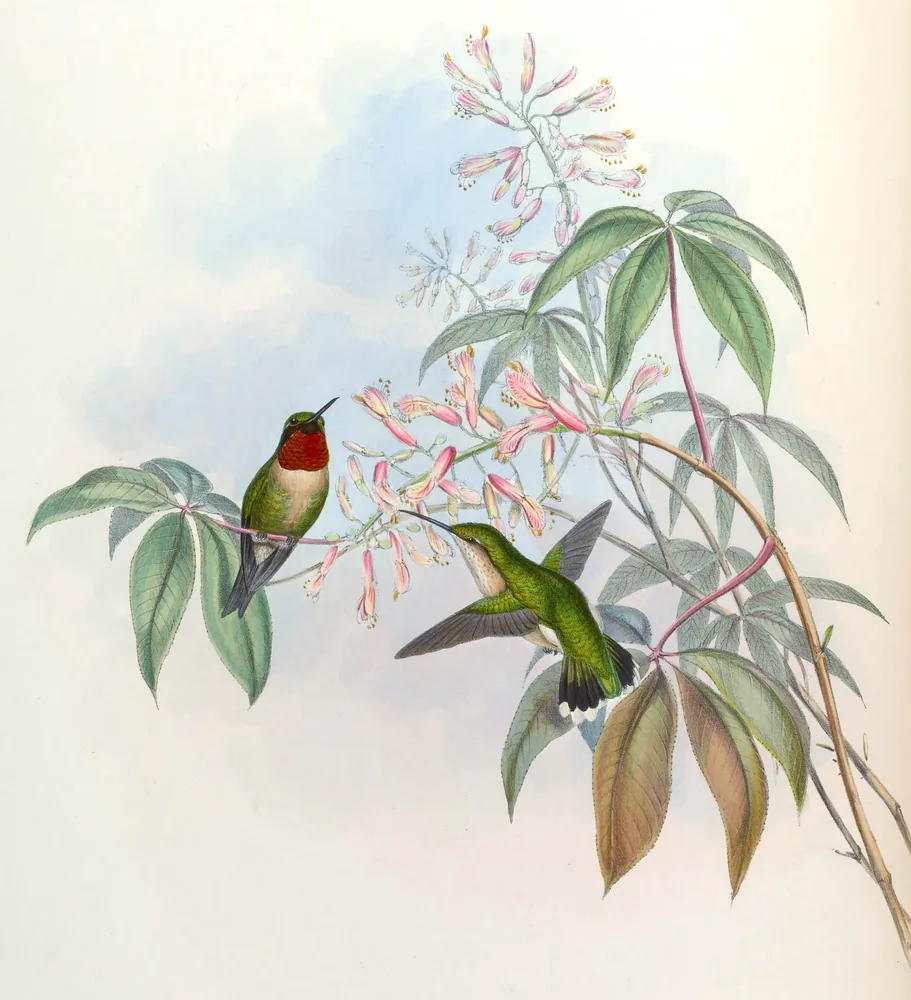
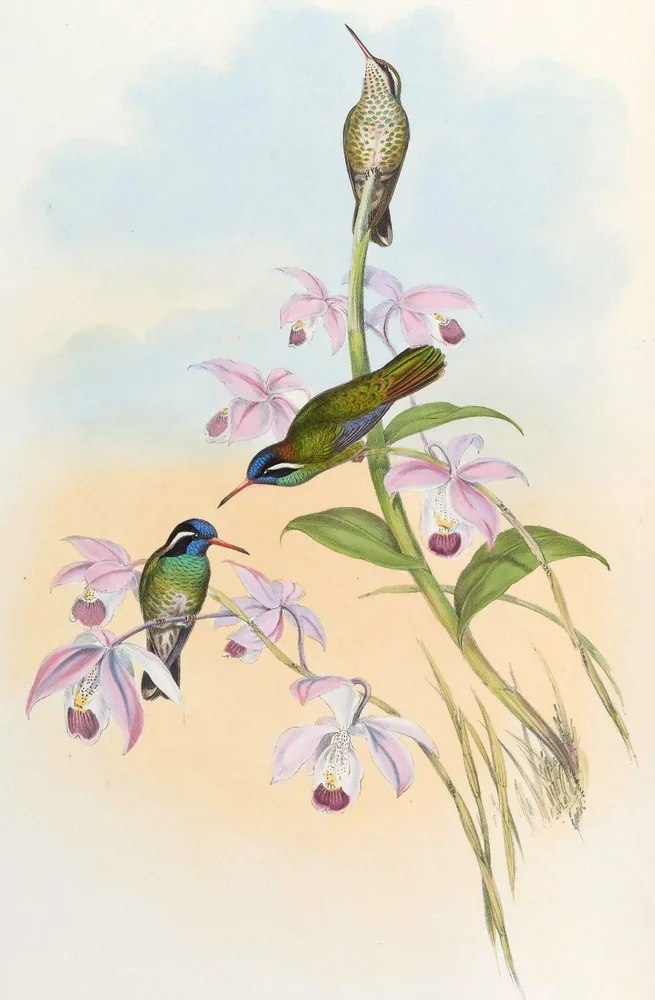
Both paintings on this page are from John Gould's A Monograph of the Trochilidae (1849–61), drawn and put on stone by Gould and Henry Constantine Richter. The pair at the top are Ruby-throated Hummingbirds; our Ruby-throated Hummingbird painting page tells how Gould first saw a living one, in Philadelphia in 1857.
The second plate is the White-eared Hummingbird, which National Geographic says ranges throughout Mexico and Central America. Gould thought it "one of the prettiest and most highly coloured of the Trochilidæ." The 24 hummingbirds seen in the United States, and when each is here, are in our guide to the types of hummingbirds.
If hummingbirds are among the birds that matter to you, a Birdfolio prints every bird you've seen beside a classic painting: page through a Birdfolio.
Questions people ask
What does a hummingbird tattoo mean?
Whatever its wearer means by it. We found no documented history for hummingbird tattoo meanings; the lists online come from tattoo shops and blogs and name no sources.
Is the hummingbird in the Bible?
No. Hummingbirds live only in the Western Hemisphere, says the National Park Service, and the Bible doesn't mention them.
What does it mean when you find a dead hummingbird?
Most often, an accident. The Pennsylvania Game Commission says more hummingbirds probably die "crashing into windows, cars, and telecommunications towers" than are killed by predators. In the United States it is illegal to keep one.
Why does a hummingbird keep coming back to my yard?
Because that is what hummingbirds do. Banding shows they return to their breeding and feeding sites year after year, says the National Park Service.