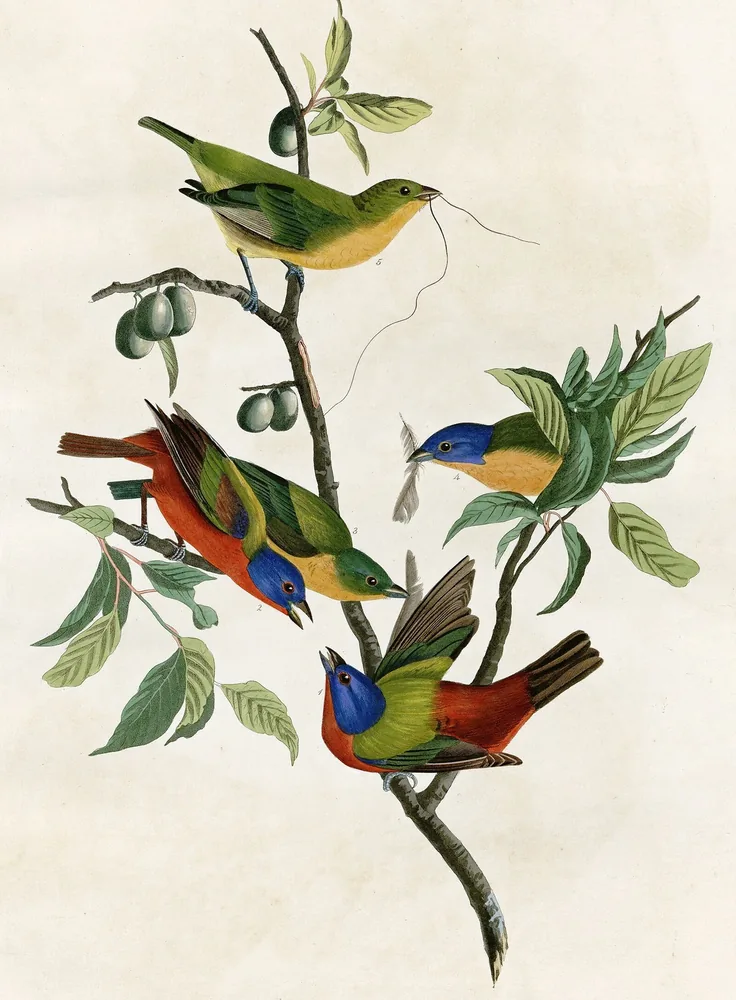
Among the most famous bird painters of the 1800s and early 1900s are John James Audubon, John Gould and his team of artists, Louis Agassiz Fuertes and J. G. Keulemans. Their pictures survive as plates: full-page, often hand-colored prints in old natural history books. Libraries have scanned many of these books and share them free online.
Most birds in a Birdfolio sit beside one of these vintage plates. This page introduces the painters you will meet most often, where our copies come from, and how we credit each one. If you are new to the idea of a life list, start with what a life list is.
| Painter | Lived | Known for | Birds in our library |
|---|---|---|---|
| John James Audubon | 1785–1851 | The Birds of America (1827–38) | about 300 |
| John Gould and his artists | 1804–1881 | A Monograph of the Trochilidae, the hummingbirds (1849–61) | about 110 |
| J. G. Keulemans | 1842–1912 | Plates for Walter Buller's A History of the Birds of New Zealand (1873, 1888) | about 60 |
| Louis Agassiz Fuertes | 1874–1927 | Birds of New York (1910–14) | about 50 |
Key facts
- Audubon's The Birds of America has 435 hand-colored plates, printed from 1827 to 1838 (Natural History Museum, London).
- John Gould and his artists issued 50 large volumes with over 3,000 hand-colored plates, over about 50 years (Linda Hall Library).
- Louis Agassiz Fuertes (1874–1927) painted at least 700 color plates (US Fish and Wildlife Service).
- New Zealand's national museum, Te Papa, counts 95 paintings by J. G. Keulemans (1842–1912) in Walter Buller's bird books.
Facts checked: September 30, 2026.
Who painted the birds in your book
We keep one picture for each bird on our US and Canada list. That list has 1,188 species, including Hawaii's birds and rare visitors. About 7 in 10 of them are shown with a painting. For the 400 most commonly recorded birds on the list, it is about 9 in 10. (We rank birds by how often they are recorded on iNaturalist in the US and Canada.)
Here is who painted them, counted from our own picture records in September 2026:
- John James Audubon: about 300 birds. That is a quarter of the full list, and more than half of the 400 most common birds.
- John Gould and his artists: about 110 birds, including 19 hummingbirds.
- J. G. Keulemans: about 60 birds, plus about 20 more where he shares the credit with other artists.
- Louis Agassiz Fuertes: about 50 birds. He appears less often overall, but among the 400 most common birds he comes second after Audubon, just ahead of Gould.
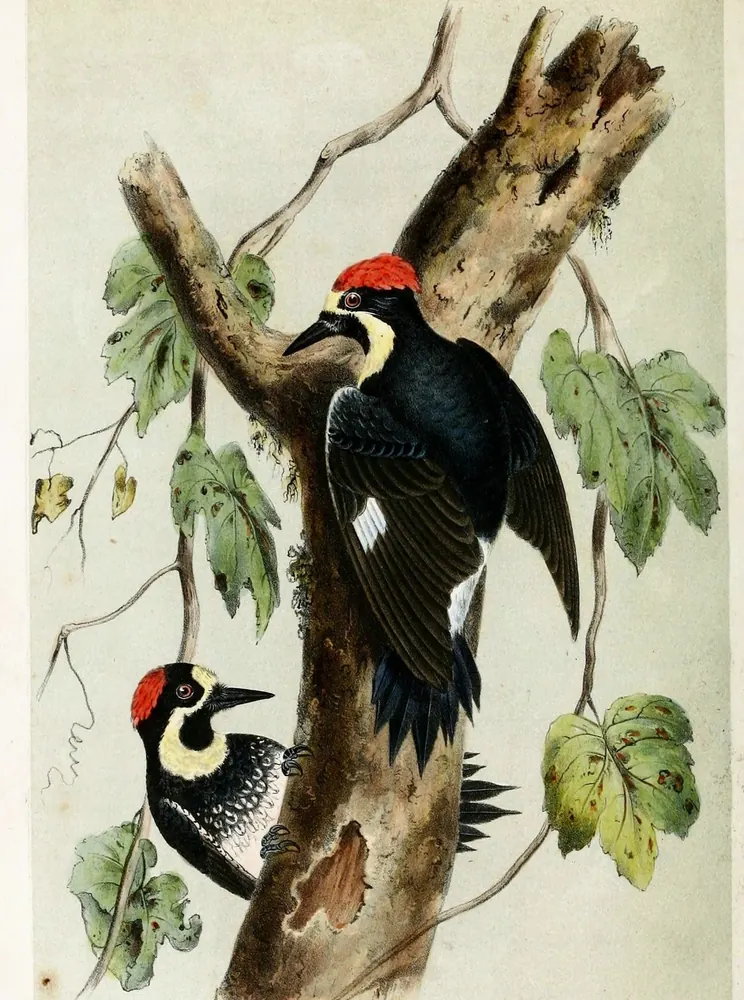
- John Cassin's book of western birds: 21 birds, such as the Acorn Woodpecker and Gambel's Quail.
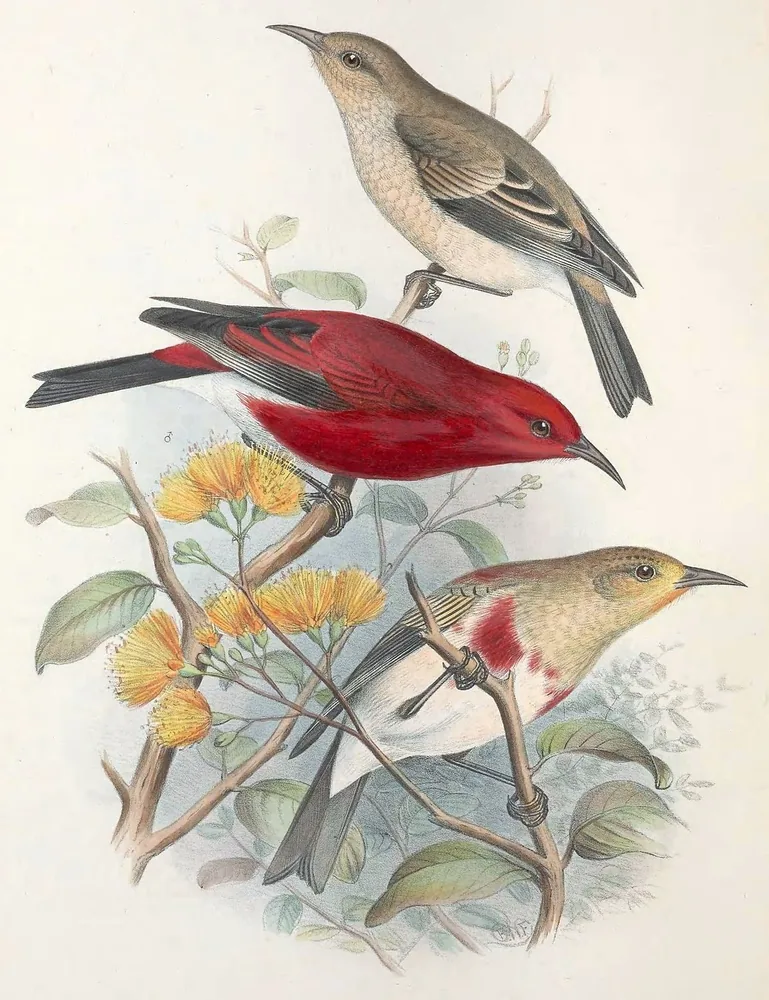
- Dozens of other artists fill in the rest. They range from French painters of the 1700s to Frederick William Frohawk, whose plates show a dozen birds of Hawaii, from the Apapane to the Hawaiian Crow.
About 65 plates come from old books that never recorded the artist's name. We credit those by the book instead.
When no good painting exists, we use a photograph that its author has shared under an open license such as CC0 or CC BY, and we name the photographer. That covers about 3 in 10 birds on the full list, but only about 1 in 10 of the most common ones.
Meet the four famous bird artists you'll see most
John James Audubon (1785–1851)
Audubon's The Birds of America came out in Edinburgh and London between 1827 and 1838. It holds 435 hand-colored plates, and every bird is drawn at life size. A smaller edition of 500 plates followed in 1840–44. London's Natural History Museum says his plates changed bird illustration for good. Read more about Audubon's paintings.
John Gould (1804–1881)
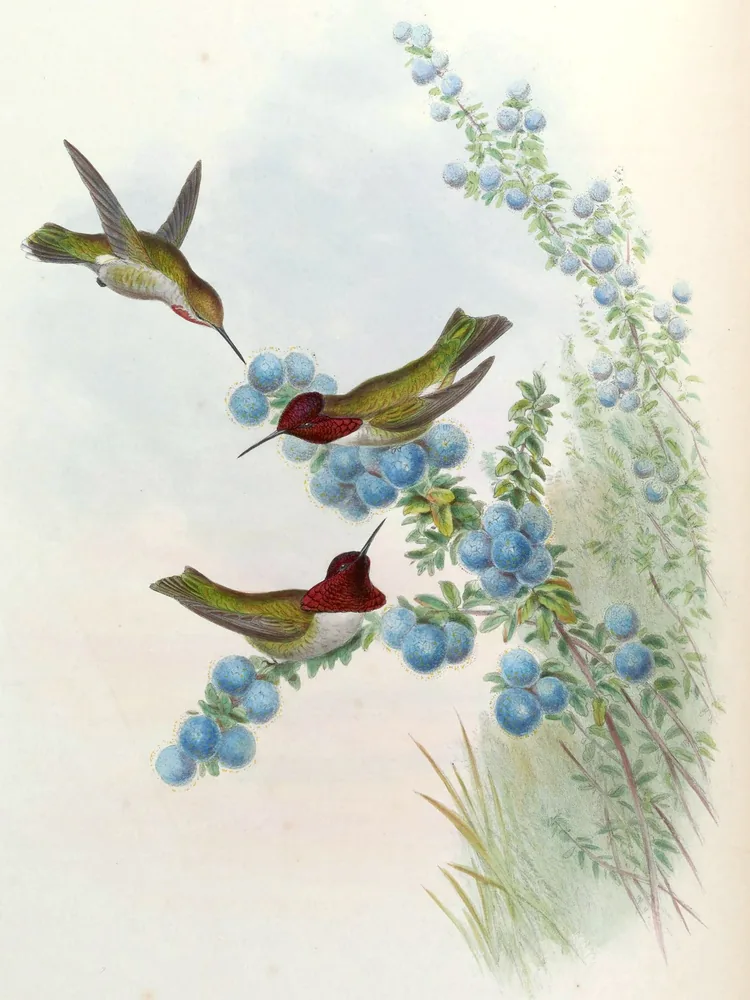
Gould was an English ornithologist and taxidermist who ran a workshop of artists. His wife Elizabeth, Edward Lear, Henry Constantine Richter, William Hart and Joseph Wolf turned his sketches into hand-colored prints. Over about 50 years his books held more than 3,000 plates. His hummingbirds are the best known. Read more about Gould's hummingbirds.
Louis Agassiz Fuertes (1874–1927)
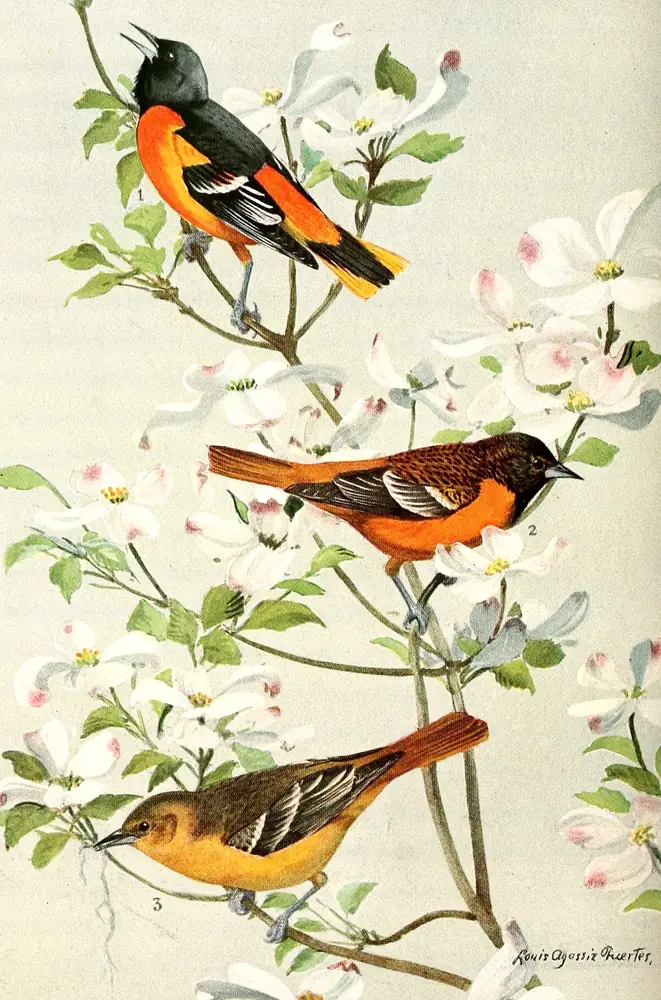
Fuertes was born in Ithaca, New York, and studied at Cornell. He painted birds for books, magazines and government reports in the early 1900s. Many critics have ranked him above Audubon. Read more about Fuertes.
J. G. Keulemans (1842–1912)
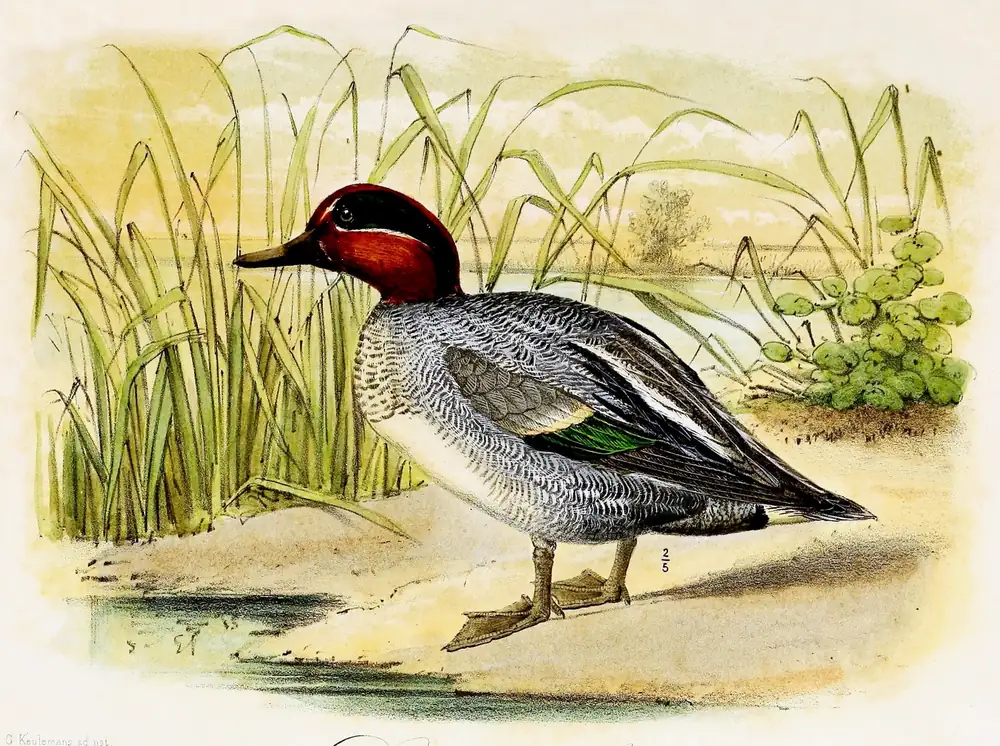
Johannes Gerardus Keulemans was born in Rotterdam in the Netherlands. As a young man he collected specimens for the natural history museum in Leiden. In 1869 the ornithologist Richard Bowdler Sharpe persuaded him to move to England to illustrate a book on kingfishers, and he stayed there for the rest of his life.
Keulemans rarely wrote books of his own. Instead he drew the plates for other people's, including many of the best-known bird books of the 1800s. One of them is Walter Buller's A History of the Birds of New Zealand: New Zealand's national museum, Te Papa, counts 95 of his paintings across its two editions and a supplement.
In our library alone, his work comes from more than a dozen books and journals. Most of his plates in your book come from his Dutch-language Onze Vogels in Huis en Tuin (1870s) and from Lord Lilford's Coloured Figures of the Birds of the British Islands, where his work sits beside Archibald Thorburn's.
Other bird artists in your book
Behind the famous four are dozens of other painters and printers. Two you may meet in a North American book:
- John Cassin's western birds. Cassin's Illustrations of the Birds of California, Texas, Oregon, British and Russian America supplies 21 of our birds, from the Acorn Woodpecker to Gambel's Quail.
- Frederick William Frohawk's Hawaiian birds. Frohawk's plates for Aves Hawaiienses, a book on the birds of Hawaii published in the 1890s, show a dozen birds on our list, from the Apapane to the Hawaiian Crow.
Some famous names are missing on purpose. The work of the great field-guide painters of recent decades belongs to them and their publishers, so it isn't in our books.
Where the scans come from
Nobody at Birdfolio owns these rare books. We use digital scans that libraries have made and shared for free:
- Audubon's big plates were almost all scanned by the University of Pittsburgh. Its set is one of no more than 120 complete sets thought to survive, and the whole set can be viewed online.
- Audubon's smaller edition comes from the New York Public Library. In 2016 the library made these images free to download in high resolution.
- Gould's books come mostly from the Biodiversity Heritage Library and the Internet Archive, and many were scanned by Smithsonian Libraries. The Biodiversity Heritage Library is a free online library of nature books and journals, run by a group of libraries around the world.
- Many others come from the Internet Archive, from books held by Cornell University Library, the Library of Congress and others, and from the University of Amsterdam.
Most of these scans reach us through Wikimedia Commons, the free media library behind Wikipedia. For every plate we keep a record of the artist, the book, the year, the library that made the scan and the web page we took it from.
Want to find these vintage bird illustrations yourself? Our guide to where to find vintage bird illustrations lists the best free archives and the traps to avoid.
How we credit every plate
At the back of each book you'll find the Picture Credits pages. They list every painting by artist and source book, with the pages it appears on. Each photograph gets its own line with the photographer's name and license.
We crop each plate to the bird and even out the old paper tone so it prints cleanly. The credits say so. We never use AI-generated birds.
How we pick the plate for each bird
We look for a real painting first. Then we check that it shows the right species, because old books often use old names. Audubon's "Painted Finch" is today's Painted Bunting, for example. We check each picture by eye before it goes into a book.
Questions people ask about bird painters
Who is the most famous bird painter?
For American birds, it is John James Audubon. The National Audubon Society is named after him, and his life-size plates set the standard that later bird artists were measured against. Many critics rank Louis Agassiz Fuertes above him as a painter.
Where can I see these paintings in person?
The University of Pittsburgh shows Audubon prints in its Hillman Library, with a special display each fall on Audubon Day. The Field Museum in Chicago holds 115 of Fuertes' watercolors and sketches from his 1926–27 trip to Ethiopia.
Did John Gould paint his own birds?
Mostly not. Gould made rough sketches and ran the business. His wife Elizabeth and artists such as Edward Lear and Henry Constantine Richter drew the finished plates. Gould's story has the details.
Is there any AI art in a Birdfolio?
No. Every bird is shown with a real painting or a credited photograph.
A book of classic plates can make a thoughtful present too. See our gift ideas for birders.
See these plates in a Birdfolio → /sample
Birdfolio is not affiliated with eBird, the Cornell Lab of Ornithology or iNaturalist.