Classic bird paintings
Steller's Jay painting: Audubon's plate and other classic portraits
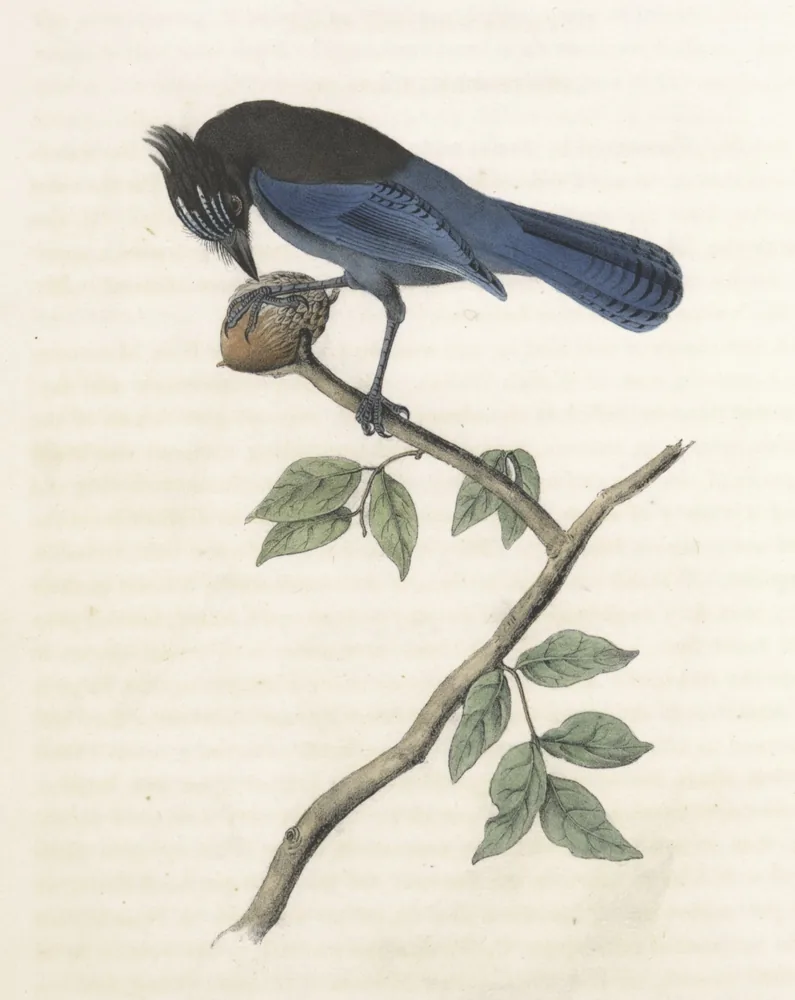
John James Audubon painted Steller's Jay on plate 362 of The Birds of America (1827–38), sharing the sheet with a magpie, a second jay and a nutcracker; the plate's title spells it Stellers Jay. A free high-resolution scan is on Audubon.org. The jay shown here is from his smaller octavo edition (1840–44), plate 230.
Updated
About this painting
Shown here: plate 230 of the octavo edition, titled Stellers Jay as on the big plate. Here the jay has a page to itself, bent over a nut it pins down with one foot; on plate 362 it shares the sheet with three other birds of the West.
Audubon’s Steller's Jay: plate 362, “Yellow billed Magpie; Stellers Jay; Ultramarine Jay; Clark's Crow”
Long before Audubon, Georg Wilhelm Steller had this jay in his hands. In July 1741, with Vitus Bering's ship at anchor off Kayak Island, Alaska, Steller's huntsman brought him a single bird. He remembered a likeness of it “painted in lively colors” in a book on the birds and plants of the Carolinas, though the author's name escaped him; it was Mark Catesby, whose plate shows the Blue Jay. “This bird proved to me that we were really in America,” Steller wrote.
He drew it, too, but had to leave the drawing behind. Of the twelve bird drawings he later sent to the Academy in St. Petersburg, only five arrived, and in 1917 the editor of his journal could not find even those.
Audubon's plate 362 groups four birds of the West, among them a Yellow-billed Magpie he named after his friend Thomas Nuttall. Nuttall's notes on the jay fill most of Audubon's text. In the pine forests of the Columbia he found the birds bold and noisy, “watchful as dogs,” following and scolding any stranger, sometimes with a large acorn still in the bill. He took two of the four eggs from one nest, and the next day the pair had abandoned it.
Story: Golder, Bering's Voyages, vol. 2 (1925), pp. 35, 59–60; Audubon, Ornithological Biography, vol. 4 (1838), p. 450; vol. 4 (1838), pp. 453–454. See plate 362 free at Audubon.org.
More classic portraits, free to see
- John James Audubon, The Birds of America, octavo edition (1840–44), plate 230: “Stellers Jay” (the painting shown above). Free scan (New York Public Library Digital Collections)
About the Steller's Jay
- Steller's Jay is the only all-dark jay with a crest, and it may mimic the screams of hawks. (Source: National Audubon Society)
- It opens hard seeds and acorns by pounding on them with its bill, and builds a bulky nest of twigs and leaves cemented together with mud. (Source: National Audubon Society)
How long does a Steller's Jay live?
We read no wildlife agency guide that gives a typical lifespan for Steller's Jay. The oldest known wild Steller's Jay was at least 16 years and 1 month old (USGS Bird Banding Laboratory): it was banded in Alaska in 1972 and found there again in 1987.
Source: USGS Bird Banding Laboratory. A banding record is the minimum age of one bird when it was found again, not a typical lifespan. How long do wild birds live?
How can you tell if a plate 362 print is an original?
By its size: an original plate 362 is a hand-colored sheet about 26 by 38 inches; the Steller's Jay’s octavo version, plate 230, is book-size, from 1840–44. Many prints sold today are reproductions: how to tell an original from a reproduction. For all 435 plates at a fraction of an original’s price, see which edition of The Birds of America to buy.
In a Birdfolio hardcover, this painting sits beside the date and place you first saw a Steller's Jay. See your own list as a book, free.