2026 split
Marsh Wren split into the Eastern and Western Marsh-Wren
The Marsh Wren is now two species. The American Ornithological Society (AOS) split it on October 20, 2026, into the Eastern Marsh-Wren and the Western Marsh-Wren, and AviList, the shared world checklist, made the same split that day, writing the names without the hyphen. The two look almost alike but sing very differently. eBird's yearly update, expected October 27, usually follows the AOS; what eBird changes is certain only once it publishes.
Updated
What changed
Nests in marshes of the East and the eastern Great Plains, east of a line from central Saskatchewan to eastern Nebraska and Kansas. Winters in the Southeast and on the Atlantic and Gulf coasts.
Nests in marshes from the western Great Plains, including Nebraska's Sandhills, to the Pacific coast; the Marsh Wrens that live all year in Mexico are Western too. Winters in the Southwest, Texas and Mexico; in western Washington many stay all year.
Has the Marsh Wren been split?
Yes. The AOS, which keeps the official list of North American birds, split it on October 20, 2026, in the 67th Supplement to its Check-list, on a proposal by Jacob Cooper, of the committee's group of early-career scientists, and Peggy Huss. AviList, the shared world checklist, made the same split in its 2026 edition, published the same day.
eBird still had one Marsh Wren when we checked on October 22, 2026. Its 2026 update is expected on October 27; it usually follows the AOS, but what it does with the Marsh Wren is certain only once it publishes.
Is it Marsh Wren or Marsh-Wren?
Both, depending on the checklist. The AOS writes the new names with a hyphen, Eastern Marsh-Wren and Western Marsh-Wren; AviList writes them without, Eastern Marsh Wren and Western Marsh Wren. They mean the same two birds. How eBird spells them will be certain once its update is out.
Surprising facts about the Eastern and Western Marsh-Wrens
A western male can sing about 200 different songs. An eastern male learns about 50. Western males race through their repertoire, one different song after another, while eastern males repeat a song before switching, Kroodsma wrote in 1988.
They learn their song, but stick to their own. Either kind can learn the other's song, yet in the wild nearly every bird sings the one that matches its ancestry, the proposal says, and birds raised in a lab still developed their own group's style, says Animal Diversity Web.
Males build decoy nests. A male may build up to 20 or more dummy nests. Most are never used for young, though the birds may sleep in them, says Audubon's field guide.
Many males have two mates. About half of the male Marsh Wrens in Washington, all western birds, have two or more mates at once, says Seattle Audubon's BirdWeb.
They break other birds' eggs. Marsh Wrens puncture the eggs of other birds, even other Marsh Wrens, says Audubon's field guide, and destroy the eggs and young of Red-winged and Yellow-headed Blackbirds nesting nearby, says Animal Diversity Web.
Why it changed
Their songs. A Western male can learn up to about 200 songs and an Eastern male up to about 50, and they sound different: Western songs are harsh and often end in a long trill, while Eastern songs start with a nasal buzz and are more musical, the AOS proposal says. After fieldwork in Nebraska in 1986, Donald Kroodsma wrote in 1988 that they seemed to be two separate species.
Their genes. A 2026 study by Kroodsma and four colleagues measured a genetic difference between them nearly four times that between Baltimore and Bullock's Orioles, two species that interbreed widely where they meet on the Great Plains, and found few hybrids where the wrens meet, the proposal reports.
They keep apart even as neighbors. In Nebraska a gap about 60 miles wide with few nesting wrens, which Kroodsma named the “Wrenless Corridor,” separates them, and it has barely changed in about 25 years; only one marsh there, Goose Lake, is known to hold both. In southern Saskatchewan the two share many of the same marshes, yet they rarely interbreed, and a bird that sings both songs is rare, the AOS said when it announced the split.
Who decided, and when
- American Ornithological Society (AOS): the 67th Supplement to its Check-list of North American birds, after its committee passed proposal 2026-B-2
- AviList, the shared world checklist: its 2026 edition, v2026, as Eastern Marsh Wren and Western Marsh Wren
- eBird and the Clements Checklist: hadn't split it yet when we checked. Its yearly update is expected on October 27, 2026; eBird usually follows the AOS, but what it changes is certain only once it publishes
How do you tell an Eastern Marsh-Wren from a Western Marsh-Wren?
By place and by ear. Over most of their range, where you saw it tells you which one it was. Where both occur, from the Canadian prairies to Nebraska and Kansas, listen: a Western song usually starts with two quick, low tuk notes that run into a rattling trill, like an old typewriter, while an Eastern song starts with a single nasal buzz and its trill sounds more like shaken coins, Nathan Pieplow writes.
By eye it's hard. Westerns average grayer and duller, Easterns darker and more chestnut with a darker cap, the proposal says, but the differences are slight; the dullest Westerns may lack a dark cap, which Easterns seem always to have, Michael Retter of the American Birding Association adds. A silent bird on migration or in winter, on the Great Plains, in Texas or in Mexico, often can't be named at all.
Where can you see Eastern and Western Marsh-Wrens?
They meet on the Great Plains, along a line from central Saskatchewan southeast to east-central Nebraska and Kansas. In Nebraska, Western Marsh-Wrens nest in the Sandhills and Eastern ones along the Missouri River and in the Rainwater Basin, the proposal says.
In winter, Westerns go to the interior Southwest, Texas and Mexico, and Easterns to the Southeast, including the Atlantic and Gulf coasts. Most Marsh Wrens wintering in Nebraska are Western.
Which one did you see?
Mostly by where it nested: Marsh Wrens of the West and the western Great Plains are Western Marsh-Wrens, those of the East are Eastern Marsh-Wrens.
Where both occur, from Saskatchewan to Kansas, a singing bird can be named by its song; a silent one often can't.
What it does to your list
In eBird, nothing has changed yet: it still lists one Marsh Wren until its update, expected on October 27, 2026. If eBird follows the AOS, as it usually does, and you have seen both, your eBird total will go up by one: an “armchair lifer.” If you have seen Marsh Wrens only in the East, or only in the West, only the name changes.
Birdfolio books use AviList's June 2026 edition, which still has one Marsh Wren, so your book counts one. Typed as an Eastern or Western Marsh Wren, with or without the hyphen, either lands on it, and a notes page in the book explains why.
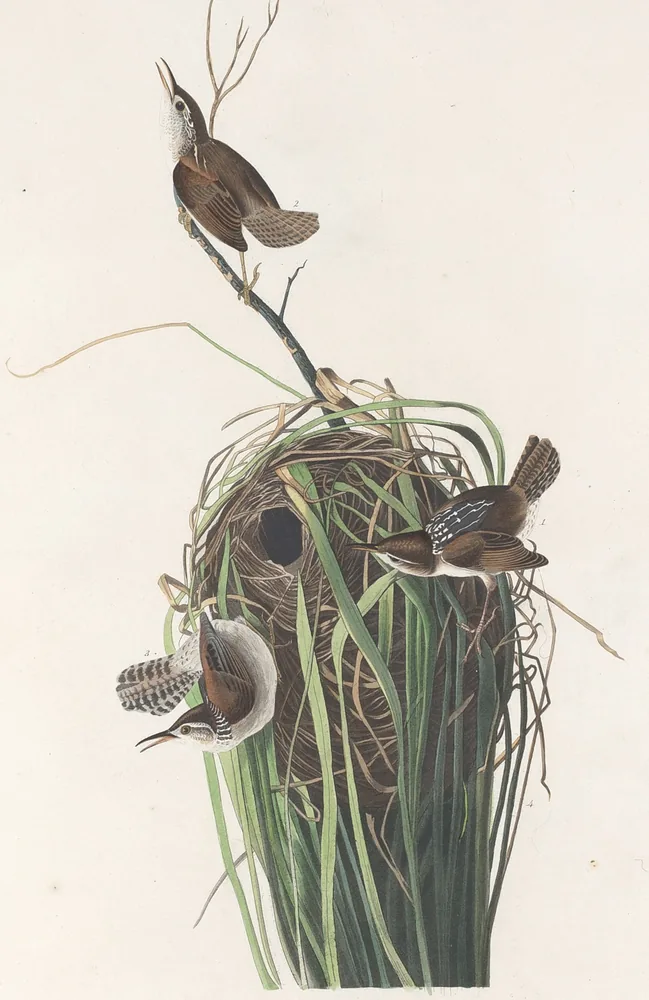
Audubon painted it as plate 100, with its round nest woven into the reeds. The AOS split the Willet the same day.
Heard Marsh Wrens in both the East and the West? After eBird's update, a fresh download of your eBird data lists each sighting with its date and place.
Check your own list. Drop your eBird download or type your birds: the free checker shows which of them this and other recent changes touched.
Check my list