2024 split
Northern House Wren: the House Wren under a new name
The Northern House Wren is the House Wren of the US and Canada under a new name: the American Ornithological Society (AOS) split the House Wren into seven species on July 18, 2024, and eBird followed in October 2024. The other six live from southern Mexico to South America and on Caribbean islands. For birders in the US and Canada it's a new name, not a new bird.
Updated
What changed
The House Wren of the US and Canada.
From southern Mexico through Central and South America.
What are the seven new species?
Northern House Wren, Southern House Wren, Cozumel Wren, Kalinago Wren, St. Lucia Wren, St. Vincent Wren and Grenada Wren. Only the Northern House Wren lives in the US and Canada.
Northern House Wren nests across southern Canada and every US state except Alaska and Hawaii, and winters in the southern US and Mexico. It includes the warm-toned "Brown-throated" wrens of the mountains of Mexico and southeastern Arizona, so the split adds no species for US birders, Retter notes.
Southern House Wren lives from southern Mexico through Central and South America. The two meet in the Mexican states of Veracruz and Oaxaca, where the Northern birds are warm brown highland wrens and the Southern ones grayish lowland birds.
Cozumel, St. Lucia, St. Vincent and Grenada Wrens each live only on their namesake island. Kalinago Wren once lived on Dominica, Martinique and Guadeloupe but survives only on Dominica. The AOS thanked Kalinago Chief Lorenzo Sanford and the Kalinago Council for permission to use the name.
Surprising facts about the Northern House Wren
It hires spiders as pest control. Males sometimes tuck spider egg sacs into the nest. When the spiders hatch, they eat the mites and other parasites that plague the nestlings, says Audubon magazine; NestWatch notes that lab studies showed the effect.
It weighs about as much as two quarters, and fights like a much bigger bird. To take over a nest hole, a House Wren often punctures other birds' eggs and sometimes kills their nestlings. Its attacks are among the top causes of nest failure for some birds, including bluebirds and chickadees. In 1925 the ornithologist Althea Sherman called it a "felon."
Its name comes from a Greek myth. Troglodytes aedon means "cave-dwelling nightingale." Aedon was a queen of Greek myth who was turned into a nightingale, forever singing her grief, Audubon magazine explains.
It sings up to 600 songs an hour. That's how many a tireless male can belt out in mating season. The Cherokee call it Ganulatsi and see it as a messenger that carries news of babies born in the community.
A Cleveland lawyer became its great expert. Samuel Prentiss Baldwin, a lawyer turned ornithologist, became the leading expert on the House Wren. At his estate in Gates Mills, Ohio, he pioneered a method of bird banding from 1914 that the US Biological Survey adopted, and he designed a "wrenograph" that recorded each time the birds went in and out of the nest, says the Encyclopedia of Cleveland History.
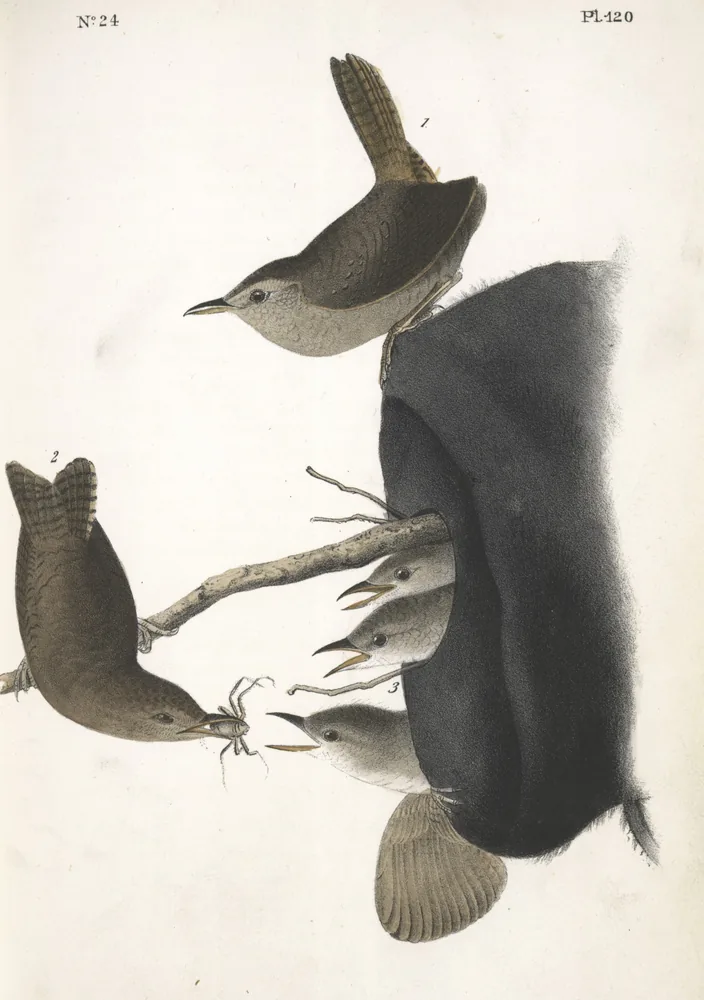
Audubon named one. In 1839 he described the western House Wren as Troglodytes parkmanii, from the Columbia River near Fort Vancouver, Washington; it is now part of the Northern House Wren, AviList records. His painting of House Wrens nesting in an old hat is at the top of this page, and the big edition of The Birds of America has the House Wren as plate 83.
Why it changed
The old House Wren ranged from Canada through South America and across many Caribbean islands. In 2024 the AOS accepted a proposal by Pamela Rasmussen, Terry Chesser, Van Remsen and Brian Sullivan to split it. A similar proposal had failed in 2022, but new DNA work, including a near-complete family tree of these wrens, changed the picture.
The committee weighed genes, songs, looks, ecology, behavior and habitat. Habitat was especially persuasive, said Terry Chesser of the US Geological Survey, who chairs the AOS committee. On the tropical mainland, House Wrens thrive in villages and towns, but most island birds live in forests and other natural places, and many are not doing well. If they were the same species, he reasoned, they would be thriving in towns like their mainland cousins.
The island wrens are not each other's closest relatives either: wrens colonized the islands several separate times, Chesser explains. And their songs differ, most remarkably the St. Vincent Wren's. Michael Retter of the American Birding Association (ABA) writes that some island songs are so different that people who know mainland House Wrens don't recognize them as wren songs at all.
Who decided, and when
- American Ornithological Society (AOS): the 65th Supplement to its Check-list of North American birds
- eBird and the Clements Checklist: its 2024 taxonomy update
- AviList, the shared world checklist: agrees
Do House Wrens come back to the same birdhouse every year?
Often to the same yard, though not always to the same box. Male House Wrens are strongly loyal to their breeding territory, says The Birder's Handbook. But each spring the male offers several holes, building the start of a nest of twigs in each, and the female picks one and finishes it with a soft lining, says Audubon's field guide.
Partners change too. Both sexes may mate with neighbors, and after the first brood some females start a second one, often with a different male, says Audubon magazine.
House Wrens nest in almost any enclosed space: Audubon's field guide lists flowerpots, parked cars, shoes and drainpipes. NestWatch offers a nest box plan made for the species.
What month do House Wrens lay eggs?
In the northern states, from late spring through summer. In Montana, for example, nests are active from mid-May through July, and young have been seen in second nests as late as August 20, says the Montana Field Guide.
A clutch is usually 6 or 7 white eggs heavily dotted with reddish brown, sometimes as few as 3 and occasionally up to 10. The female incubates them for about 12 to 15 days; the young leave the nest 12 to 18 days after hatching; and pairs raise two broods a year, rarely three, says Audubon's field guide.
Where do Northern House Wrens go in winter?
South. In winter they live in communities across the southern US and into Mexico, then return north in spring to suburbs, parks and woodlands, says Audubon magazine. They probably migrate at night, and males seem to head north slightly earlier than females.
Are House Wrens declining?
No: the Northern House Wren population is increasing while many other common birds are declining, says Audubon magazine, and the IUCN rates it of least concern. Audubon's field guide puts the population at 190 million.
It wasn't always so easy. After the House Sparrow was introduced in the 1800s, House Wrens declined in some areas, because the sparrows competed for nest holes, says Audubon's field guide.
Which one did you see?
Go by where you saw it. In the US and Canada, it's Northern House Wren.
Southern House Wren lives from southern Mexico through Central and South America. The other five new species each live on Caribbean islands, such as Cozumel, St. Lucia, St. Vincent and Grenada, and sound quite different from mainland birds.
In the US, look for a small, plain brown wren, 4.3 to 5.1 inches long, with a faint eyebrow, a thin eye-ring and bars on the wings and tail, often bouncing about with its short tail held high, says Audubon's field guide.
What it does to your list
For birders in the US and Canada it's a new name only: your House Wren is now Northern House Wren.
If you have also seen house wrens in Central or South America, or on one of those islands, the split may add to your total. Birders call a species gained from a split, without a new sighting, an "armchair lifer."
Other familiar birds changed the same year: see the Barn Owl split and the redpoll lump. Another wren was split in 2026: the Marsh Wren. And read more about how bird splits and lumps work.
With your list up to date, try it as a book: you see your species count and the first pages free.
Check your own list. Drop your eBird download or type your birds: the free checker shows which of them this and other recent changes touched.
Check my list