1995 split
Rufous-sided Towhee: now the Eastern Towhee and the Spotted Towhee
The Rufous-sided Towhee is now two birds: the Eastern Towhee in the East and the Spotted Towhee in the West. The American Ornithologists' Union, the forerunner of today's American Ornithological Society (AOS), split it in July 1995. If the old name is in your notebook or field guide, where you saw the bird tells you which one it was.
Updated
What changed
East of the Great Plains, in open woods and brushy edges: New England, the Mid-Atlantic, the Southeast and Florida, the Great Lakes and eastern Canada. Many southern birds stay all year; most northern ones migrate.
The West: California, the Northwest, the Rocky Mountains and the Southwest. Birds of the northern interior spread east onto the Great Plains in winter.
When was the Rufous-sided Towhee split?
In July 1995. That month the American Ornithologists' Union (AOU), the forerunner of today's AOS, printed the 40th Supplement to its Check-list of North American Birds, and one line did it: “Split Pipilo erythrophthalmus into P. erythrophthalmus and P. maculatus.” The supplement covers what its committee decided between March 1, 1993 and March 15, 1995.
The bird of the East became the Eastern Towhee and the bird of the West the Spotted Towhee. The name Rufous-sided Towhee, on the check-list by its 1957 edition, was gone from it.
Surprising facts about the Rufous-sided Towhee
It was two birds, then one, then two again. The union's first check-list, in 1886, had the Towhee as number 587 and the Arctic Towhee, a form of today's Spotted Towhee, as number 588. The 1931 edition still kept them apart. By the 1957 edition they were one bird, the Rufous-sided Towhee. The 1995 split handed the old numbers back: Eastern Towhee 587, Spotted Towhee 588.
It is named for its own voice, twice over. John James Audubon wrote in 1831 of the bird “scratching with great assiduity, and every now and then uttering the notes tow-hee, from which it has obtained its name.” In some places it is called the Chewink instead, after the sound of its call note, says Audubon's field guide.
The eastern bird has gone by four names on one list. Towhee in 1886, Red-eyed Towhee in 1931, Rufous-sided Towhee by 1957 and Eastern Towhee since 1995. Audubon had a fifth: he painted it as plate 29 of The Birds of America and headed his chapter on it “The Towhe Bunting.”
The western bird once had ten names of its own. The 1931 check-list divided it into the Arctic, Spurred, Nevada, Oregon, Sacramento, San Francisco, San Diego, San Clemente, Cape Colnett and Large-billed Towhees.
Its scientific name rests on a “Towhee-bird.” The 1983 check-list says the name erythrophthalmus is based on the “Towhee-bird” of Catesby's Natural History of Carolina, volume 1, plate 34.
Why it changed
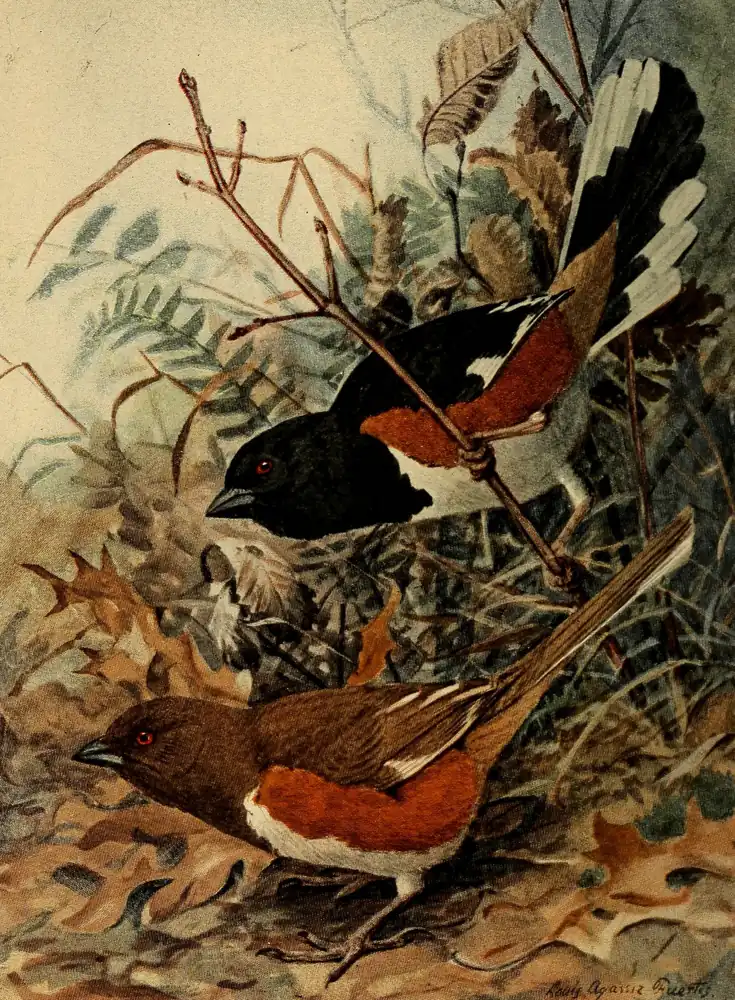
The committee gave three differences in 1995: the two birds “differ conspicuously in vocalizations, dorsal plumage pattern, and nature and degree of sexual dimorphism.” In plain words, they sound different, the Spotted Towhee has white spots on a back that is plain on the Eastern, and the sexes differ in their own way in each: an Eastern female is brown where her mate is black, while a Spotted female may be black or gray.
Where they meet, most still keep to their own kind. In the narrow strip of the central Great Plains where the two interbreed, a 1959 study found that 56 percent of the towhees were still pure Eastern or pure Spotted. Across 28 places in that strip the figure averaged 60 percent, and even on the short stretch of the Platte River where mixed birds were in the majority, 20 percent were pure. The committee read that as strong evidence that each bird chooses mates of its own kind.
The genes agreed. A 1992 study found that the two shared no types of mitochondrial DNA, and that the gap between them was wider than the gap between several pairs of birds already counted as separate species.
It was a return more than a discovery. The union's 1983 check-list had already noted that the two “were once regarded as distinct species,” even though they mix in riverside woods in southern Saskatchewan and along the Platte River in Nebraska.
Who decided, and when
- American Ornithological Society (AOS): the 40th Supplement to its Check-list, printed in its journal The Auk when the society was still the American Ornithologists' Union (AOU)
Is a Rufous-sided Towhee the same as an Eastern Towhee?
In the East, yes: the Eastern Towhee is the same bird under a newer name. In the West, no: a Rufous-sided Towhee seen there is what we now call the Spotted Towhee. The old name covered both, which is why it could not stay with either one after the split.
The Eastern Towhee kept the old scientific name, Pipilo erythrophthalmus. The Spotted Towhee went back to Pipilo maculatus, the name it had on the 1886 and 1931 check-lists.
Where does the Eastern Towhee live?
East of the Great Plains, in open woods, undergrowth and brushy edges. Audubon's field guide lists it for New England, the Mid-Atlantic, the Southeast, Florida, the Great Lakes, the Plains, Texas, and both eastern and western Canada. Many southern birds live in one place all year, while most of those in the North migrate.
It is scarcer than it was: the same guide says its numbers in the Northeast have declined seriously in recent decades.
What is the western Rufous-sided Towhee called now?
The Spotted Towhee (Pipilo maculatus). It is the widespread towhee of the West: California, the Northwest, the Rocky Mountains and the Southwest, says Audubon's field guide. Birds of the northern interior spread east onto the Great Plains in winter, and now and then one strays all the way to the Atlantic coast.
Audubon painted this bird too: plate 394 of The Birds of America includes it under the name Arctic Ground Finch. And the story may not be over. The 1995 supplement notes that the towhee of Socorro Island has been treated as a species of its own, the Socorro Towhee.
How do you tell a male towhee from a female?
In the East, by the color of the hood and back: black on the male, chocolate-brown on the female. Both have the rusty sides, the white belly and the big white corners on the tail. The painting on this page, by Louis Agassiz Fuertes, shows a pair: the black male up on a twig, the brown female down among the fallen leaves.
In the West it is harder. A male Spotted Towhee is black on the hood and back, and a female may be black or gray, says Audubon's field guide.
What does a Rufous-sided Towhee sound like?
It depends on which half you hear. The Eastern Towhee's song often starts with a few opening notes and usually ends in a long trill, written drink-your-teeaaa or to-wheeeee in Audubon's field guide. The Spotted Towhee's is a long, buzzy cheweeeee, and its songs and calls are more varied and much harsher in tone.
Voice was the first difference the committee named when it split the two.
What birds are similar to the Eastern Towhee?
The Spotted Towhee, above all: it has the same dark hood, rusty sides and white belly, plus bold white spots on its back and wings. East of the Great Plains it turns up only as an occasional stray.
Audubon's field guide also tells readers to compare the towhee with the American Robin. The marks to check on a towhee are the white stripe down the middle of the belly, between the rusty sides, and the big white corners of the tail.
What does a green towhee look like?
The Green-tailed Towhee is a different bird, not one of the two halves of the Rufous-sided Towhee. It has a gray face and chest, a sharp white throat and a reddish cap, and its upperparts and tail are olive green, says Audubon's field guide. It is 7 to 8 inches long, fairly common in the western mountains in summer, and has a cat-like mewing call.
Which one did you see?
Start with the place. East of the Great Plains it was an Eastern Towhee. From the Rocky Mountains to the Pacific it was a Spotted Towhee.
On the Great Plains it could be either. The two meet and interbreed there, and Spotted Towhees from farther north move onto the Plains for the winter.
Then look at the back. A Spotted Towhee has bold white spots on its back and wings. An Eastern Towhee's back is plain: black on a male, chocolate-brown on a female.
Eyes and size settle little. An Eastern Towhee's eyes are usually red, though a white-eyed form lives in Florida. The Eastern is 7 to 8½ inches long and the Spotted 8¼.
What it does to your list
One old name, two birds today. If your list has a Rufous-sided Towhee from the East and another from the West, that single line is now two species.
If you saw it on one side of the country only, your count stays the same and the bird takes its new name.
The old name lives on in notebooks, in older field guides and in lists typed from them. In a Birdfolio, a Rufous-sided Towhee that comes with a place is filed by it: seen in the eastern states and provinces, it is an Eastern Towhee; seen from the Pacific states to Utah and Arizona, a Spotted Towhee. Anywhere in between, or with no place, we ask you which one it was.
Read more about how bird splits and lumps work, and why names change.
Does your list still say Rufous-sided Towhee? Put it into a book, each bird under the name it has today, and look through the first pages free.
Check your own list. Drop your eBird download or type your birds: the free checker shows which of them the changes since 2018 touched.
Check my list