1997 split
Plain Titmouse: now the Oak Titmouse and the Juniper Titmouse
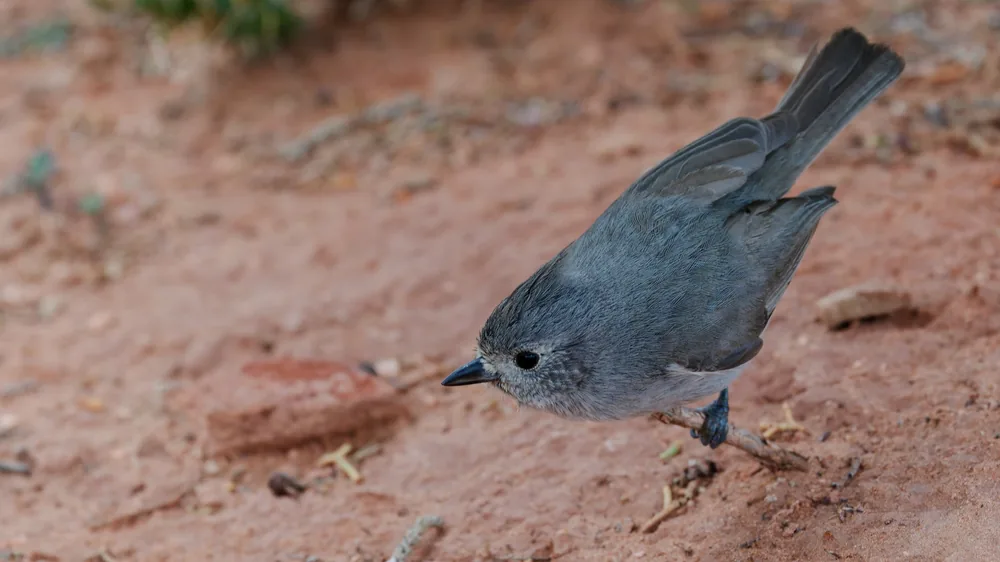
The Plain Titmouse is now two birds: the Oak Titmouse of California and the Pacific slope, and the Juniper Titmouse of the interior West. The American Ornithologists' Union, the forerunner of today's American Ornithological Society (AOS), split it in July 1997. The two look almost alike, so where you saw the bird is the way to tell.
Updated
What changed
California west of the Sierra Nevada, south into Baja California, and a corner of southwestern Oregon: oak woodland above all, also streamside trees, pines and well-wooded suburbs. It stays all year.
The interior West, from southern Oregon and Idaho to the northern edge of Sonora: pinyon-juniper woods in Nevada, Utah, Colorado, Arizona and New Mexico, with an outpost in the Guadalupe Mountains on the Texas line. It stays all year.
What is a plain titmouse called now?
An Oak Titmouse or a Juniper Titmouse, depending on where it was: the Oak Titmouse along the Pacific slope, mostly in California, and the Juniper Titmouse in the pinyon-juniper woods of the interior West. Audubon's field guide notes on both birds' pages that, until recently, they were considered one species under the name Plain Titmouse.
Plain Titmouse had been on the union's check-list since its first edition, in 1886, at first for the birds of California and western Oregon, with those of the interior listed as the Gray Titmouse. The 1957 edition used it for the whole species, and it stayed until 1997.
Surprising facts about the Plain Titmouse
The Juniper Titmouse used to be the Gray Titmouse. That was its name as a race of the Plain Titmouse on the check-lists of 1886, 1910 and 1931. Ridgway had described it as griseus in 1882, from Iron City, Utah, the 1910 check-list records.
Its scientific name had to change after the split. The 1998 check-list printed the new species as Baeolophus griseus. In 2000 the union changed it to Baeolophus ridgwayi, because the name griseus had been “permanently invalidated” under the rules of zoological names.
The 1931 check-list had six of them. It named the Oregon, Plain, San Diego, San Pedro, Ashy and Gray Titmice, all races of one species. AviList, the shared world list, now counts four races of the Oak Titmouse and two of the Juniper.
It hammers acorns open. Both titmice open nuts and acorns by holding them with their feet and pounding with the bill, says Audubon's field guide, and the Juniper also eats pinyon nuts.
Pairs keep house all year. Juniper Titmice form pair bonds for life, and male and female defend their territory even outside the nesting season, says Wyoming's wildlife agency. Oak Titmouse pairs or family groups may hold territories all year too.
Why it changed
Two birds were hiding under one plain coat. Carla Cicero compared Plain Titmice across western North America by their measurements, color, proteins, mitochondrial DNA and voice, and every set of traits drew much the same line: Pacific slope birds on one side, birds of the interior on the other. Her study, published by the University of California Press in April 1996, treated the two groups as sibling species.
In July 1997 the union split it. Wyoming's Game and Fish Department sums up the decision: the Plain Titmouse “was split into two geographically distinct species based on genetic evidence” and differences in ecology, shape, color and song.
They hardly ever meet. The two live apart everywhere except a small part of northern California, Wyoming's account says, and Audubon's field guide calls their ranges “entirely separate except very locally in northeast California.”
Part of the line was drawn long before. The union's first check-list, in 1886, already called the birds of California and western Oregon the Plain Titmouse and those of the interior, from New Mexico and Colorado to Arizona and Nevada, the Gray Titmouse.
Who decided, and when
- American Ornithological Society (AOS): the 41st Supplement to its Check-list, printed in its journal The Auk when the society was still the American Ornithologists' Union (AOU); it also took the titmice out of Parus and into the genus Baeolophus
- American Ornithological Society (AOS): the 42nd Supplement changed the Juniper Titmouse's scientific name from Baeolophus griseus to Baeolophus ridgwayi
When was the plain titmouse split?
In July 1997, in the 41st Supplement to the Check-list of North American Birds, printed in The Auk. It covers what the union's committee decided between March 15, 1995 and March 15, 1997, says its record in the US Geological Survey's publications database.
The same supplement made the Solitary Vireo three species and split up the genus Parus: chickadees went to Poecile and titmice to Baeolophus, New Mexico's bird society reported that year. That is why the Plain Titmouse, Parus inornatus until then, became two species of Baeolophus.
What is the difference between an Oak Titmouse and a Juniper Titmouse?
Mostly where they live: oak woods near the Pacific for the Oak Titmouse, pinyon and juniper in the interior for the Juniper. To look at they are very similar; the Juniper Titmouse is “usually a bit grayer (less brownish),” says Audubon's field guide, and both are best identified by range.
Cicero's study found differences in size, color, genes and voice, all following the same divide between the Pacific slope and the interior. They lay different numbers of eggs, too: usually 6 or 7 for the Oak, 5 or 6 for the Juniper, says Audubon's field guide.
Why is it called a plain titmouse?
For its looks: a small gray bird with a short crest and nothing else to mark it. Audubon's field guide calls the Oak Titmouse “as plain as a bird can be, marked only by a short crest.”
Wyoming's wildlife agency describes the Juniper the same way: uniform brownish-gray all year, the breast a little lighter than the back, a short crest and an unmarked face. The sexes look alike. Gambel named the species Parus inornatus in 1845, from birds first found near Monterey, California.
Where do Oak and Juniper Titmice live?
The Oak Titmouse lives in California and the Northwest, mostly in oak woodland, including where oaks meet streamside trees or pines, and in well-wooded suburbs. The Juniper Titmouse lives in open woods of pinyon pine and juniper from southern Oregon and Idaho to extreme northern Sonora, in Mexico.
Neither migrates; both seldom wander far from where they nest. The Juniper even has an isolated population in the Guadalupe Mountains on the border of New Mexico and Texas. Its northern edge may be set by the cold, Wyoming's account says, because the bird's tolerance of cold seems limited; in Wyoming it is seen mostly in the southwest.
What does a plain titmouse sound like?
A harsh, fussy see-dee-dee or chick-a-dee-dee: that is how Audubon's field guide writes the Oak Titmouse, and it gives the Juniper a harsh see-dee-dee too. Pairs and family parties of Oak Titmice call to each other often as they move through the trees.
The songs differ between the two, which is one of the reasons for the split, Wyoming's account notes, and Cicero's study counted voice among the traits that divide the Pacific slope birds from those of the interior.
Do Oak and Juniper Titmice come to bird feeders?
Yes, both come to feeders for seeds or suet, says Audubon's field guide, and both will nest in a nest box. Their food in the wild is mostly insects, with acorns, weed seeds and, for the Juniper, pinyon nuts.
Wyoming's account adds that the Juniper Titmouse hoards seeds, though how it caches them has not been formally studied.
Where do plain titmice nest?
In a hole: a natural cavity or an old woodpecker hole in a tree, sometimes a stump, fence post or pole, or a nest box. The nest is a base of grass, weeds, moss and bark fibers with a soft lining of feathers or animal hair, says Audubon's field guide.
The female sits on the eggs for 14 to 16 days, and both parents feed the young, which leave the nest 16 to 21 days after hatching. In southwestern Wyoming, nests with young have been found in mid and late May.
Is the Juniper Titmouse rare?
Not across its range: it is locally common, with no obvious trend in its numbers, says Audubon's field guide, and Partners in Flight put the world population at about 180,000 birds in 2013, Wyoming's account notes.
At the edges it is scarce. Wyoming's Natural Diversity Database ranks it in that state between critically imperiled and vulnerable, and juniper woodland covers only 2.2 percent of Wyoming's land. The Oak Titmouse is very common in parts of its range, but surveys suggest its numbers have declined in recent decades.
Which one did you see?
Start with the place. In California's oak country and along the Pacific slope it was an Oak Titmouse. In the pinyon-juniper woods of Nevada, Utah, Colorado, Arizona, New Mexico and west Texas, a Juniper Titmouse.
The two meet in only one place: a small area of northeast California.
Color helps a little. The Juniper is usually a bit grayer, the Oak a bit browner, but the two are very similar.
They stay put. Neither migrates, so the place of a sighting is a safe guide in every season.
What it does to your list
One old name, two birds today. If your list has a Plain Titmouse from California and another from Arizona or Nevada, that one line is now two species.
If you saw it in one region only, your count stays the same and the bird takes its new name.
In a Birdfolio, a Plain Titmouse that comes with a place is filed by it: seen in Nevada, Idaho, Utah, Wyoming, Colorado, Arizona, New Mexico, Texas or Oklahoma, it is a Juniper Titmouse. Seen in California or Oregon, where both live, or with no place, we ask you which one it was.
Read more about how bird splits and lumps work, and why names change.
Still have a Plain Titmouse in an old notebook? Here's how to print your life list with every bird under the name it has now.
Check your own list. Drop your eBird download or type your birds: the free checker shows which of them the changes since 2018 touched.
Check my list