Classic bird paintings
Belted Kingfisher painting: Audubon's plate and other classic portraits
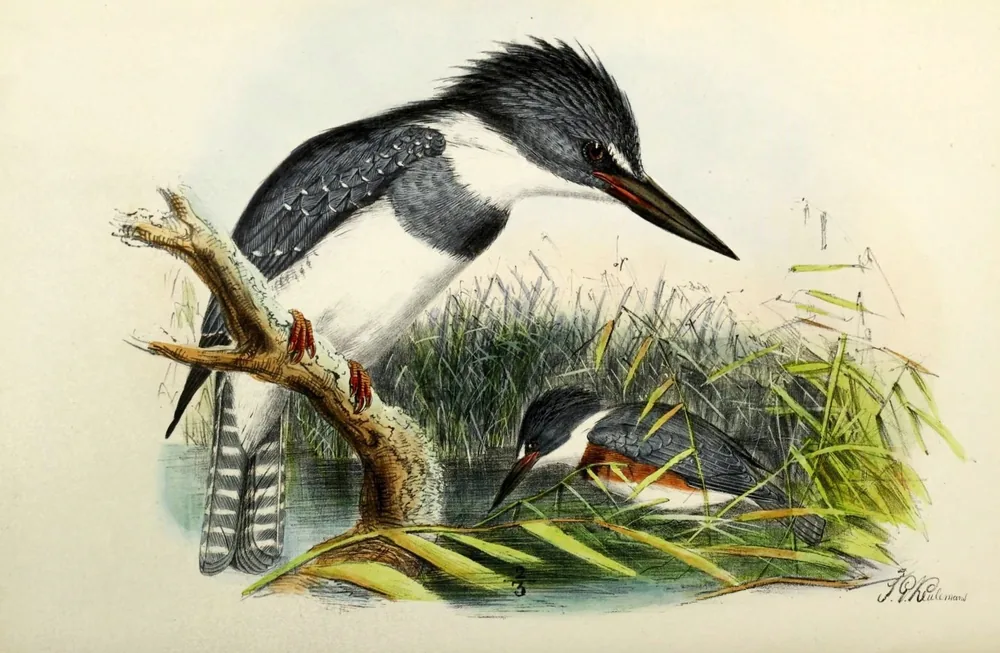
John James Audubon painted the Belted Kingfisher as plate 77 of The Birds of America (1827–38), a male and a female, under the same name. A free high-resolution scan is on Audubon.org. The pair shown here was painted by John Gerrard Keulemans for Richard Bowdler Sharpe's A Monograph of the Alcedinidae (1868–71), on the world's kingfishers.
Updated
The story of this painting
Two Belted Kingfishers were taken in Ireland in 1845, one at Annsbrook and one at Luggela in County Wicklow, and when Richard Bowdler Sharpe wrote his A Monograph of the Alcedinidae (1868–71), on the kingfishers of the world, they were still the only ones known from Europe. He was not surprised. He quoted Audubon on the bird's long, high flights and guessed that the first, shot on October 26, had been blown across the Atlantic while migrating.
Its loud call, he wrote, had been well likened to the sound of a watchman's rattle. Edward Newton, sailing home in October 1858, saw one far out in the Atlantic circle his steamer several times, its dark breast band plain to see. On St. Croix it fished the mangrove swamps and sometimes half a mile out at sea, and one there had crab shells in its stomach.
In the plate, number 23, the male sits on a branch and the female, with her extra rust-colored band, perches among the reeds. John Gerrard Keulemans signed it.
Story: Sharpe, A Monograph of the Alcedinidae (1868–71), plate 23; pp. 79–82.
Audubon’s Belted Kingfisher: plate 77, “Belted Kingfisher”
Had he been one for renaming birds, Audubon wrote, he would have called this one “the United States’ Kingsfisher,” since it was the only kingfisher on the inland streams; and the belt, he pointed out, belonged only to the female. He let the old name stand.
Male and female dig the nest tunnel together, clinging to the bank like woodpeckers: one digs with bill and feet while the other seems to cheer it on, until the tunnel runs four to six feet and ends in a rounded room shaped like an oven. At the Chickasaw Bluffs on the Mississippi he saw holes more than fifty feet below the top of the bank. Come too near, and the mother may flounder on the water as if wounded while the male rattles angrily from a bough.
Twice he tried to trap one in its burrow at night. The first time it scratched its way out under his net; the next night it worked past a stick he had wedged a foot into the entrance, and he gave up, though the bird went on roosting in the same hole.
Story: Audubon, Ornithological Biography, vol. 1 (1831), pp. 394–397. See plate 77 free at Audubon.org.
More classic portraits, free to see
- John James Audubon, The Birds of America, octavo edition (1840–44), plate 255: “Belted Kingfisher”. Free scan (New York Public Library Digital Collections)
- Louis Agassiz Fuertes, for Elon H. Eaton’s Birds of New York (1910–14), plate 58: “Belted Kingfisher”, with Black-billed Cuckoo and Yellow-billed Cuckoo. Free scan (Internet Archive)
About the Belted Kingfisher
- Belted Kingfishers dive headfirst for their prey, and later cough up the parts they can't digest as pellets. (Source: National Audubon Society)
How long does a Belted Kingfisher live?
The Chesapeake Bay Program's field guide gives the Belted Kingfisher's lifespan as unknown, and no other source we checked offers a typical figure. Skunks, minks, raccoons and black rat snakes kill some young in the nest, and after fledging the young are vulnerable to hawks, notes Pennsylvania's Game Commission. The oldest known wild Belted Kingfisher was at least 5 years and 3 months old (USGS Bird Banding Laboratory): it was banded in Maryland in 2003 and found there again in 2006.
Sources: Chesapeake Bay Program; Pennsylvania Game Commission; USGS Bird Banding Laboratory. A banding record is the minimum age of one bird when it was found again, not a typical lifespan. How long do wild birds live?
How can you tell if a plate 77 print is an original?
By its size: an original plate 77 is a hand-colored sheet about 26 by 38 inches; the Belted Kingfisher’s octavo version, plate 255, is book-size, from 1840–44. Many prints sold today are reproductions: how to tell an original from a reproduction. For all 435 plates at a fraction of an original’s price, see which edition of The Birds of America to buy.
In a Birdfolio hardcover, this painting sits beside the date and place you first saw a Belted Kingfisher. See your own list as a book, free.