1973 lump
Yellow-shafted Flicker: now part of the Northern Flicker
The Yellow-shafted Flicker is the eastern, yellow-winged form of the Northern Flicker. The American Ornithologists' Union, the forerunner of today's American Ornithological Society (AOS), merged it with the western Red-shafted Flicker in April 1973 under the name Common Flicker, and in July 1982 the merged bird became the Northern Flicker. Birders still use both old names for the two forms.
Updated
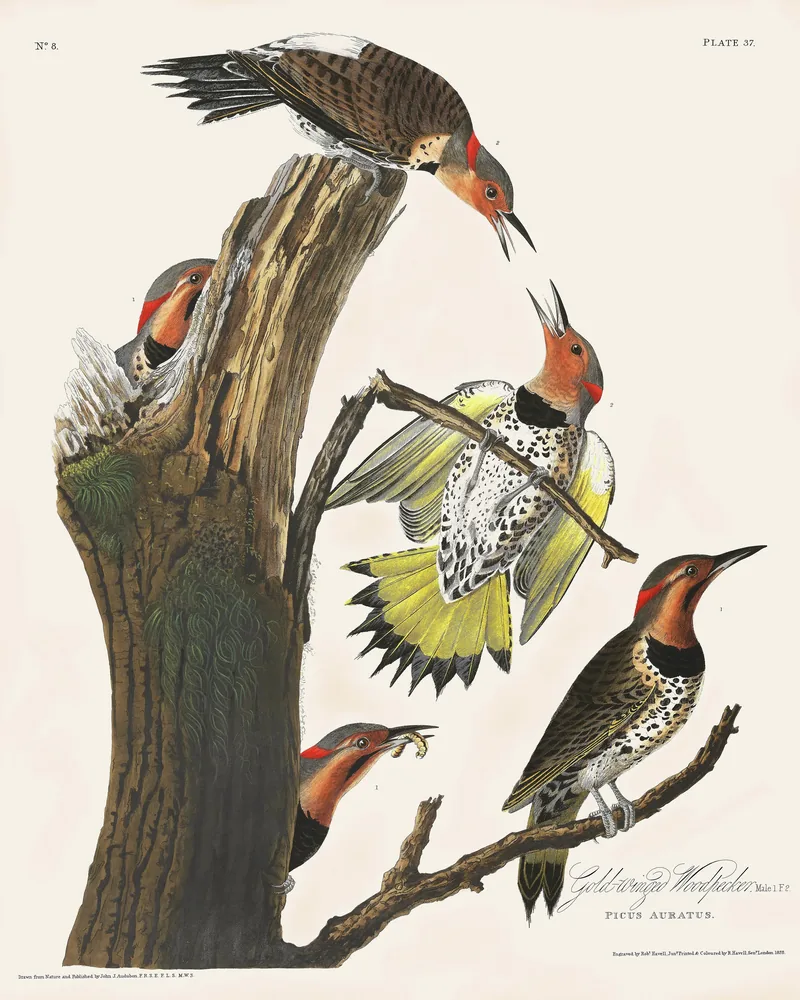
What changed
The Yellow-shafted form nests from Alaska and Canada east of the Rockies south to Texas, the Gulf coast and Florida; the Red-shafted form from southeastern Alaska and British Columbia south through the West to Mexico. On the western Great Plains, where they meet, many flickers are a mix of the two.
What is a Yellow-shafted Flicker called now?
A Northern Flicker. The Yellow-shafted Flicker is the eastern and northern form of that species, Colaptes auratus, and birders still use the old name for it.
It was a species of its own on the AOU's check-lists until 1973. The first edition, in 1886, called it simply the Flicker, number 412, and the 1957 edition the Yellow-shafted Flicker. Its scientific name goes back to Linnaeus in 1758, based on Catesby's “Golden-winged Wood-pecker” of Carolina, the check-lists record.
Surprising facts about the Yellow-shafted Flicker
Northern Flicker once meant only some of them. In the 1931 check-list the name belonged to one race of the yellow-shafted bird, the northern one, luteus, while the birds of the Southeast were the Southern Flicker. Since 1982 it has been the name of the whole species.
A canary gene paints the wings. The yellow or red under a flicker's wings and tail goes with a gene called CYP2J19, a 2021 study of flicker genomes found. It is the same gene that turns a yellow canary into a red one in the cage birds known as “red factor” canaries. Across about 7.25 million genetic markers, the two forms were fixed for different versions at only 780.
Their meeting zone has moved 45 miles west. Researchers compared flickers from the Great Plains collected in 1955 to 1957 with birds from 2016 to 2018. The center of the mixed zone had shifted about 73 kilometers, some 45 miles, westward, perhaps as trees spread on the plains or as the climate changed, a 2022 digest in the journal Evolution explains.
It has been seen catching bats. Flickers have been reported snatching young bats as they left their roost in Wyoming, says Audubon's field guide, though ants are their everyday food.
Why it changed
Because the two interbreed wherever they meet. The 32nd Supplement treats the Red-shafted and Gilded Flickers as the same species as the Yellow-shafted, Colaptes auratus, and names the enlarged bird the Common Flicker, keeping “Yellow-shafted Flicker,” “Red-shafted Flicker” and “Gilded Flicker” for its groups. Like the rest of that supplement, it was a case the committee saw as almost beyond argument.
The mixing was no secret. The 1931 check-list already noted that the Red-shafted Flicker “interbreeds extensively” with the Yellow-shafted on the western Great Plains, and the 1957 edition said the same. Today Audubon's field guide describes a broad zone there where all the flickers are intergrades, and the two forms also interbreed freely in southwestern Canada.
The name changed again nine years later. In July 1982 a supplement printed with The Auk gave the AOU's new English names ahead of its sixth edition, and the Common Flicker became the Northern Flicker. The 1983 check-list keeps Common Flicker only as an “also known as.”
The same 1973 supplement merged the Myrtle and Audubon's Warblers, folded four juncos into the Dark-eyed Junco and renamed the Upland Plover the Upland Sandpiper.
Who decided, and when
- American Ornithological Society (AOS): the 32nd Supplement to its Check-list, printed in its journal The Auk when the society was still the American Ornithologists' Union (AOU), which named the merged bird the Common Flicker
- American Ornithological Society (AOS): the 34th Supplement, a list printed with the July 1982 Auk in the names of its coming sixth edition, renamed the Common Flicker the Northern Flicker
- American Ornithological Society (AOS): the 40th Supplement made the Gilded Flicker, merged in 1973, a species of its own again
Are Yellow-shafted and Red-shafted Flickers the same species?
Yes: both are the Northern Flicker, and have been since April 1973. They interbreed wherever their ranges come into contact, producing many birds in between, says Audubon's field guide.
Their genes agree. Until 2018, researchers had never found a genetic difference between them. That year a study using thousands of regions of the genome told the two apart for the first time, and found them “incredibly similar,” the AOS's publications office reported. Even when two birds look very different, the lead author said, they may not be very different genetically.
The few real differences sit in a handful of places in the genome, linked to genes for feather color, the 2021 study found.
What is the difference between a Yellow-shafted and a Red-shafted Flicker?
Color under the wings and tail, and on the head. The Yellow-shafted has bright yellow underwings and tail, a red crescent on the back of the head, a tan face and a gray crown. The Red-shafted has salmon-pink underwings and tail, a gray face and a brown crown, says Audubon's field guide.
The males differ most: a Yellow-shafted male has a black mustache stripe, a Red-shafted male a red one. Both forms share the brown back with narrow black bars, the black patch on the chest and the spotted belly.
Where they meet, many birds are intermediates, with some marks of each.
Where do Yellow-shafted Flickers live?
East of the Rocky Mountains and across the North. Yellow-shafted Flickers nest from central Alaska and the Yukon across Canada to Labrador and Newfoundland, and south through the eastern United States to Texas, the Gulf coast and southern Florida, the 1983 check-list records.
In winter they leave the far north, and a few reach the Pacific states. Red-shafted Flickers take their place in the West, from southeastern Alaska to Mexico.
They need open ground near trees. Look in woodlots, groves, towns and semi-open country, says Audubon's field guide: flickers tend to avoid dense, unbroken forest.
Do Yellow-shafted Flickers migrate?
The northern ones do, strongly. Yellow-shafted Flickers from Alaska and Canada travel east and then south, and big flights move down the Atlantic Coast in fall, by day, says Audubon's field guide.
Red-shafted Flickers usually go shorter distances, from the mountains into the lowlands, and some spread east onto the Great Plains in winter. The yellow-shafted birds of the Southeast stay mostly where they are, the 1957 check-list notes.
Is a Yellow-shafted Flicker a woodpecker?
Yes, a brown woodpecker that spends much of its time on the ground. Alabama knows it as the yellowhammer, its state bird: the yellowhammer's story.
It nests in a hole it digs itself, usually in dead wood 6 to 20 feet up, and pine, cottonwood and willow are among its favorite trees, says Audubon's field guide. Both parents dig, and both sit on the five to eight white eggs.
All the woodpeckers of the US and Canada are in our guide to the types of woodpeckers.
Why do flickers feed on the ground?
For ants. The Northern Flicker probably eats ants more often than any other North American bird, Audubon's field guide says, and it hops on the ground to find them, along with beetles, termites and caterpillars.
In fall and winter it turns to fruit and berries, and at times to seeds and nuts.
Why is it called a flicker?
The name echoes its call, which Audubon's field guide gives as a loud, repeated flicker or wicka-wicka-wicka.
What Audubon wrote about its call and its other old names is with his plate 37 of the bird.
“Yellow-shafted” and “Red-shafted” come from the color of the wing and tail feathers, the part of the bird that flashes bright as it flies off.
Is the Gilded Flicker a Northern Flicker?
Not anymore. The 1973 supplement merged the Gilded Flicker into the Common Flicker along with the Red-shafted, but the AOU split it off again in its 40th Supplement, in 1995, New Mexico's bird society reported.
It looks like a blend of the two forms. It is bright yellow under the wings and tail, like a Yellow-shafted, but has no red on the back of the head, and the male has a red mustache, like a Red-shafted. It lives in the Sonoran Desert and nests in holes in giant saguaro cactus, says Audubon's field guide.
In a few places at middle elevations in Arizona, such as Sonoita Creek, Gilded and Red-shafted Flickers interbreed freely. California lists the Gilded Flicker as endangered: see woodpeckers in California.
Will the Northern Flicker be split again?
Not in the US and Canada, for now. The AOS check-list and AviList, the shared world list, both keep the Yellow-shafted and Red-shafted Flickers together as one species, Colaptes auratus.
Farther south the answer changed. In 2017 the AOS turned down a proposal to make the Guatemalan Flicker of Central America a species, but its online check-list now lists it as one, Colaptes mexicanoides, “formerly considered conspecific” with the Northern Flicker, and AviList counts it as a species too.
For a US or Canadian list, that changes nothing.
Which bird is it now?
Nothing to choose: a Yellow-shafted Flicker and a Red-shafted Flicker on an old list are both the Northern Flicker today, and so is a Common Flicker from the years 1973 to 1982.
To know which form you saw, look under the wings and tail: yellow on a Yellow-shafted, salmon-pink on a Red-shafted. A black mustache marks a Yellow-shafted male, a red one a Red-shafted male.
Place helps. East of the Rockies most flickers are Yellow-shafted, in the West most are Red-shafted, and on the western Great Plains many are a mix.
One exception: a Gilded Flicker from the desert Southwest has been its own species again since 1995.
What it does to your list
Two old names, one bird today. If your list counts a Yellow-shafted Flicker and a Red-shafted Flicker as two species, they are one now, and the total drops by one.
With only one of the two on your list, nothing changes but the name. A Gilded Flicker still counts on its own.
In a Birdfolio, a bird entered as Yellow-shafted Flicker or Red-shafted Flicker is filed as Northern Flicker, with a note that your list named the form, and the two together count once. One entered as Common Flicker, the name from 1973 to 1982, is filed as Northern Flicker too.
Why species merge and split: our guide to bird splits and lumps.
Keeping a Yellow-shafted Flicker on your Merlin list? Turn your Merlin birds into a book, where it appears as the Northern Flicker.
Check your own list. Drop your eBird download or type your birds: the free checker shows which of them the changes since 2018 touched.
Check my list