1973 lump
Oregon Junco: now part of the Dark-eyed Junco
The Oregon Junco is the western, black-hooded form of the Dark-eyed Junco. The American Ornithologists' Union, the forerunner of today's American Ornithological Society (AOS), merged it with the Slate-colored and White-winged Juncos in April 1973, and they have been one species ever since. Birders still tell the forms apart, and “Oregon Junco” is still the right name for the western birds.
Updated
What changed
Nests in northern and mountain forests from Alaska and Canada south to the Appalachians of Georgia and, in the West, to California, Arizona and New Mexico; in winter it spreads over most of the US. The Oregon form is the western one.
What is an Oregon Junco called now?
A Dark-eyed Junco. Since April 1973 the Oregon Junco has been one form of that species, Junco hyemalis, and birders still use the old name for the western birds with a dark hood and a brown back.
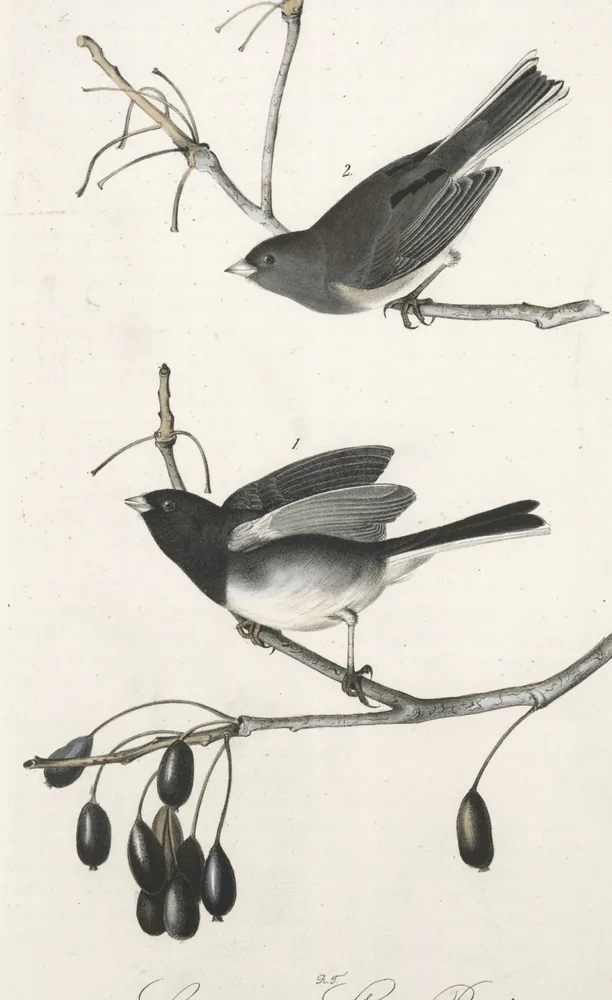
The name goes back to 1837, when J. K. Townsend described the bird as Fringilla oregona from the forests near the Columbia River, at what is now Fort Vancouver, Washington, the 1931 and 1957 check-lists record. Audubon put it into The Birds of America as the Oregon Snow-Finch, his plate 398.
Surprising facts about the Oregon Junco
Juncos on a California campus evolved in under 30 years. In the early 1980s some Oregon Juncos stayed to nest at the University of California, San Diego, instead of flying back up to the mountains. The campus birds nest from February into August and raise up to four broods, against one on nearby Mount Laguna; they have less white in their tails and let people come three times closer. Raised side by side in an aviary, they stayed different, so the changes had evolved, says Indiana University's junco film.
The whole family is brand new. The dark-eyed forms barely differ in their DNA. Their ancestor, a yellow-eyed junco from the mountains of Mexico, spread north as the glaciers melted, perhaps 10,000 to 20,000 years ago, which makes them “one of the most stunning examples of rapid diversification” in the animal kingdom, the same film says.
It is the last bird named for Oregon. A hundred years ago there were Oregon Jays, Chickadees, Titmice and Towhees, the Oregon Encyclopedia notes; only the junco kept the name.
Audubon knew it only secondhand. He painted his Oregon Snow-Finch from specimens Townsend collected on the Columbia River on October 5, 1834, and wrote that all he knew of its habits came from notes Nuttall gave him.
Why it changed
Because the juncos interbreed where they meet. The ruling in the 32nd Supplement is a single sentence: the White-winged, Oregon and Guadalupe Juncos “are considered conspecific with” the Slate-colored, Junco hyemalis, whose scientific name the enlarged species keeps. Like every change in that supplement, it had the committee “unanimous, or almost unanimous” at its meetings in Seattle in 1971.
The bigger species needed a name, and got Dark-eyed Junco. The supplement kept “Slate-colored Junco,” “White-winged Junco,” “Oregon Junco” and “Guadalupe Junco” as names for the groups inside it. In the same breath it merged the Mexican and Baird's Juncos as the Yellow-eyed Junco, so both big junco species were now named for their eyes.
One junco had to wait. The Gray-headed Junco of the Rockies and the Great Basin, Junco caniceps, was “currently under study,” the committee wrote, and stayed a species for the time being. By the sixth edition of the check-list, in 1983, it too was a group of the Dark-eyed Junco.
The lump was not the first change. The AOU's first check-list, in 1886, listed the Oregon Junco as a race of Junco hyemalis, and the 1910 edition made ten juncos, eastern and western, races of that one species. The 1931 edition split them up again, with the Oregon Junco as Junco oreganus, and the 1957 edition kept it a species. The same 1973 supplement merged the Myrtle and Audubon's Warblers and the Yellow-shafted and Red-shafted Flickers, and gave the Upland Plover its new name.
Who decided, and when
- American Ornithological Society (AOS): the 32nd Supplement to its Check-list, printed in its journal The Auk when the society was still the American Ornithologists' Union (AOU)
- American Ornithological Society (AOS): the 55th Supplement made the Guadalupe Junco, merged in 1973, a species again, on its song, build and DNA
- American Ornithological Society (AOS): the 58th Supplement made Baird's Junco a species again and turned down merging the Dark-eyed Junco with the Yellow-eyed Junco
Is the Oregon Junco a separate species?
No, not since April 1973. The Oregon Junco is a form of the Dark-eyed Junco, and the AOS check-list and AviList, the shared world list, both count one species.
What holds them together is that they interbreed. Where two forms meet, they pair up, and their young are fertile; that is “the primary reason” the juncos are one species, Indiana University's junco film explains.
They still look very different. A museum curator in San Diego says of an Oregon and a Gray-headed Junco in the same film: “No one would ever think those are the same species.”
Which juncos were merged into the Dark-eyed Junco?
Five that were species in the 1957 check-list: the Slate-colored, White-winged, Oregon and Guadalupe Juncos in April 1973, and the Gray-headed Junco by 1983.
The AOS still names four groups within the species: the Slate-colored, the gray junco of the East; the Oregon; the White-winged, which nests around the Black Hills of South Dakota; and the Gray-headed, of the mountains from Idaho and Wyoming south to Arizona, New Mexico and western Texas.
One of the five has left again. The Guadalupe Junco, which lives only on Guadalupe Island off Baja California, became a species of its own in July 2014.
What does an Oregon Junco look like?
A sparrow-sized bird, about 6 inches long, with a dark hood, a brown back and rusty sides. Audubon's field guide describes the male with a black or slaty hood and a chestnut back, and the female as paler, with a gray hood. Like every junco, it has a pink bill and white outer tail feathers that flash with each hop.
Young juncos start out brown and streaked like other sparrows; by September, the Oregon Encyclopedia says, they wear the hood.
A female Oregon can look very like a Pink-sided Junco, a Rocky Mountain form with a pale blue-gray hood and pink sides. The Gray-headed has a reddish back too, but gray sides.
Where do Oregon Juncos live?
In the West. Oregon Juncos nest from southeastern Alaska and British Columbia south to central California and the mountains of Baja California, and east to Nevada, Idaho and northwestern Wyoming, the 1983 check-list records.
In winter they spread east to the Dakotas, Kansas, Oklahoma and Texas. Farther east one is a rare find, a casual visitor from Michigan and Maine south to the Gulf coast.
In Oregon it is one of the most common birds, the Oregon Encyclopedia says, and the only sparrow that nests in the deep shade of dense forest.
Do Oregon Juncos migrate?
Most do, but some hardly move. Audubon's field guide says most junco populations migrate, while some in the southwestern mountains and on the southern Pacific coast stay all year, and males tend to winter a little farther north than females.
Many Oregon Juncos simply go downhill. In Oregon they may spend the cold months in the foothill forests and in hedgerows on the valley floor, the Oregon Encyclopedia says, and in southern California the birds that nest on the mountains move to lower ground, the coast included, for the winter.
Why are juncos called snowbirds?
Because they arrive with the cold. Audubon called the eastern junco simply the Snow Bird in 1831, a winter visitor that reached Louisiana around the start of November and left again as spring came.
It was “cherished as the Robin is in Europe,” he wrote, and, less fondly, small strings of them were sold for the table in the New Orleans market. They migrated by night, here one day and gone the next.
How juncos and other small birds get through a hard winter is in our guide to birds in winter.
What does an Oregon Junco sound like?
A trill. Audubon's field guide describes the junco's song as a ringing, metallic trill on one pitch, and its calls as a tsick or tchet, given over and over as a flock spreads out.
Listen closely: the quick notes vary in pitch, the Oregon Encyclopedia says, and a few males sing a song in two parts, two different trills one after the other.
Where do Oregon Juncos nest?
On the ground, almost always. The nest is a cup of grass, weeds and leaves, hidden under overhanging grass, a log, a rock or roots, or in a hollow in a dirt bank, and the female builds most of it, says Audubon's field guide.
Oregon Juncos raise two broods a year from early spring, the Oregon Encyclopedia says: three to five brown-speckled white eggs, hatching after 12 or 13 days, the young leaving 11 or 12 days later.
Will the Oregon Junco be split again?
Not for now. The AOS check-list and AviList both keep one Dark-eyed Junco, with the Oregon Junco as one of its groups.
The family keeps moving, though. The Guadalupe Junco was split off in 2014, and in 2017 the AOS made Baird's Junco, folded into the Yellow-eyed Junco in 1973, a species again, while turning down a merger of the Dark-eyed and Yellow-eyed Juncos.
If the Oregon Junco is ever split, an Oregon and a Slate-colored on one list would count as two species again, so it is worth noting which one you saw.
Which bird is it now?
Nothing to choose: an Oregon, Slate-colored or White-winged Junco on an old list is a Dark-eyed Junco today, and so is a Gray-headed Junco.
To know which form you saw, look at the hood and the back: the Oregon has a black or slaty hood with a brown back and rusty sides; the Slate-colored is solid gray on the head, back and sides, with a white belly.
Place helps. The Slate-colored is the only form usually seen in the East, and the Oregon is widespread in the West, says Audubon's field guide. In parts of the West, one winter flock can hold several forms.
What it does to your list
Several old names, one bird today. If your list counts an Oregon Junco and a Slate-colored Junco as two species, they are one now, and the total drops by one. A White-winged or Gray-headed Junco on the same list folds in too.
With only one of them on your list, nothing changes but the name.
In a Birdfolio, a bird entered as Oregon Junco, Slate-colored Junco, White-winged Junco or Gray-headed Junco is filed as Dark-eyed Junco, with a note that your list named the form, and they count once together. A Guadalupe Junco is the exception: it is a species again, so it keeps its own line.
Why species merge and split: our guide to bird splits and lumps.
An Oregon Junco at the feeder and a Slate-colored one on a trip back east? Print your life list and see them under the one name they share today.
Check your own list. Drop your eBird download or type your birds: the free checker shows which of them the changes since 2018 touched.
Check my list