2026 split
Willet split into Prairie Willet and Saltmarsh Willet
The Willet is now two species. The American Ornithological Society (AOS) split it on October 20, 2026, and AviList, the shared world checklist, did the same that day. Willets that nest inland, on the northern prairies and in the Great Basin, are now the Prairie Willet; those that nest in salt marshes along the Atlantic and Gulf coasts are the Saltmarsh Willet. eBird's yearly update, expected October 27, usually follows the AOS; what eBird changes is certain only once it publishes.
Updated
What changed
Nests inland, from Alberta and Manitoba south to central California, northern Nevada, Utah and Colorado, and western Nebraska. Winters on both coasts of the US and south to Chile.
Nests in coastal salt marshes from the Canadian Maritimes to the Gulf of Mexico and in parts of the Caribbean. Winters mostly on the coasts of South America.
Has the Willet been split?
Yes. The AOS, which keeps the official list of North American birds, split it on October 20, 2026, in the 67th Supplement to its Check-list. AviList, the shared world checklist, made the same split, with the same names, in its 2026 edition, published the same day.
eBird, where most US birders keep their lists, still had one Willet when we checked on October 22, 2026. It updates once a year, and its 2026 update is expected on October 27. It usually follows the AOS, but what it does with the Willet is certain only once it publishes, and we'll update this page that day.
Why Prairie and Saltmarsh, not Western and Eastern?
Because the old names mislead for much of the year. Birders have long called the two Western and Eastern Willet, but many western birds spend the winter on the East Coast, so a “Western” Willet is often standing on an Atlantic beach. The new names reflect where each one nests, the AOS says, and its proposal points out that they also draw attention to two habitats in trouble: prairie wetlands and coastal marsh.
Michael Retter of the American Birding Association (ABA) welcomed them, adding that Eastern and Western are “just boring names that we have enough of already.” The name Willet itself copies the bird's ringing call, often written pill-will-willet, says Audubon's field guide.
Surprising facts about the two willets
The plain gray bird has flashy wings. On the ground a Willet looks plain and gray. When it opens its wings, a bold black-and-white pattern shows, says Audubon's field guide.
They nearly vanished from the Northeast. Hunters took Willets for their meat and eggs in the late 1800s and early 1900s. After the Migratory Bird Treaty Act of 1918 protected them, they came back as nesting birds: to New Jersey in the 1950s, New York in the 1960s, Maine and Connecticut in the 1970s, and New Hampshire and Rhode Island in the 1980s, New York's Department of Environmental Conservation says.
The saltmarsh bird travels farther than you'd think. Nine Saltmarsh Willets from the Texas coast fitted with trackers all spent the winter on the Pacific coast of Central and South America, a 2021 study found, the AOS proposal reports.
Prairie Willets nest beside a landmark. Their nests are often next to a stone, a piece of wood or a dried cow pie, a US Geological Survey report says.
Why it changed
Genes, size and voice. A 2016 study of their DNA found two clear groups and no sign of the two interbreeding, and dated their parting to roughly 700,000 years ago, the AOS proposal says. The prairie bird is bigger, with a longer wing, leg and bill, and its song is lower and slower. In playback tests, Saltmarsh Willets answered recordings of the Prairie Willet's song only weakly, a 1998 study found, as both the AOS and AviList note.
They also pair up apart. Willets form their pairs on the nesting grounds, and the two nest in different places that never overlap: the prairie bird by mostly fresh inland water, the saltmarsh bird in coastal marsh. On migration and in winter they mix.
It took two tries. A first proposal to split the Willet failed at the AOS committee in 2017. The 2026 proposal, by Pamela Rasmussen and four co-authors, is an updated version of it, and the AOS called the new case convincing when it announced the split.
Who decided, and when
- American Ornithological Society (AOS): the 67th Supplement to its Check-list of North American birds, after its committee passed proposal 2026-A-3
- AviList, the shared world checklist: its 2026 edition, v2026, with the same names
- eBird and the Clements Checklist: hadn't split it yet when we checked. Its yearly update is expected on October 27, 2026; eBird usually follows the AOS, but what it changes is certain only once it publishes
How do you tell a Prairie Willet from a Saltmarsh Willet?
Start with the calendar. Saltmarsh Willets leave North America completely for the winter, so a Willet in the US or Canada from November to February can safely be taken for a Prairie Willet, Retter writes. In summer, place decides: inland on the northern prairies or in the Great Basin it's a Prairie Willet; nesting in an Atlantic or Gulf Coast salt marsh, a Saltmarsh Willet.
Then look at shape. The Prairie Willet is bigger, lankier and paler, with longer legs and a slimmer, slightly upturned bill; Retter likens it to a beefy Greater Yellowlegs. The Saltmarsh Willet is smaller and dumpier, darker and browner, with a much thicker bill, and in breeding plumage it is heavily barred on the breast and sides, where the Prairie is more spotted.
Listen, too. The Prairie Willet's song is longer and lower, with a longer middle will; the Saltmarsh's sounds rushed, David Sibley wrote in 2015. And a Willet growing new flight feathers in July or August is a Prairie Willet, the proposal notes: Saltmarsh Willets wait until they reach South America.
Where can you see Prairie and Saltmarsh Willets?
Saltmarsh Willets nest on the coast from the Canadian Maritimes to Tamaulipas, Mexico, and are common nesting birds on the south shore of Long Island, says New York's wildlife agency. Prairie Willets nest from central Alberta and Montana through the Dakotas, and south to central California, northern Nevada, northern Utah and western Nebraska, says the US Geological Survey.
In fall many Prairie Willets head east, and they winter on both coasts of the US. Saltmarsh Willets mostly leave for the coasts of South America, the AOS proposal says, so a Willet on an East Coast beach in winter is a Prairie Willet.
Which one did you see?
Mostly by where and when. In summer, Willets on the northern prairies and in the Great Basin are Prairie Willets; those in Atlantic and Gulf Coast salt marshes are Saltmarsh Willets. From November to February, a Willet in the US or Canada is a Prairie Willet.
On spring and fall migration both can stand on the same beach. Shape and song help then (see above), but some birds can't be named for sure.
What it does to your list
In eBird, nothing has changed yet: it still lists one Willet until its update, expected on October 27, 2026. If eBird follows the AOS, as it usually does, and you have seen both, your eBird total will go up by one: an “armchair lifer.” If you have seen Willets only inland, or only nesting in eastern salt marshes, only the name changes.
Birdfolio books use AviList's June 2026 edition, which still has one Willet, so your book counts one. A Prairie or Saltmarsh Willet typed into your list lands on it, and a notes page in the book explains why.
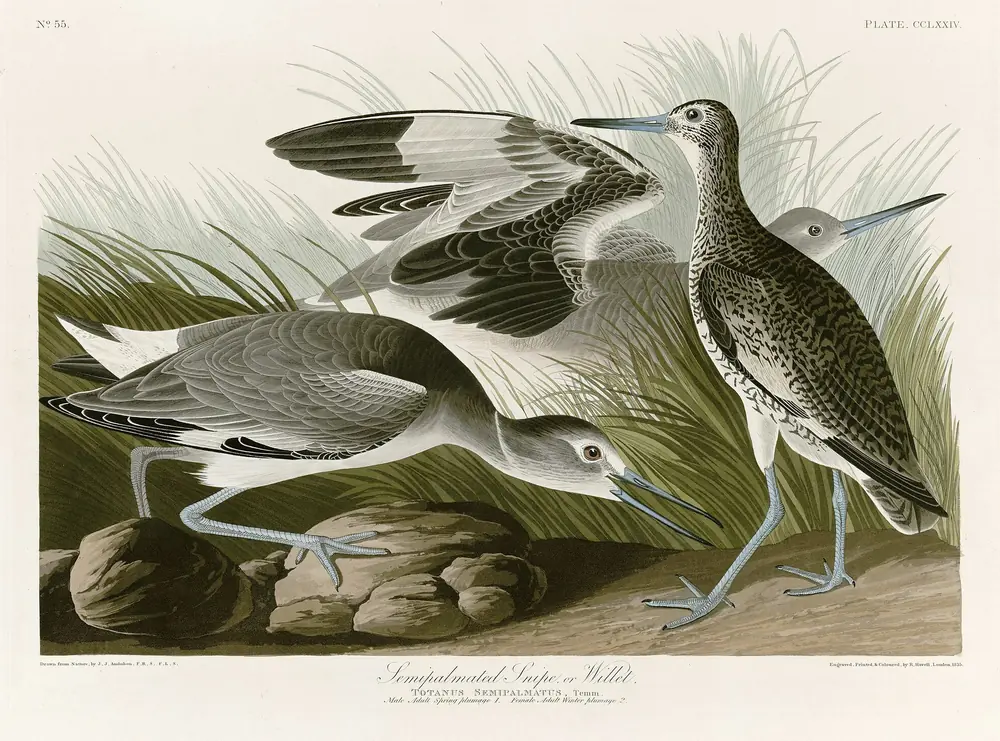
Audubon painted it as plate 274, his “Semipalmated Snipe, or Willet,” a male in spring plumage and a female in winter plumage, the plate's caption says. The AOS split the Marsh Wren and the Tufted Flycatcher the same day.
Seen Willets both on the coast and inland? When your list shows Prairie and Saltmarsh Willet, here's how to print the new list.
Check your own list. Drop your eBird download or type your birds: the free checker shows which of them this and other recent changes touched.
Check my list