1973 new name
Upland Plover: the bird now called the Upland Sandpiper
Upland Plover is the old name of the Upland Sandpiper, a long-necked bird of prairies, meadows and fields. The American Ornithologists' Union, the forerunner of today's American Ornithological Society (AOS), renamed it in April 1973, in the same list that made the Sparrow Hawk the American Kestrel. It is the same bird, so nothing on your list changes but the name.
Updated
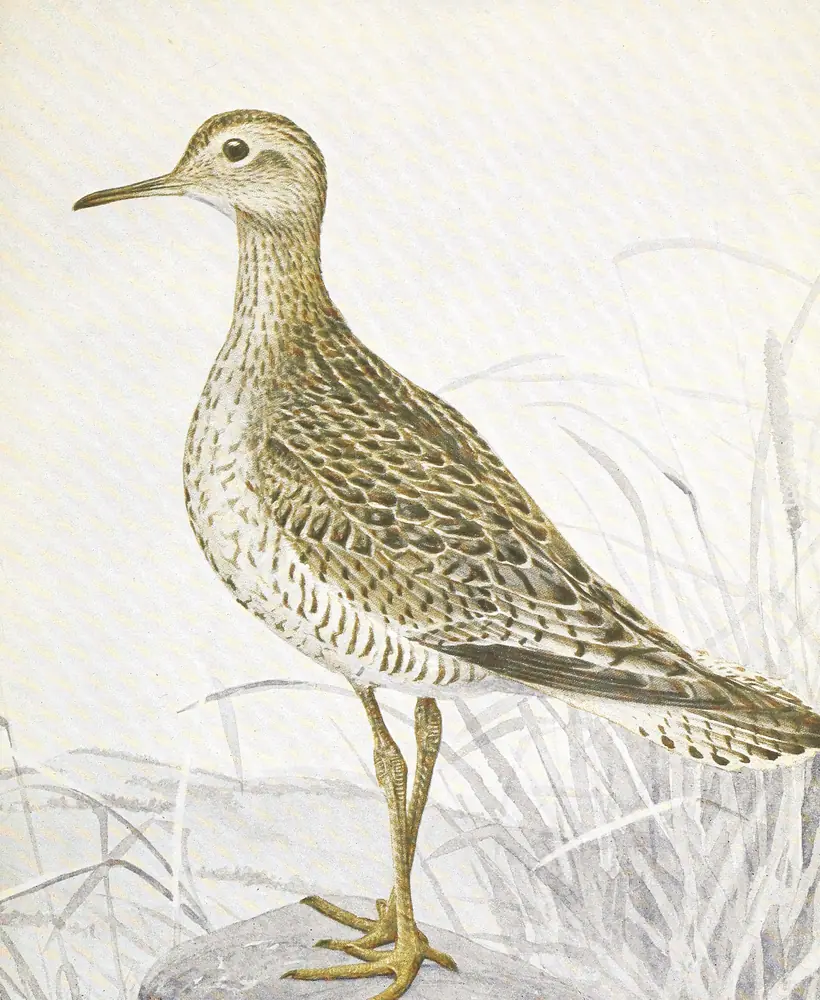
What changed
Grassy prairies, meadows and fields in summer, from Alaska and the northern Great Plains east to New England; in the Northeast it is often found at airports. It leaves North America entirely in winter, for South America.
What is an upland plover called now?
The Upland Sandpiper, Bartramia longicauda: the same bird under the name it has had since April 1973. The union's 1983 check-list says so in a note on the species: it was “formerly known as UPLAND PLOVER.”
It is a sandpiper of dry grassland, 11 to 12 inches long, long-tailed for a sandpiper, with a thin neck, a short bill and a small, dove-like head with a large eye, says Audubon's field guide.
Surprising facts about the Upland Plover
It went from sandpiper to plover and back. The check-lists of 1886 and 1895 called it the Bartramian Sandpiper, those of 1910, 1931 and 1957 the Upland Plover, and since 1973 it has been the Upland Sandpiper.
It carries a naturalist's name. Alexander Wilson called it Bartram's Sandpiper, honoring his friend Bartram, “near whose Botanic Gardens, on the banks of the river Schuylkill, I first found it.” The genus is still Bartramia, and the 1983 check-list notes that Old World books know it as Bartram's Sandpiper.
It nests at JFK. Breeding pairs have been reported at John F. Kennedy International Airport since 1969, says New York's Department of Environmental Conservation. In the Northeast, where wild grassland is scarce, airports are where it is most often found, Audubon's field guide adds.
It lands with its wings held high. It often perches on fence posts with its wings raised after landing, New York's wildlife agency says. Audubon saw the same in 1838: they “seldom settle without raising both wings upright.”
One wild bird reached 13. An Upland Sandpiper banded in Kansas in May 2006 was seen there in June 2019, its band read while it was free: 13 years and 1 month old, the species' age record in the US Geological Survey's banding files.
In New Orleans it was the Papabote. That was its name there, Audubon wrote, where it arrived “in great bands” each spring.
Why the name changed
The bird was never a plover. Audubon's field guide explains the old name: it was called Upland Plover “because of its short bill and round-headed shape,” but “it is a true sandpiper, and apparently a close relative of the curlews.”
The check-lists had filed it with the sandpipers all along. Even the 1957 edition, which called it the Upland Plover, listed it in the sandpiper family, Scolopacidae, beside the curlews and yellowlegs; the 1983 edition, under its new name, placed it in the curlews' own tribe.
The new name came in a long list. The 32nd Supplement to the union's Check-list, printed in The Auk in April 1973, renamed and merged dozens of birds, and The Chat, the Carolina Bird Club's journal, gave its readers the change in one line: “Upland Plover becomes Upland Sandpiper.”
It was a return more than a new idea. The union's first check-list, in 1886, called the bird the Bartramian Sandpiper; by the 1910 edition it had become the Upland Plover, a name Audubon reported from Massachusetts in 1838.
Who decided, and when
- American Ornithological Society (AOS): the 32nd Supplement to its Check-list, printed in its journal The Auk when the society was still the American Ornithologists' Union (AOU)
When did the upland plover become the upland sandpiper?
In April 1973, in the 32nd Supplement to the American Ornithologists' Union's Check-list of North American Birds, printed in The Auk. The Chat took up the new names from its June 1973 issue, with a list of them that included “Upland Plover becomes Upland Sandpiper.”
The same supplement made the Sparrow Hawk the American Kestrel, the Pigeon Hawk the Merlin, the Common Egret the Great Egret, the Wood Ibis the Wood Stork and the Catbird the Gray Catbird, and it merged the Myrtle Warbler into the Yellow-rumped Warbler.
Is the upland plover a plover?
No. It is a true sandpiper, and apparently a close relative of the curlews, says Audubon's field guide; it got the name plover from its short bill and round head.
Even Audubon, who called it the Bartramian Sandpiper, found it unlike the rest of the shorebirds: in 1838 he called it “the most truly terrestrial of its tribe” he knew, more inclined to keep away from water than even the Killdeer, which is a plover.
Why is it called an upland sandpiper?
For where it lives: dry, open uplands rather than the water's edge. New York's wildlife agency says it is referred to as “the shorebird of the prairies” and spends little time near water; Audubon's field guide says it is almost never on mudflats or other typical shorebird places.
The name is old. In Massachusetts and to the east of it, Audubon wrote in 1838, the bird was best known as the Upland Plover, and in some other places as the Field Plover. In spring and fall he found it on “the dry upland plains” of parts of Louisiana.
What does an upland sandpiper sound like?
A long, mournful, rolling whistle, given on the nesting grounds and at night in migration, says Audubon's field guide; New York's wildlife agency says it is commonly called a wolf whistle. The alarm call is a mellow quip-ip-ip-ip.
The guide calls the whistle one of the characteristic sounds of spring on the northern Great Plains. The bird sings from fence posts or poles, but often in flight, high up, with shallow, fluttering wingbeats.
How big is an upland sandpiper?
Between a robin and a crow in size: 11 to 12 inches long, with a wingspan of 19 to 21 inches and a weight of 6.7 to 8.8 ounces, says Audubon's field guide. New York's wildlife agency gives 11 to 13 inches.
Wilson measured his first birds at twelve inches long and twenty-one across the wings, and found them “remarkable plump birds,” upwards of three quarters of a pound. The tail is long for a sandpiper and reaches past the wingtips when the bird stands.
What do upland sandpipers eat?
Insects above all, many of them grasshoppers and crickets, with beetles and their larvae, caterpillars, spiders, centipedes, earthworms and snails, and some seeds and waste grain, says Audubon's field guide. It walks through the grass with abrupt, jerky movements, picking food from the ground or the plants.
Audubon noticed it ate what each place offered: beetles in Louisiana, grasshoppers in Massachusetts, crickets and crabgrass seed in the Carolinas, and strawberries in the barrens of Kentucky.
Where can you see an upland sandpiper?
On the northern Great Plains in spring and summer, in native grassland with tall grass and broad-leaved weeds; it migrates mostly through the Great Plains, says Audubon's field guide. In migration it also stops in open pastures and on lawns.
In the East it is now very local. In New York it nests mainly in the grasslands of the St. Lawrence Valley in Jefferson County and the Mohawk Valley, and around airports, the state's wildlife agency says.
Is the upland sandpiper endangered?
Not nationally: it is not on the federal list, and the IUCN rates it Least Concern, as Audubon's field guide shows. But New York lists it as threatened, and in much of the East and Northeast it is now very local, the guide says.
Its story runs in two directions. Numbers probably rose as eastern forest became farmland in the early 1800s; then market hunters shot great numbers in the late 1800s, and the population dropped sharply. The 1931 check-list called it “rapidly becoming rare.” Since then it has recovered in a few areas, while in the Northeast the loss of grassland has cut its numbers, New York's wildlife agency says.
Where does the upland sandpiper nest?
On the ground, hidden in dense grass, often with the grass arched over it: a shallow scrape lined with dry grass, says Audubon's field guide. Pairs may nest in loose colonies, all laying and hatching at almost the same time.
The 4 eggs are pale buff, lightly spotted with reddish brown, and both parents sit on them for about three to four weeks. The chicks leave the nest within a day of hatching and feed themselves, and they can fly at about 30 days, say New York's wildlife agency and the guide.
Where do upland sandpipers go in winter?
To South America. The 1983 check-list gives its winter range as northern Brazil and Surinam south to central Argentina and Uruguay, and the 1910 edition put it on “the pampas of South America.” It leaves North America entirely, says Audubon's field guide.
It leaves early: New York's birds are gone by mid-September, the state's wildlife agency says, and it travels by night as well as by day, Audubon noted in 1838.
Which bird is it?
Nothing to sort out: an Upland Plover in an old book and an Upland Sandpiper in a new one are the same bird.
Look for the shape: a thin neck, a small head with a big dark eye, a short bill, long yellow legs and a long tail, often standing on a fence post.
Listen for the whistle: the long, rolling wolf whistle over grassland in spring.
Bartram's Sandpiper, in older and European books, is the same bird too.
What it does to your list
Only the name is different: an Upland Plover on your list is an Upland Sandpiper, and your total stays as it was.
In a Birdfolio, a bird entered as Upland Plover, Bartramian Sandpiper or Bartram's Sandpiper is filed as Upland Sandpiper, with a note that your list used a former name.
How names change, and why: our guide to bird splits and lumps.
Kept a list since before 1973, with an Upland Plover on it? Print your life list with every bird under its present name.
Check your own list. Drop your eBird download or type your birds: the free checker shows which of them the changes since 2018 touched.
Check my list