1973 lump
Myrtle Warbler: now part of the Yellow-rumped Warbler
The Myrtle Warbler is the eastern, white-throated form of the Yellow-rumped Warbler. The American Ornithologists' Union, the forerunner of today's American Ornithological Society (AOS), merged it with the western Audubon's Warbler in April 1973, and the two have been one species ever since. Birders still tell them apart, and the old name lives on for the eastern form.
Updated
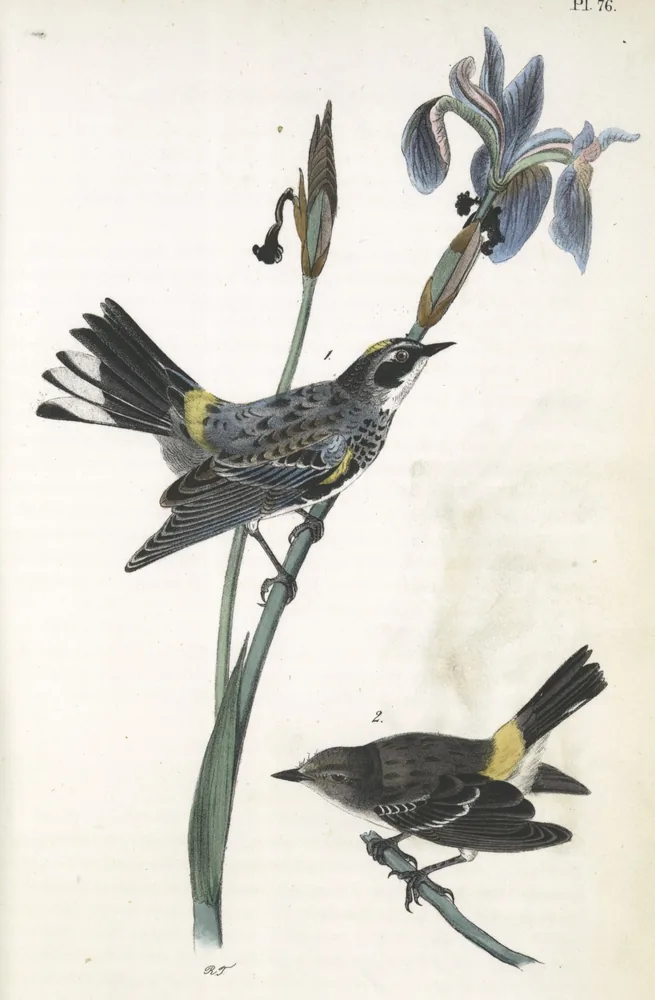
What changed
Myrtle Warblers nest in the northern forests from Alaska across Canada to Newfoundland, south into the Great Lakes states, New England and the Appalachians, and winter from the Pacific states and the central and eastern US south to Panama and the West Indies. Audubon's Warblers nest in the mountains of the West.
What is a Myrtle Warbler?
The white-throated, mostly eastern form of the Yellow-rumped Warbler, a small, active songbird 5 to 6 inches long. From 1886 until 1973 it was a species of its own on the AOU's check-list, number 655, with the western Audubon's Warbler beside it as number 656.
Birders went on using the name after the merger. Field guides kept showing both forms, and Christmas Bird Counts still let counters record them apart, Kenn Kaufman wrote. Tennessee's wildlife agency lists myrtle warbler among the bird's “obsolete English names.”
Surprising facts about the Myrtle Warbler
It eats wax. Yellow-rumped Warblers carry high levels of bile salts that dissolve the waxy coat of berries such as wax myrtle and bayberry, says the Smithsonian's National Zoo, and that lets them winter farther north than most warblers. Audubon found in 1834 that its winter food was mostly berries, “especially those of the Myrtle and Poke-weed.”
Audubon called it the Yellow-rump. His 1834 chapter is headed “The Yellow-rump Warbler,” 139 years before the AOU settled on Yellow-rumped Warbler, and his plate 153 names it the Yellow-crown Warbler. Among its other names he listed the “Myrtle Bird,” from Nuttall's Manual.
1973 cost birders several species at once. The same supplement merged three flickers into the Common Flicker, the Baltimore and Bullock's Orioles into the Northern Oriole and four juncos into one. “I still remember how bummed we all were when we lost the Myrtle Warbler,” he wrote.
Its scientific name means “crowned moth-eater,” says the Smithsonian's National Zoo. The first half is newer than the lump: the AOU moved the Dendroica warblers into Setophaga in 2011.
Why it changed
Because the two forms interbred where they met. John Hubbard studied them closely and published his results in 1969: their ranges touched in a narrow zone in western Canada, and there the two seemed to pair up at random, Kenn Kaufman recalled in Audubon magazine in 2016. “By the standards accepted at the time, they had to be the same species.”
The committee's ruling is short: Audubon's Warbler “is considered conspecific with” the Myrtle, and the merged species keeps the Myrtle's older scientific name, coronata, with a pointer to Hubbard's paper. Like every change in that supplement, it had the committee “unanimous, or almost unanimous” at its meetings in Seattle in 1971. The same supplement gave the Upland Plover its new name, Upland Sandpiper.
A new name had to fit both birds. The 1983 check-list explained the choice: Yellow-rumped Warbler “is equally descriptive of all populations of both forms,” and most books were already using it. It was hardly new, either. Alexander Wilson and Audubon had both called the bird the Yellow-rump Warbler in the early 1800s.
Who decided, and when
- American Ornithological Society (AOS): the 32nd Supplement to its Check-list, printed in its journal The Auk when the society was still the American Ornithologists' Union (AOU)
- American Ornithological Society (AOS): the 52nd Supplement moved the Dendroica warblers into the genus Setophaga, so the species became Setophaga coronata, and turned down splitting it into two, three or four species
Are the Myrtle Warbler and the Yellow-rumped Warbler the same?
Every Myrtle Warbler is a Yellow-rumped Warbler, but not every Yellow-rump is a Myrtle. Since April 1973 the species has also taken in Audubon's Warbler of the West, and the 1973 supplement kept “Myrtle Warbler” and “Audubon's Warbler” as names for its two groups, so both are still correct for the forms.
The two meet and blend in a belt from southeastern Alaska across central British Columbia to southern Alberta, the 1983 check-list says. AviList, the shared world list, also counts one species, with five subspecies: coronata and hooveri on the Myrtle side, auduboni, nigrifrons and goldmani on the Audubon's side.
Myrtle vs Audubon's Warbler: what is the difference?
Look at the throat first: white on a Myrtle, yellow on an Audubon's. Spring males differ most. Both wear a yellow cap, a yellow rump and yellow patches at the sides on slate-gray feathers, but the Audubon's has more white on the wings, while the male Myrtle has a white throat and a sharp black mask, says Audubon magazine.
The Myrtle's white throat curls up behind a dark cheek patch, and the Audubon's face is plainer, Audubon's field guide adds. Females, in brown, are harder; on a Myrtle, look for the white line over the eye and heavy streaking. The calls differ too: a member of the AOS committee wrote in 2017 that the two can be told apart by call note “as far away as I can see them.”
What does a female Myrtle Warbler look like?
Duller than the male, with the same yellow rump. In fall and winter, males and females alike are mostly brown, with two white wing bars and a yellow patch at each side of the breast, says Tennessee's wildlife agency, and young females are the dullest of all, Audubon's field guide notes.
In spring she takes on the male's dark-streaked gray, only softer, and her white throat and white eyeline still mark her as a Myrtle.
Do Myrtle Warblers migrate?
Yes, but not as far as most warblers. Yellow-rumps winter mostly in the southern United States, Mexico and the Caribbean, and in the East hardy flocks stay along the coast as far north as New York and Connecticut, says Audubon magazine. Myrtles also winter commonly near the Pacific coast, according to Audubon's field guide.
They travel early and late, heading north earlier in spring and south later in fall than other warblers. In Tennessee they generally arrive in late September and leave by mid-May, says the state's wildlife agency; it is the only warbler that regularly winters there.
Why do birders call it a butter-butt?
For the yellow patch on its rump. That patch “has led birdwatchers to give it the affectionate name ‘butter-butt,’” says Tennessee's wildlife agency. The Smithsonian's National Zoo uses the nickname too, and Audubon magazine counts it among the more memorable nicknames in the bird world.
Both sexes keep the yellow rump all year, and it shows best as the bird flies away, so the nickname fits in every season.
What does a Myrtle Warbler sound like?
Most of the year you hear only its call, a sharp check. Audubon's field guide spells it chek! and calls the song “a colorless buzzy warble.” Tennessee's wildlife agency describes a loose trill in two parts, the second a little lower, and says the song is unlikely before late winter.
Audubon noticed the call in 1834: in winter the bird gave a single tweet at every move, so unlike any other warbler's that one could pick the species out of a dozen by it.
Will the Myrtle Warbler be split again?
Not yet. The AOS checklist still lists one species, the Yellow-rumped Warbler, Setophaga coronata. Its committee turned down a split in 2011, when it was asked for two, three or four species, and again in 2017.
The case for a split is in the genes. A 2016 study led by David Toews found the two forms very distinct genetically away from where they meet, and Kaufman predicted a split that year. In 2017 the committee was divided; one member who voted no wrote, “Maintain as one species, for now,” because the two still pair freely where they meet.
If the split comes, a Myrtle and an Audubon's on one list would count as two species again, so note which one you saw.
Which bird is it now?
Nothing to choose: a Myrtle Warbler and an Audubon's Warbler on an old list are both the Yellow-rumped Warbler today.
To know which form you saw, check the throat: white on a Myrtle, yellow on an Audubon's.
Place helps a little. Myrtles are mostly eastern but also winter near the Pacific coast, while an Audubon's is a very rare stray in the East, says Audubon's field guide.
What it does to your list
Two old names, one bird today. If your list counts a Myrtle Warbler and an Audubon's Warbler as two species, they are one now, and the total drops by one.
With only one of the two on your list, nothing changes but the name.
In a Birdfolio, a bird entered as Myrtle Warbler or Audubon's Warbler is filed as Yellow-rumped Warbler, with a note that your list named the form, and the two together count once.
Why species merge and split: our guide to bird splits and lumps.
Got a Myrtle Warbler in an old notebook? Make it a book, every bird under today's name, and leaf through the first pages free.
Check your own list. Drop your eBird download or type your birds: the free checker shows which of them the changes since 2018 touched.
Check my list