2017 split
Magnificent Hummingbird: now Rivoli's Hummingbird again
The Magnificent Hummingbird of the US and Mexico is Rivoli's Hummingbird again: in July 2017 the American Ornithological Society (AOS), as the American Ornithologists' Union had become, split off the Talamanca Hummingbird of Costa Rica and Panama and gave the northern bird back the name it carried until 1983. If you saw yours in Arizona, New Mexico or west Texas, it is the same bird under its older name.
Updated
What changed
Mountain forests from southeastern Arizona, southwestern New Mexico and west Texas south through Mexico and Guatemala to northern Nicaragua. In the US it is mostly a summer bird, at 5,000 to 9,000 feet; a few winter at Arizona feeders.
Mountain forests from central Costa Rica to western Panama, all year, at about 5,200 to 9,800 feet. It does not reach the US.
What is a Magnificent Hummingbird called now?
Rivoli's Hummingbird, Eugenes fulgens, in the US, Mexico and northern Central America; the birds of Costa Rica and Panama are now the Talamanca Hummingbird, Eugenes spectabilis. The AOS's online checklist lists both that way today.
Not every birder took to the change. The Tucson Bird Alliance says it “was not the most popular move,” and that many people still call the bird a “Mag.”
Surprising facts about the Magnificent Hummingbird
It is named for a duke, and Anna's Hummingbird for his wife. René Lesson named this bird for François Victor Masséna, Duke of Rivoli, as John Gould and the Tucson Bird Alliance record, and named Anna's Hummingbird for the duchess, Anna Masséna, says a museum in Sherbrooke, Quebec.
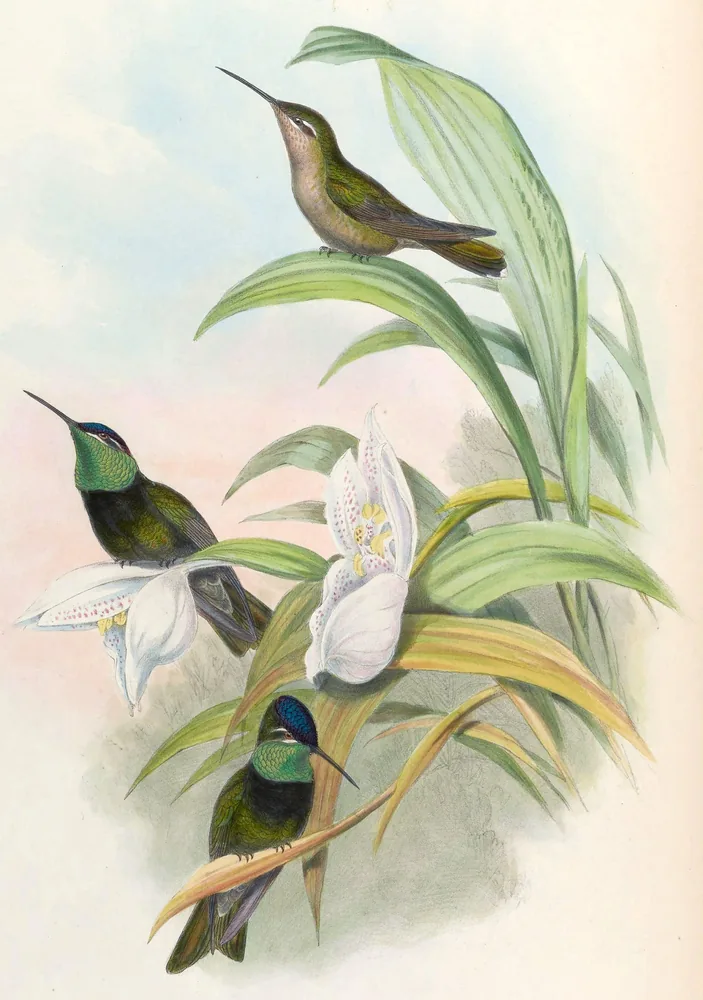
Gould knew nothing of its life. In his monograph of the hummingbirds, John Gould regretted that “nothing has yet been recorded” of its habits; he knew it only from Mexico and Guatemala. He named its genus, Eugenes, in the same work in 1856.
You can almost see its wings. In hovering flight its wingbeats are almost slow enough for the human eye to follow, says Audubon's field guide.
One lived at least 11 years. A male banded in Arizona in June 1998 was caught and released there again in June 2008, the US Geological Survey's banding records show.
Why it changed
Because the two halves look too different to be one bird, and no one had ever said why they were joined. The 58th Supplement split them for differences in plumage like those between other pairs of closely related hummingbirds, and noted “a lack of explicit rationale” from Peters, who had merged them in 1945.
Before Peters they were two. Ridgway in 1911 and Cory in 1918 counted Rivoli's Hummingbird and the Admirable Hummingbird of Costa Rica and Panama as separate species, recalls the proposal that led to the split. Van Remsen, who wrote it, said Peters' lump “was never justified.”
Side by side the difference is plain. In the proposal's specimen photos the northern birds' underparts are blackish and the Talamanca birds' greenish, and the two differ in the color of the throat and the depth of the fork in the tail. A committee member who knew the Costa Rican bird wrote that it was “unrecognizable as Magnificent” to anyone used to the northern one.
The genes agree. A molecular study by Luz Zamudio-Beltrán and Blanca Hernández-Baños confirmed that the Costa Rica and Panama birds are a separate species, Zamudio wrote on the AOS's blog in 2020.
Not every proposed split passed. The same proposal asked whether the birds south of Mexico's Isthmus of Tehuantepec should be a species too, and the committee said no, though a 2020 study later found three distinct lineages within Rivoli's.
Who decided, and when
- American Ornithological Society (AOS): the 58th Supplement to its Check-list, published July 5, 2017, the first under the society's new name, the American Ornithological Society
Why was the Magnificent Hummingbird renamed?
Because it was split: when the AOS set the Talamanca Hummingbird apart in 2017, the name Magnificent, which had covered both, was retired, and the northern bird took back Rivoli's Hummingbird.
That name was the older one. The first check-list, in 1886, called it the Rivoli Hummingbird, and the 1957 edition Rivoli's Hummingbird. The 1983 edition switched to Magnificent Hummingbird, adding that it was “also known as Rivoli's Hummingbird,” but gave no reason. Rivoli's “would be the obvious choice,” the 2016 proposal said.
Who was Rivoli?
François Victor Masséna, the second Duke of Rivoli, an amateur ornithologist, in whose honor the bird was named in 1829, says the Tucson Bird Alliance. Gould calls him “Prince of Essling and Duke of Rivoli.”
The duke's name never reached the scientific name. Swainson had described the bird two years earlier, in 1827, as Trochilus fulgens, from Temascaltepec in Mexico, Gould and the 1983 check-list record, so fulgens stayed and Rivoli lived on only in English.
Where can you see a Rivoli's Hummingbird?
In the mountains of southeastern Arizona and southwestern New Mexico in summer, usually at 5,000 to 9,000 feet, in pine-oak woods and shady canyons with sycamore and maple, says Audubon's field guide.
The Tucson Bird Alliance suggests feeders and hummingbird gardens in Madera Canyon, Cave Creek Canyon, the eastern canyons of the Huachuca Mountains and Summerhaven on Mount Lemmon. In Texas the 1983 check-list recorded it nesting in Culberson, Jeff Davis and Brewster counties. Most probably move only a short way into Mexico for the winter, Audubon's guide says.
How big is a Rivoli's Hummingbird?
Big for a hummingbird: 4.7 to 5.5 inches long and 6 to 9 grams, says Audubon's field guide. The Tucson Bird Alliance calls it the second-largest hummingbird in the US, after the Blue-throated Mountain-gem.
Its colors are easy to miss. The male's green throat and purple crown flash in good light, but usually he looks all dark, with a white spot behind the eye. The female is plainer, mottled gray-green at the sides, with small pale tips to the outer tail feathers.
What is the Talamanca Hummingbird?
The southern half of the old Magnificent Hummingbird, living all year in mountain forests from central Costa Rica to western Panama, at about 5,200 to 9,800 feet, the 58th Supplement says.
Its name comes from the Talamanca range, the mountains that make up much of its home. The AOS preferred it to Admirable Hummingbird, the name Ridgway had used in 1911, which one committee member said does sound “a bit odd.”
Is there a giant hummingbird?
Yes: the Giant Hummingbird of the Andes, about eight times the size of a Black-chinned Hummingbird, says the University of New Mexico, whose team showed in 2024 that it is really two species.
AviList, the shared world list, now calls them the Northern and Southern Giant Hummingbirds. North of Mexico the biggest are the Blue-throated Mountain-gem and Rivoli's; our guide to the types of hummingbirds compares them all.
What is Lucifer's bird?
Most likely the Lucifer Hummingbird, a small desert hummingbird of Mexico that reaches the US mainly in the Big Bend region of west Texas, says Audubon's field guide.
The male has a purple throat, a long, curved bill and a long black tail, and it is most often seen at flowering agave stalks on dry hillsides. AviList, the shared world list, calls it the Lucifer Sheartail.
What is the most aggressive hummingbird?
No list ranks them, but Audubon's field guide calls the Rufous Hummingbird “notably pugnacious” and the Blue-throated Mountain-gem bold and aggressive, chasing other hummingbirds from flowers and feeders.
Rivoli's is usually calmer, the guide says, though some are very pugnacious at a flower patch or feeder, even fighting Blue-throated Mountain-gems. In southeast Arizona, the Tucson Bird Alliance adds, males are not known to hold territories and make the rounds of scattered flowers instead.
Will Rivoli's Hummingbird get a new name?
Possibly, but not yet: in November 2023 the AOS said it would change the English names of birds named after people, starting with 70 to 80 species found mainly in the US and Canada, and Rivoli's honors a person.
When we checked on November 19, 2026, the AOS's checklist still said Rivoli's Hummingbird, and its pilot project covered six other birds, among them Townsend's Warbler and the Inca Dove.
Which one did you see?
North of Costa Rica, it's a Rivoli's Hummingbird. Any Magnificent Hummingbird on a list kept in the US, Mexico or northern Central America is today's Rivoli's Hummingbird.
In Costa Rica or Panama, it's a Talamanca Hummingbird, the southern half of the old species.
Look at the underparts: blackish on a male Rivoli's, greenish on a Talamanca, with a differently colored throat.
Its big neighbor is the Blue-throated Mountain-gem, with big white corners on a big black tail; a female Rivoli's has smaller, duller pale corners and is more mottled below.
What it does to your list
Usually only the name changes: a Magnificent Hummingbird seen in the US is a Rivoli's Hummingbird, and your total stays as it was.
If you also saw one in the mountains of Costa Rica or Panama and kept both on one line, you gain a species: they are two now.
In a Birdfolio, a Magnificent Hummingbird seen in Costa Rica or Panama is filed as a Talamanca Hummingbird; one seen anywhere else, or with no place given, is filed as a Rivoli's Hummingbird.
The same supplement merged Thayer's Gull into the Iceland Gull; how such changes work is in our guide to bird splits and lumps.
Saw a Magnificent Hummingbird at an Arizona feeder years ago? Make your book: it comes out as Rivoli's Hummingbird, and the first pages are yours to leaf through free.
Check your own list. Drop your eBird download or type your birds: the free checker shows which of them the changes since 2018 touched.
Check my list