2012 split
Xantus's Murrelet: now the Scripps's and the Guadalupe Murrelet
Xantus's Murrelet is now two birds: Scripps's Murrelet, which nests on islands off southern California and Baja California, and the Guadalupe Murrelet of islands off Baja. The American Ornithologists' Union, the forerunner of today's American Ornithological Society (AOS), split it in July 2012. A Xantus's Murrelet seen from a boat off California could have been either, though Scripps's is the more numerous close to shore.
Updated
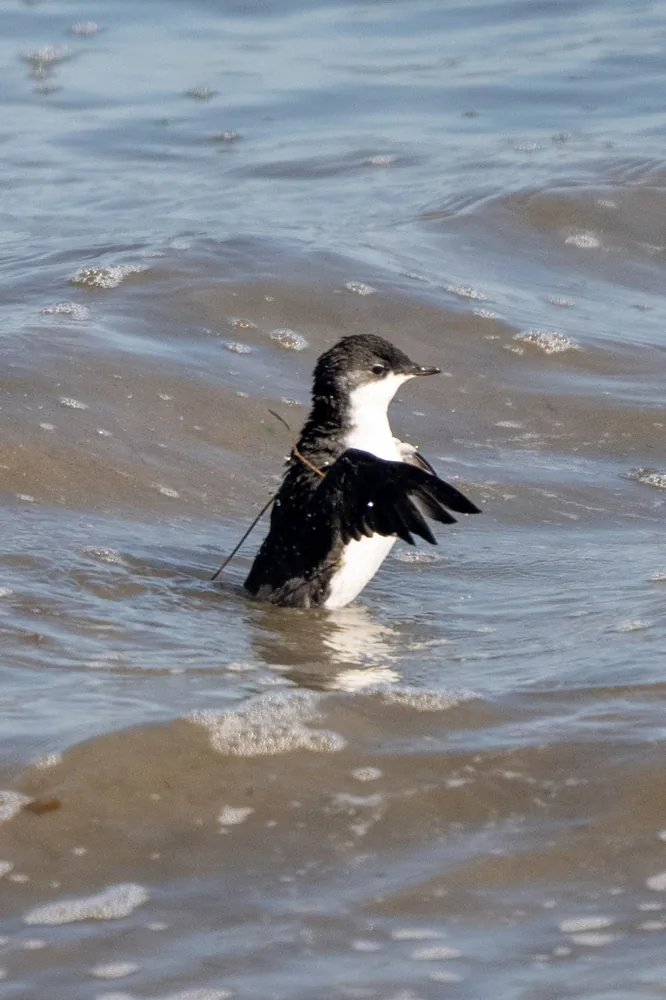
What changed
Nests on islands off southern California (San Miguel, Santa Cruz, Anacapa, Santa Barbara and San Clemente) and off western Baja California. After nesting it wanders at sea north to Oregon, rarely to Washington and British Columbia.
Nests on Guadalupe Island and the San Benito Islands off western Baja California. After nesting some wander far off central California, and a few at least as far north as Washington.
What is a Xantus's Murrelet called now?
It depends on which half you saw: since July 2012 the old Xantus's Murrelet is two species, Scripps's Murrelet, Synthliboramphus scrippsi, and the Guadalupe Murrelet, Synthliboramphus hypoleucus.
The AOS's online checklist notes for each that the two together “were known as Xantus's Murrelet.” The old name lingers in French: the AOS still lists the Guadalupe Murrelet as Guillemot de Xantus.
Surprising facts about Xantus's Murrelet
The chicks go to sea at two days old. Scripps's Murrelet chicks are never fed at the nest. One or two nights after hatching they scramble down to the water, sometimes leaping from cliffs as high as 200 feet, and find their parents waiting beyond the surf, say Channel Islands National Park and Audubon's field guide.
Its eggs are enormous. Each can weigh up to a quarter of the mother's weight, one of the largest egg-to-parent ratios of any bird, the park says.
A 6-ounce seabird lived at least 20 years. A Scripps's Murrelet banded in California in May 1996 was found dead there in March 2016, the US Geological Survey's banding records show.
It was named from a yacht. Green and Arnold took the first Scripps's Murrelet from its nest on Anacapa Island on May 16, 1938, on a collecting trip aboard the yacht of the late Robert Scripps of San Diego.
Why it changed
Because the two do not interbreed where they nest side by side. The 53rd Supplement found no evidence of mixing on the San Benito Islands off Baja, where both breed, and differences in the face pattern, the shape of the bill, the voice and the genes, the last from a range-wide study by Birt and colleagues published in The Auk that year.
The question was old. In 1939 two collectors, J. Elton Green and Lee W. Arnold, noticed that murrelets nesting on Guadalupe Island had white around the eyes, while birds from the islands farther north had dark faces. They named the northern birds a new subspecies, scrippsi.
The 1983 check-list already said the two might be separate species, since both seemed to breed on the San Benito Islands and on Santa Barbara Island with only limited hybridization.
Xantus's own bird was the Guadalupe kind. His 1859 description, of a bird taken 14 miles off Cape San Lucas, says the white of the underparts extends to include the eyes, a mark Green and Arnold found only in Guadalupe birds. So the scientific name hypoleucus stayed with the Guadalupe Murrelet, which received its English name in 2012.
Who decided, and when
- American Ornithological Society (AOS): the 53rd Supplement to its Check-list, printed in its journal The Auk when the society was still the American Ornithologists' Union (AOU)
Why is it called Scripps's Murrelet?
For Robert Scripps of San Diego: Green and Arnold named the new form in his honor in January 1939, as a man who had done much for Pacific coast science, and they had collected the type specimen from his yacht.
The older name honors John Xantus, who described the species in 1859; the 1983 check-list credits him as Xantus de Vesey. The AOS renamed McCown's Longspur in 2020, and in 2023 it said it would replace all English bird names that honor people, starting with 70 to 80 species found mainly in the US and Canada. When we checked on November 19, 2026, it still called the bird Scripps's Murrelet.
Where can you see a Scripps's Murrelet?
Mostly from a boat: it nests on offshore islands and is almost never seen from the mainland, says Audubon's field guide, and it is common off southern California mainly from March through June.
Channel Islands National Park holds about a third of the world's population, and Santa Barbara Island has the largest colony in the US, perhaps in the world. Adults visit the colonies only at night. Santa Cruz Island, one of its nesting islands, is the only home of the Island Scrub-Jay.
Where does the Guadalupe Murrelet nest?
On Guadalupe Island and the San Benito Islands off the Pacific coast of Baja California, mostly on offshore rocks and islets, the US Fish and Wildlife Service said in 2016.
Cats are the reason. Elton Green collected a white-faced bird on its eggs on a small islet off Guadalupe's south point in July 1937, and he and Arnold warned in 1939 that the main island was overrun with introduced cats. The cats were still there in 2016, the service found, but most murrelets nest out of their reach, and Mexico made Guadalupe Island a biosphere reserve in June 2005.
How do you tell Scripps's, Guadalupe and Craveri's Murrelets apart?
By the face and the underwing: a Guadalupe Murrelet shows more white around the eye than a Scripps's, and a Craveri's has a dusky, not white, underwing, says Audubon's field guide.
In flight, the white underwing is the easiest way to tell a Scripps's from a Craveri's, Channel Islands National Park notes, and a Craveri's also has a slightly longer, thinner bill. It nests off western Mexico and wanders north into California waters in some summers, more often when the water is warm.
Is the Scripps's Murrelet endangered?
Not under federal law: in September 2016 the US Fish and Wildlife Service found that listing either Scripps's or Guadalupe Murrelet was not warranted, as numbers had held steady or grown after island restoration.
The question had been open since 2002, when the Pacific Seabird Group petitioned to list Xantus's Murrelet as threatened; it was a candidate for listing from 2004. California listed the bird as threatened under state law on December 22, 2004, the national park says. Audubon's field guide gives its world status as Vulnerable, and the Guadalupe Murrelet's as Endangered.
What threatens Scripps's Murrelets?
Mostly predators brought to their islands: in one study deer mice destroyed almost half of all eggs, and an accidental introduction of rats could devastate a colony, says Audubon's field guide.
Clearing them has worked. After feral cats were removed from Santa Barbara Island in 1978, its murrelets grew to about 1,500 by 1992, and after the park service cleared black rats from Anacapa Island, clutches there rose 61 percent in 2009 over the year before, says Channel Islands National Park.
What is a murrelet bird?
A small seabird of the auk family, the family of puffins and murres, that dives and swims underwater, driving itself with its wings.
Most auks favor cold northern seas, but Scripps's is found mostly off Baja and southern California, says Audubon's field guide. It travels in pairs or family groups rather than flocks, and is about the size of a robin.
Why is it called an ancient murrelet?
For its gray back, which looks a little like a shawl draped over an old person's shoulders, says Audubon's field guide.
The Ancient Murrelet is a bird of the northern Pacific that winters south to California waters. Like Scripps's, it raises two young and leads them to sea within a few days of hatching.
Why are marbled murrelets endangered?
Because they nest in old-growth forest that keeps being cut, says Audubon's field guide, which notes that the bird is listed as threatened under the US Endangered Species Act.
In the Pacific Northwest the Marbled Murrelet nests high in old trees, several miles inland from the coast. It also feeds close to shore, which makes it especially vulnerable to oil spills, and its nests were essentially unknown until the 1970s.
Which one did you see?
Where it nested tells you most. A murrelet at a nesting colony on California's Channel Islands is almost surely a Scripps's Murrelet; one at Guadalupe Island off Baja is a Guadalupe Murrelet.
At sea, look at the face. A Guadalupe shows more white around the eye; a Scripps's has a darker face.
Off California, Scripps's is the likelier one close to shore, while the Guadalupe wanders well offshore after nesting, the 53rd Supplement says.
Rule out Craveri's Murrelet, with its dusky underwing and longer, thinner bill.
What it does to your list
One old name, two species today. If you had seen both kinds under the old name, your total goes up by one; if you saw only one, only the name changes, once you know which one it was.
In a Birdfolio, a bird entered as Xantus's Murrelet is not guessed: we ask you which of the two it was.
Why a split adds a bird only sometimes: bird splits and lumps, explained.
Got a Xantus's Murrelet from a boat trip off San Diego on an old list? Once you know which murrelet it was, print your life list under today's names.
Check your own list. Drop your eBird download or type your birds: the free checker shows which of them the changes since 2018 touched.
Check my list