2017 lump
Thayer's Gull: now part of the Iceland Gull
Thayer's Gull is now part of the Iceland Gull: the American Ornithological Society (AOS) merged the two in July 2017. Thayer's had been a species of its own since 1973, when the society was still the American Ornithologists' Union, and a race of the Herring Gull before that. Birders still call the darker western birds Thayer's, but on a list they count as Iceland Gulls.
Updated
What changed
Nests on Arctic cliffs: the Thayer's form on Canada's high Arctic islands and in northwestern Greenland, the Kumlien's form in northeastern Canada, the white-winged form in Greenland. Thayer's birds winter mainly along the Pacific coast, the others in eastern Canada, New England, the Great Lakes and around Iceland.
What is a Thayer's Gull called now?
An Iceland Gull, Larus glaucoides: since July 2017 Thayer's has been one of its three forms, Larus glaucoides thayeri, beside Kumlien's and the white-winged birds of Greenland. The AOS's online checklist lists it that way today.
Audubon's field guide calls it the darker western type of the Iceland Gull, “considered a separate species until recently.” So a Thayer's Gull in an older notebook or field guide is an Iceland Gull on a list now.
Surprising facts about Thayer's Gull
It was named for a patron, not a finder. W. Sprague Brooks described the gull in 1915, in the Bulletin of Harvard's Museum of Comparative Zoology, and dedicated it to Colonel John E. Thayer, whose generosity had enriched the museum's collections. The type specimen had been collected 14 years earlier, on June 10, 1901, at Buchanan Bay on Ellesmere Island.
The Iceland Gull hardly lives in Iceland. Despite its name, it occurs there only in winter, says Audubon's field guide, and the white-winged form nests only in Greenland.
One lived at least 18 years and 9 months. A female Thayer's banded in Nunavut, in Canada's Arctic, in July 2003 was seen alive in British Columbia in March 2020, still wearing its markers, the US Geological Survey's banding records show.
It has been a Herring Gull, a species and an Iceland Gull. The 1931 check-list counted it as a race of the Herring Gull, the 1973 supplement made it a species, and the 2017 supplement folded it into the Iceland Gull.
Why it changed
Because the study that had made it a species could not be trusted. The 58th Supplement merged Thayer's into the Iceland Gull on evidence that the two pair freely where they meet, on Baffin and Southampton islands in Arctic Canada, and on “doubts concerning the validity” of the 1966 study the union had relied on in 1973.
That study, by Neal G. Smith, had been famous. Its best-known claim, as the 2017 proposal to the committee retold it, was that painting the colored ring of skin around a gull's eye was enough to change which kind of gull it paired with. No later study reached his conclusion that Thayer's and Kumlien's Gulls kept apart. Richard Snell went to the same bay on Baffin Island in 1985 to repeat the work and could not find colonies where Smith had reported them.
The proposal, by Jon Dunn and Van Remsen, is dated March 1, 2017. They called the question “hotly debated” for some three decades and noted that the committee had not voted on Thayer's Gull since it first split it in 1973.
Kumlien's Gull is the bridge. This variable form of northeastern Canada sits between the pale Iceland Gulls of Greenland and the darker Thayer's, and the AOS kept it as a group within the Iceland Gull “pending further research.” The same 1973 supplement that made Thayer's a species merged the Myrtle Warbler into the Yellow-rumped Warbler.
Who decided, and when
- American Ornithological Society (AOS): the 58th Supplement to its Check-list, published July 5, 2017, the first since the American Ornithologists' Union merged with the Cooper Ornithological Society in October 2016 to form the American Ornithological Society
When did Thayer's Gull become a species?
In April 1973, in the 32nd Supplement to the AOU's check-list: “Thayer's Gull now attains species rank,” the Carolina Bird Club's journal The Chat summed it up that June. Until then the check-lists of 1931 and 1957 had listed it as Larus argentatus thayeri, a race of the Herring Gull.
That supplement was the first in 17 years: there were none between the 31st, in 1956, and the 32nd, the 2017 proposal points out. The 1983 check-list kept Thayer's as a species but already noted that it interbred with Kumlien's Gulls in mixed colonies on Baffin Island.
What are the key differences between a Herring Gull and a Thayer's Gull?
A Thayer's is smaller than an American Herring Gull, with a shorter bill, dark eyes and less black in the wingtips, says Audubon's field guide; young birds look much like young Herring Gulls but have paler wingtips.
Up close, look at the eye ring. Thayer's and other Iceland Gulls share a purplish ring of skin around the eye, where a Herring Gull's is yellow, and they nest in colonies on Arctic cliffs, the 2017 proposal says, citing a 1961 study by Macpherson. That study found Thayer's and Herring Gulls nesting side by side without interbreeding.
The Herring Gull has since been split itself: the one of North America is now the American Herring Gull.
Why is it called Thayer's Gull?
For Colonel John E. Thayer, a benefactor of Harvard's Museum of Comparative Zoology: W. Sprague Brooks named the gull for him in September 1915, in the museum's Bulletin.
Thayer had helped send Brooks north. With Professor Theodore Lyman he made it possible for Brooks and Joseph Dixon to join a 1913 hunting expedition of Harvard graduates to East Siberia and Arctic Alaska as its zoological collectors. Thayer's own collection held several sets of the new gull's eggs from Buchanan Bay, and Dixon took an adult female at Demarcation Point, Alaska, on August 28, 1913.
Where do Thayer's Gulls live?
They nest on Canada's high Arctic islands and in northwestern Greenland, and winter mainly along the Pacific coast, say the AOS and Audubon's field guide. The nesting range runs from Banks and Victoria islands east to Ellesmere and northern Baffin Island.
The 1983 check-list put the winter range at the Pacific coast from southern British Columbia to central Baja California. Fewer reached southeastern Alaska, the Gulf of St. Lawrence and Lakes Erie and Ontario, and a few strayed inland as far as Arizona, New Mexico, Texas and Florida.
What is a Kumlien's Gull?
The middle form of the Iceland Gull, with gray in its wingtips and usually dull yellow eyes, nesting in northeastern Canada and wintering mostly in eastern Canada and the northeastern US, says Audubon's field guide.
Its history is as tangled as Thayer's. The first check-list, in 1886, counted Kumlien's Gull as a species nesting in Cumberland Gulf, in what the 1931 edition called Arctic America; the 1931 edition called it a hybrid of the Iceland Gull and Thayer's and moved it to the hypothetical list; by 1957 it was a race of the Iceland Gull. The 2017 proposal judged it best seen as a population blending the other two, much as the 1931 edition had.
Is Thayer's Gull still a species?
No: the AOS has counted it as part of the Iceland Gull since July 2017, and AviList, the shared world list, does the same, with thayeri as one of the Iceland Gull's three subspecies.
The name lives on for the form. Audubon's field guide still speaks of the “Thayer's” type, and the US Geological Survey's banding records list Larus glaucoides thayeri as Thayer's Gull.
Why do Iceland Gulls look so different from each other?
Because the forms blend into one another: adults grow darker in back and wingtip from Greenland west to Banks Island, with wide overlap everywhere. That was the finding of a study of 317 museum specimens presented at the AOU's 1991 meeting, the 2017 proposal reports.
The 2017 proposal put it plainly: any ten-minute visit to Quidi Vidi Lake in St. John's, Newfoundland, in winter shows hundreds of gulls, most of them Iceland Gulls, and no two look alike.
What did Audubon call the Iceland Gull?
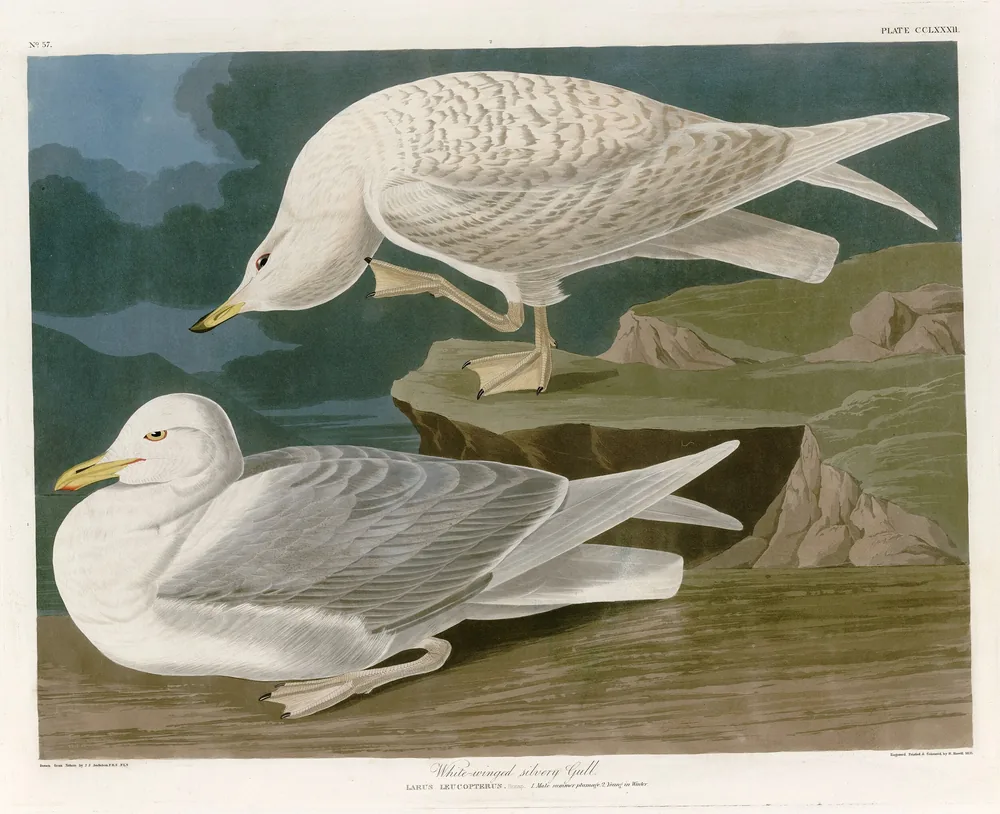
The White-winged Silvery Gull: that is the title of his plate 282, shown on this page, and of his 1835 chapter. His scientific name for it, Larus leucopterus, is the one the first check-list, in 1886, gave the Iceland Gull.
He never met it farther south than New York Bay, he wrote, but it was not rare around Boston in winter. At Portland, Maine, he watched a good number over the inner harbor, picking up garbage beside the Herring Gulls they flew with.
Which bird is it now?
Nothing to choose: a Thayer's Gull and an Iceland Gull on an old list are both the Iceland Gull today.
To know which form you saw, look at the wingtips and the eye. A Thayer's adult is darker, with dark eyes and some black in the wingtips; a Kumlien's has gray in the wingtips and usually dull yellow eyes; the Greenland birds are the palest, says Audubon's field guide.
Place helps. A winter bird on the Pacific coast is most likely the Thayer's form; one in New England or eastern Canada, a Kumlien's.
What it does to your list
Two old names, one bird today. If your list counts a Thayer's Gull and an Iceland Gull as two species, they are one now, and the total drops by one.
With only one of the two on your list, nothing changes but the name.
In a Birdfolio, a bird entered as Thayer's Gull is filed as Iceland Gull, with a note that it is now part of that species, and a Thayer's and an Iceland Gull on one list count once.
How merging and splitting move a total: our guide to bird splits and lumps.
Wrote down a Thayer's Gull on a Pacific beach one winter? Print your life list with that gull under the name it carries today, Iceland Gull.
Check your own list. Drop your eBird download or type your birds: the free checker shows which of them the changes since 2018 touched.
Check my list