2011 split
Common Moorhen: in the Americas, now the Common Gallinule
Common Moorhen is the old name of the Common Gallinule, the red-billed marsh bird of the Americas. The American Ornithologists' Union, the forerunner of today's American Ornithological Society (AOS), split it from the moorhen of Europe, Asia and Africa in July 2011 and gave it back an older American name. If you saw yours in the US, it is the same bird under a new name.
Updated
What changed
Fresh marshes and reedy ponds, nesting locally from California and Arizona across the southern and central states to Minnesota, Michigan and New England, and south through Mexico and the West Indies to South America; also Hawaii. In winter it stays from South Carolina and the Gulf coast southward.
Europe, Asia and Africa, from the British Isles and Scandinavia to Japan and south to southern Africa and the East Indies. In the US only as a stray: one young male on Shemya Island, Alaska, in October 2010.
What is a common moorhen called now?
In the Americas, the Common Gallinule, Gallinula galeata: since July 2011 the name Common Moorhen belongs only to the bird of Europe, Asia and Africa, Gallinula chloropus. Audubon's field guide says the gallinule “was formerly considered to belong to the same species as the Common Moorhen.”
So a Common Moorhen in an American notebook from 1983 to 2011 is a Common Gallinule today. Some state pages still use the old name: Connecticut's wildlife fact sheet is headed Common Moorhen.
Surprising facts about the Common Moorhen
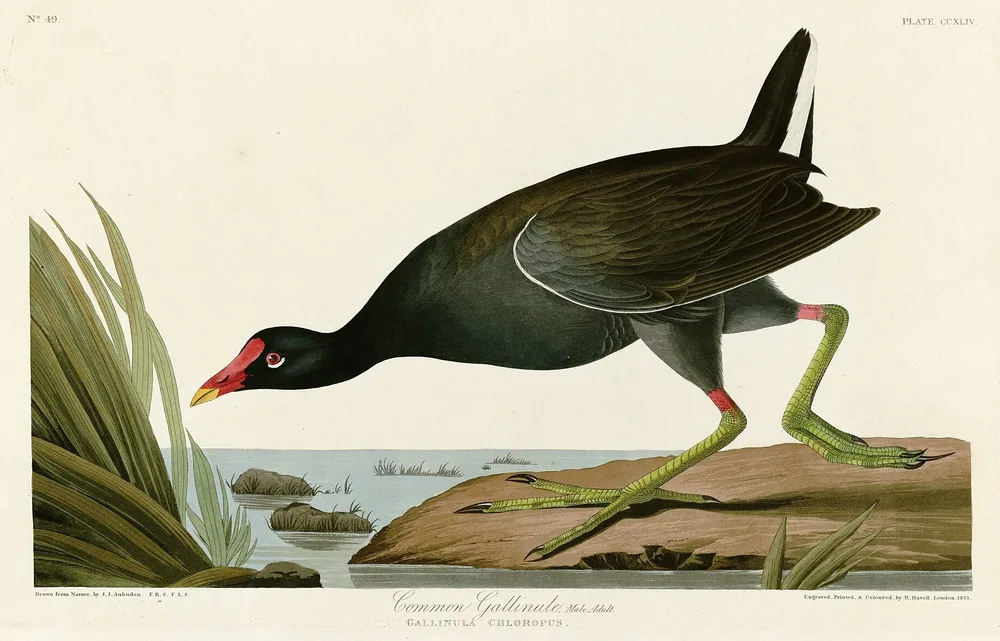
Audubon already called it the Common Gallinule. His plate 244, shown on this page, is engraved “Common Gallinule, Male Adult,” and his 1835 chapter has the same title. The name came back 176 years later.
He thought London's moorhens were the same bird. On his stays in London, Audubon watched “the Gallinules” in Regent's Park, nearly tame, walking the meadows while crowds fed the ducks and swans. Since 2011 those birds and America's are two species.
Its American name has changed three times. Florida Gallinule on the check-lists of 1886, 1910 and 1931, Common Gallinule in 1957, Common Moorhen in 1983 and Common Gallinule again since 2011. In 1886 and 1910 it even had today's scientific name, Gallinula galeata.
A real moorhen has reached the US once. A young male turned up on Shemya Island, in Alaska's Aleutians, on October 12 to 14, 2010, and a DNA test confirmed it, the first American record. The AOS added the species to its list in 2013.
Garfish took the young. Audubon watched gallinule chicks playing on the water “like Ducks” until a garfish seized one; the rest raced across the surface to shore and hid, silent, for a quarter of an hour.
On land it walks like a chicken. That is Audubon's comparison, and he saw thirty, forty or more at a time picking worms and insects from the grass.
Why it changed
The two birds look alike but are not the same. The 52nd Supplement set the American bird apart for differences in voice, in the shape of the bill and its frontal shield, and in its mitochondrial DNA, and left the name Common Moorhen with the bird of Europe, Asia and Africa.
The name Common Moorhen had itself come from a rule. For its 1983 check-list the union chose names used around the world for birds that range far beyond North America: “we have adopted ‘Common Moorhen’ for Gallinula chloropus,” it wrote. The same rule turned the Marsh Hawk into the Northern Harrier, though the committee kept the American name Oldsquaw for a sea duck.
So in 2011 the American bird took back an American name. Its check-list notes now say it was “Formerly known as Florida Gallinule,” the name of 1886 to 1931; Common Gallinule was its name on the 1957 check-list, and Audubon's before that.
Who decided, and when
- American Ornithological Society (AOS): the 52nd Supplement to its Check-list, printed in its journal The Auk when the society was still the American Ornithologists' Union (AOU)
- American Ornithological Society (AOS): the 54th Supplement added the true Common Moorhen to its list, after one turned up on Shemya Island, Alaska, in October 2010
When did the common moorhen become the common gallinule?
In July 2011, in the 52nd Supplement to the Check-list of North American Birds, printed in The Auk. It covers the committee's decisions between April 1, 2010 and April 15, 2011, and it changed three species' names because of splits from birds outside North America, the gallinule's among them.
The supplement treats the American bird as a species “separate from the allopatric G. chloropus”: allopatric means the two live in different parts of the world and do not meet.
Are there moorhens in the US?
Only as a rare stray: the one confirmed Common Moorhen in the US was a young male on Shemya Island, Alaska, in October 2010. The red-billed marsh bird you see across the US is the Common Gallinule.
That one is common in many places. Audubon's field guide calls it adaptable and successful, common in the marshes of North and South America.
Are common moorhens ducks?
No: they are rails, in the family of rails, gallinules and coots, though they swim much like ducks. Connecticut's wildlife agency calls the bird “duck-like,” and notes that it pumps its head back and forth as it swims, as a coot does.
On land it looks nothing like a duck. It walks and runs on open ground near water and clambers through reeds and cattails, says Audubon's field guide, and Audubon saw young ones run over the broad leaves of water lilies “as if on land.”
How do you tell a Common Gallinule from an American Coot?
By the bill and the side stripe: a gallinule has a red bill tipped with yellow and a line of white feathers along its flanks, and Connecticut's fact sheet says those two marks set it apart from the similar-looking coot.
Its habits help too. The gallinule is related to the coot, the old “mud hen,” and often found with it, but it is not so bold and spends more time hidden in the marsh, says Audubon's field guide. Young gallinules are paler gray with a dull bill, but they show the white side stripe.
Are moorhens a rare bird?
Not overall: the Common Gallinule is still widespread, and common where good marsh remains, though its numbers have undoubtedly fallen with the loss of wetlands, says Audubon's field guide.
At the edges of its range it is scarce. Connecticut lists it as state endangered: a common summer resident of the state's coastal marshes in the late 1800s and early 1900s, it is now a rare summer visitor there.
What do common gallinules eat?
Mostly water plants: their leaves, stems and seeds, with fruits and berries, insects, spiders, earthworms, snails and tadpoles, and now and then carrion or other birds' eggs, says Audubon's field guide. It feeds while swimming, walking or climbing through the marsh, and sometimes tips up, tail in the air, or dives.
Where do common gallinules nest?
In the marsh, on a solid platform of cattails, bulrushes or reeds over shallow water, often with a ramp of the same stuff leading down to the water. Both parents build it, and they take turns on the 8 to 11 eggs for 19 to 22 days, says Audubon's field guide.
Older chicks from an earlier brood sometimes help feed the young, and a pair may raise two broods a year, rarely three. The young can swim soon after hatching and fly at 40 to 50 days or more.
How long do common gallinules live?
The oldest in the US Geological Survey's banding files lived at least 9 years and 10 months: it was banded in Louisiana in February 1931 and caught there again at the end of 1940.
Audubon listed their enemies in Florida's streams and ponds, alligators, turtles and many kinds of fish, and found the birds abundant all the same, because they raise so many young.
Which one did you see?
In the Americas, it's a Common Gallinule. Any Common Moorhen on a list kept in North or South America, the West Indies or Hawaii is today's Common Gallinule.
In Europe, Asia or Africa, it's still a Common Moorhen. That bird kept the name and the scientific name Gallinula chloropus.
Look for the red shield and the white side stripe on a slaty bird with a browner back, and the white feathers under the tail that flash as it jerks it.
The Purple Gallinule is another species, which Audubon painted as plate 305.
What it does to your list
Usually only the name changes: a Common Moorhen seen in the US is a Common Gallinule, and your total stays as it was.
If you also saw moorhens in Europe or Asia and kept them on the same line, you gain a species: they are two now.
In a Birdfolio, a Common Moorhen or Florida Gallinule seen in the Americas, or with no place given, is filed as a Common Gallinule, with a note that your list used an older, broader name; one seen anywhere else stays a Common Moorhen.
Why a split far away can leave a list at home alone: splits and lumps, from the start.
Still have Common Moorhen on a list from marsh trips of the 1990s? Download your eBird data and every bird comes out under today's name.
Check your own list. Drop your eBird download or type your birds: the free checker shows which of them the changes since 2018 touched.
Check my list