1985 split
Arctic Loon: the 1985 split that brought back the Pacific Loon
Arctic Loon is the name North American birders used until 1985 for the bird now called the Pacific Loon, together with the true Arctic Loon of Europe, Asia and far western Alaska. The American Ornithologists' Union, the forerunner of today's American Ornithological Society (AOS), split the two in July 1985. An Arctic Loon seen before then anywhere south of western Alaska was very likely a Pacific Loon.
Updated
What changed
Nests on tundra lakes from Alaska across northern Canada to Hudson Bay and Baffin Island. Nearly all winter on the Pacific coast, from Alaska to Baja California; a few stray inland and to the East Coast.
Nests from the British Isles and Scandinavia across northern Europe and Siberia. In North America only in far western Alaska, where it is an uncommon summer bird.
What is an Arctic Loon?
A sleek diving bird of northern lakes and seas, 26 to 30 inches long, with a gray head, a dark throat and a back checkered black and white in summer. Since 1985 the name means the loon of Europe and Asia, Gavia arctica; before that it also covered the bird now called the Pacific Loon.
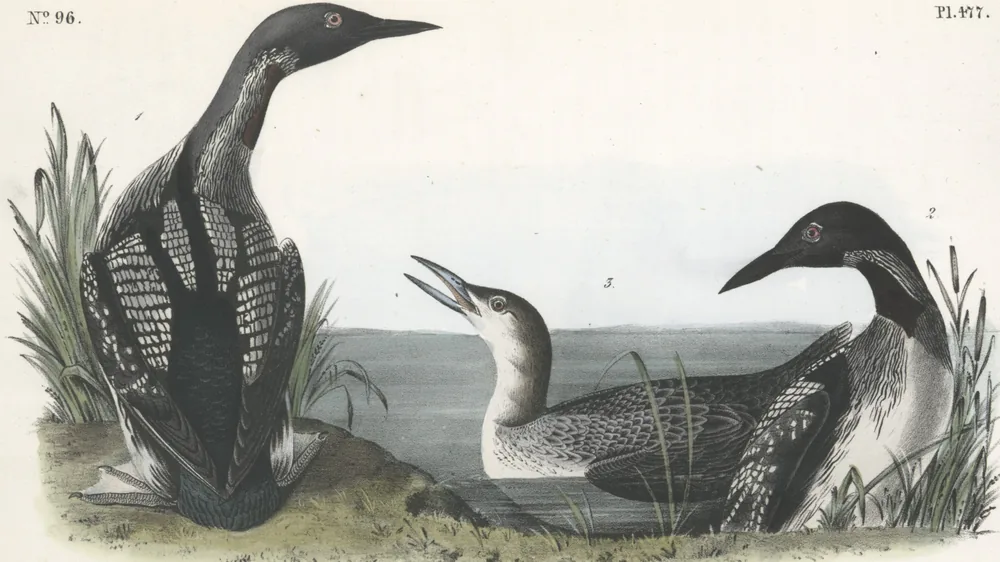
Europeans call it the Black-throated Diver, the 1983 check-list noted, and Audubon used that name too, for his plate 346. The National Audubon Society now lists the bird of that plate as the Pacific Loon.
Surprising facts about the Arctic Loon
Its name has come full circle. On the AOU's check-lists of 1886 and 1910 this bird was the Black-throated Loon. AviList, today's world list, calls it the Black-throated Loon again, while eBird and the federal list of protected birds still say Arctic Loon.
The Pacific Loon is hardly Pacific in summer. It nests east to Hudson Bay and Baffin Island, says Audubon's field guide, and only crowds the Pacific coast in winter.
Pacific Loons wait for a better wind. Northbound migrants travel in flocks several miles offshore, usually less than 60 feet above the water, and avoid flying on days with strong headwinds.
Audubon caught one on the Ohio River that could not dive: a large mussel had stuck in its throat. He kept it for several days; it refused every kind of food and struck out with its bill.
Why it changed
Because two birds had been folded into one. The AOU's check-lists of 1886 and 1910 had both, the Black-throated Loon and the Pacific Loon. In 1931 the committee made the Pacific Loon a race of the Old World bird, and in 1957 the whole species took the name Arctic Loon.
By 1983 the check-list admitted its doubts. Its notes say the Pacific group was “frequently treated as a separate species,” because the two were reported nesting side by side in eastern Siberia and western Alaska. The committee kept one species only because some specimens seemed to blend with the Siberian form.
The 35th Supplement, printed in The Auk in 1985, made the Pacific Loon a species again, Gavia pacifica, and left the name Arctic Loon with the bird of Europe and Asia. Federal wildlife officials summed it up in 1995: the old Arctic Loon “is now considered to be two species.”
For the 54 years in between, few birders tried to tell them apart. Two field biologists wrote in Western Birds in 1993 that “little attention was given to distinction of the two in the field.”
Who decided, and when
- American Ornithological Society (AOS): the 35th Supplement to its Check-list, printed in its journal The Auk when the society was still the American Ornithologists' Union (AOU)
- AviList, the shared world checklist: keeps the two apart, and calls Gavia arctica the Black-throated Loon, its name on the AOU's check-lists of 1886 and 1910
When was the Arctic Loon split?
In 1985, in the 35th Supplement to the AOU's Check-list of North American Birds, printed in The Auk (volume 102, pages 680 to 686). It made the Pacific Loon, Gavia pacifica, a species again after 54 years as a race of the Arctic Loon.
The federal government was a step behind. Its list of birds protected by the Migratory Bird Treaty Act had last been revised on April 5, 1985, and in May 1995 the U.S. Fish and Wildlife Service proposed listing the Pacific Loon “formerly included in G. arctica.”
What are the key differences between an Arctic Loon and a Pacific Loon?
Look at the flanks first: an Arctic Loon shows a white patch above the waterline near the tail, which a Pacific Loon lacks, say Audubon's field guide and a 1989 note in The Chat.
The Arctic is a bit larger, with slightly bolder stripes on the neck, and at close range Alaska's Arctic Loons show a green gloss on the throat, usually purple on a Pacific, Audubon's guide adds. Two biologists who watched both nesting on Alaska's Cape Krusenstern in 1991 found the Pacific's head puffier and rounder, silver-white, and the Arctic's flatter on top, with a bill tilted slightly up. Even the chicks differ: sooty dark on the Arctic, gray-brown on the Pacific.
It takes patience all the same. Seven birders studied one small loon off Cape Hatteras for two hours on May 15, 1987; it became North Carolina's first detailed record of a Pacific Loon.
Does the Arctic Loon live in North America?
Only at the edge: it enters North America mainly as an uncommon summer bird in far western Alaska, says Audubon's field guide.
For decades Wales, on the Seward Peninsula, was the only place in Alaska where it had been reported nesting: eleven adults and eight sets of eggs were collected there between 1923 and 1936. In 1991 two biologists found at least three nesting pairs at Cape Krusenstern, about 160 miles east-northeast, and reported them in Western Birds.
The first North American specimen was taken on St. George Island in the Pribilofs on June 22, 1873. On June 4, 1992, an observer counted 28 flying past Gambell on St. Lawrence Island, a record for Alaska.
Was my old Arctic Loon a Pacific Loon?
Very likely, if you saw it before 1985 anywhere south of western Alaska: the Pacific Loon winters along the whole Pacific coast, while the true Arctic Loon is a bird of Alaska's far west.
The evidence is old and consistent. In 1919 the naturalist A. C. Bent found that all the eastern North American specimens he examined were the Pacific form, The Chat noted in 1989, adding that all recent East Coast sightings and specimens were Pacific Loons. By 1993 only one Arctic Loon had been recorded in Alaska east of the Bering Sea coast, a male taken in Chatham Strait in May 1948.
What are the five species of loons?
The Red-throated, Arctic, Pacific, Common and Yellow-billed Loons: the world has five, and all five are on the U.S. list of birds protected by the Migratory Bird Treaty Act, revised in 2023.
The Common Loon is the best known. It is Minnesota's state bird, and Audubon painted it as the Great Northern Diver or Loon, his plate 306; there is more on Common Loon paintings here.
How rare is a loon?
Most loons are not rare: four of the five are rated Least Concern on the IUCN Red List, as AviList carries it, and only the Yellow-billed Loon is Near Threatened.
In North America the Arctic Loon is the scarce one, a summer bird of Alaska's western edge. The Pacific Loon is common in its season; Audubon's field guide calls its numbers apparently stable.
What is the penalty for killing a loon?
Under federal law, killing a loon is a misdemeanor with a fine of up to $15,000, up to six months in prison, or both, because all five loons are protected by the Migratory Bird Treaty Act.
Taking one in order to sell it, or selling one, is a felony, with up to two years in prison. The $15,000 limit dates from 1998; before that, the fine for a misdemeanor was capped at $500.
Where do Pacific Loons spend the winter?
On the ocean along the Pacific coast, often farther from shore than Red-throated or Common Loons, says Audubon's field guide. In summer they nest on tundra lakes, and they defend those lakes hard: a Pacific Loon has been seen killing ducklings that strayed near its nest.
Which one did you see?
Seen south of western Alaska before 1985, it's a Pacific Loon. An Arctic Loon on a list kept along the Pacific coast, inland or in the East is very likely today's Pacific Loon.
In Europe or Asia, it's an Arctic Loon, the bird that kept the name, called the Black-throated Diver there.
In far western Alaska, it could be either. Both nest there; look for the Arctic Loon's white flank patch.
After 1985, trust the name. A list made since the split that says Arctic Loon means the true Arctic Loon.
What it does to your list
If your list has only an old Arctic Loon from the Pacific coast, it is a Pacific Loon today, and your total stays the same.
If you have seen both, a Pacific Loon in North America and an Arctic Loon in Europe, Asia or western Alaska, you gain a species: they are two now.
In a Birdfolio, a bird entered as Arctic Loon stays an Arctic Loon, because that is a species today; the book can't tell when you saw it, so if yours was seen south of western Alaska before 1985, write it as a Pacific Loon in your list.
How a split like this one adds a species: the guide to splits and lumps.
An Arctic Loon from a winter on the Pacific coast before 1985? Settle which loon it was, then print your life list under today's names.
Check your own list. Drop your eBird download or type your birds: the free checker shows which of them the changes since 2018 touched.
Check my list