1993 split
Black-shouldered Kite: the White-tailed Kite's name from 1983 to 1993
Black-shouldered Kite was the North American name of the White-tailed Kite from 1983 to 1993, while the American Ornithologists' Union counted it as one species with the kites of the Old World and Australia. The union, the forerunner of today's American Ornithological Society (AOS), split them again in July 1993. Today the name Black-shouldered Kite belongs to an Australian bird, Elanus axillaris.
Updated
What changed
Open grassland, marsh and farm country, all year: California and western Oregon, the Texas coast and lower Rio Grande Valley, and south Florida, then from Mexico to Argentina and Chile. It wanders widely and has spread since the 1930s.
Africa, southern Europe and southern Asia, east to the Philippines and New Guinea.
Australia, throughout the continent.
What is a black-shouldered kite?
Today, a small gray-and-white hawk of Australia, Elanus axillaris. From 1983 to 1993, though, it was the official North American name of the White-tailed Kite, so older American field guides and notebooks use it for the American bird.
The name fits the American bird well enough: it is gray and white, with black on the shoulders, says Audubon's field guide. But since the 1993 split the name belongs to the kite of Australia alone, as AviList, today's world list, has it.
Surprising facts about the Black-shouldered Kite
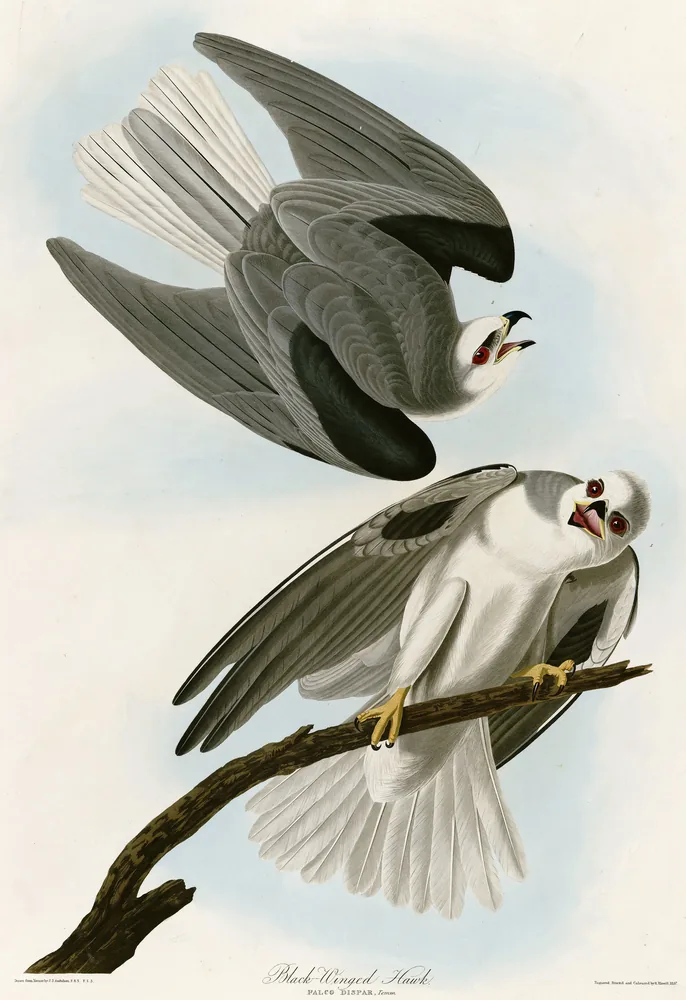
Audubon used the name first, for a hawk. His 1838 chapter on this bird is headed “Black-Shouldered Hawk,” and his plate 352, shown here, is engraved “Black-Winged Hawk.” Both names live on today for kites of other continents.
A mouse from Europe may have helped save it. As recently as the 1940s the White-tailed Kite was considered rare and endangered in North America, found at only a few sites in California and Texas. It has since spread widely, and the arrival of the house mouse may have played a part, says Audubon's field guide; it once fed almost entirely on voles.
Audubon's first live kite would not eat. On February 8, 1834, Dr. Ravenel of Charleston sent him one that had refused food for eight days in his yard. “The beauty of its large eyes struck me at once,” Audubon wrote, and he drew it on the spot.
The American name lasted about eleven years, from the list of new names printed with The Auk in July 1982 to the AOU's 39th Supplement in 1993.
Why it changed
Because the 1983 check-list had joined kites of three continents into one species. It put America's White-tailed Kite together with the Black-winged Kite of Africa and Asia and the kite of Australia under Elanus caeruleus, and called the whole species the Black-shouldered Kite. The new names went out first in July 1982, in a list printed with The Auk ahead of the new edition; the Carolina Bird Club's journal The Chat summed this one up as “Black-shouldered Kite (formerly White-tailed Kite).”
Even then the union hedged. Its notes said the three groups were “sometimes considered as three allospecies,” that is, as three separate species.
The 39th Supplement, printed in The Auk in 1993, separated them. New Mexico's bird society reported the next spring that the three forms “are now regarded as allospecies and all are considered separate,” and that the American bird went back to its earlier name, White-tailed Kite, Elanus leucurus. The Texas Breeding Bird Atlas calls the merger a “brief marriage,” undone as ornithologists turned from lumping to splitting.
The federal list followed. In May 1995 the U.S. Fish and Wildlife Service proposed changing “Kite, Black-shouldered” to “Kite, White-tailed” on its list of birds protected by the Migratory Bird Treaty Act. Another name the 1983 check-list brought in, Common Moorhen, lasted longer in America: until 2011.
Who decided, and when
- American Ornithological Society (AOS): the 39th Supplement to its Check-list, printed in its journal The Auk when the society was still the American Ornithologists' Union (AOU)
- AviList, the shared world checklist: counts four kites in the genus Elanus, and keeps the name Black-shouldered Kite for the Australian bird alone
When did the black-shouldered kite become the white-tailed kite again?
In 1993, with the 39th Supplement to the AOU's Check-list of North American Birds, printed in The Auk (volume 110, pages 675 to 682).
The same supplement made other old names new again, New Mexico's bird society reported: the Green-backed Heron became the Green Heron, the Rosy Finch went back to three species, and the Lesser Golden-Plover was split into the American and Pacific Golden-Plovers.
Is the White-tailed Kite the same as the Black-shouldered Kite?
Not any more: they were one species on the AOU's list from 1983 to 1993 and have been separate since.
AviList, today's shared world list, counts four kites in the genus: the White-tailed Kite of the Americas, the Black-winged Kite of Africa and Asia, the Black-shouldered Kite of Australia and the Letter-winged Kite.
Are black-shouldered kites rare?
No: the Australian Black-shouldered Kite is rated Least Concern on the IUCN Red List, as AviList carries it, and so is America's White-tailed Kite, the bird that carried the name from 1983 to 1993.
The American bird had a close call. The 1957 check-list called it “now very rare” in Florida, and in the 1940s it was thought rare and endangered across North America. Since about the 1930s it has increased and spread into many places where it was never known, says Audubon's field guide, and Breeding Bird Survey routes in Texas suggest growth of about 10 percent a year from 1980 to 2006.
Where can you see a White-tailed Kite in the US?
In open country with scattered trees in California, western Oregon and Washington, Texas, and south Florida, where it lives all year, say the Texas Breeding Bird Atlas and Audubon's field guide.
In Texas it is an uncommon to common resident of the coastal prairies and the brush country of the south, with most confirmed nests along the coast and in the lower Rio Grande Valley. Our guide to birds of prey in Texas sets it beside the state's other hawks and kites.
How does a White-tailed Kite hunt?
By hovering: it pauses again and again over open country on rapidly beating wings to study the ground, then dives and seizes its prey in its talons, says Audubon's field guide.
The Texas Breeding Bird Atlas gives the details. Kites start soon after first light, hover 16 to 78 feet up facing into the wind, try another spot if nothing moves, and return to a perch after five or six minutes on average. A South Carolina planter described the same thing to Audubon in 1834: the bird poised over a wet meadow, then plunged with a rumbling noise.
What do white-tailed kites eat?
Mostly small rodents active by day in open country, especially voles and house mice, says Audubon's field guide; the Texas atlas puts small mammals at 95 percent of the diet.
Pocket gophers, harvest mice, rats, shrews and young rabbits round it out, with a few birds, and rarely snakes, lizards, frogs or large insects. In 1838 Audubon found the remains of birds and beetles in two he examined.
How do you tell a White-tailed Kite from other gray hawks?
Look for black shoulders on a gray-and-white bird that may suggest a gull more than a hawk, says Audubon's field guide.
There is black under the bend of the wing, too. Young birds have brown marks on the chest and back but the same basic pattern. Watch what it does, too: the White-tailed Kite is often seen hovering over open fields. The South Carolina planter who shot one for Audubon in 1834 thought its cries so like a Mississippi Kite's that he took it for one.
Where do white-tailed kites nest?
In the top of a tree, usually 20 to 50 feet up, often a live oak, on a good-sized platform of sticks and twigs lined with grass, weeds or Spanish moss that both birds build, says Audubon's field guide.
The female usually lays 4 eggs and sits on them for 26 to 32 days while the male brings food. The young fly at about 30 to 35 days, and a pair may nest a second time in the same season.
Which one did you see?
In the Americas, it's a White-tailed Kite. A Black-shouldered Kite on a list kept in the US, Mexico or South America is today's White-tailed Kite.
In Australia, it's still a Black-shouldered Kite, Elanus axillaris.
In Africa, Europe or Asia, it's a Black-winged Kite, Elanus caeruleus, the scientific name the AOU gave all three from 1983 to 1993.
Before 1983 and after 1993, American lists already say White-tailed Kite.
What it does to your list
Only the name changes for a bird seen in North America: your Black-shouldered Kite is a White-tailed Kite, and your total stays the same.
If you saw one in the Americas and another in Australia, Africa or Asia and counted them once, they are two species now, or three if you saw all of them.
In a Birdfolio, a Black-shouldered Kite seen in the Americas, or with no place given, is filed as a White-tailed Kite, with a note that your list used an older, broader name; one seen in Australia stays a Black-shouldered Kite, and one seen in Africa, Europe or Asia is filed as a Black-winged Kite.
Why names come and go like this: our guide to splits and lumps.
Black-shouldered Kite in a notebook from the 1980s? If those trips are in eBird, download your eBird data and the kite comes back as a White-tailed Kite.
Check your own list. Drop your eBird download or type your birds: the free checker shows which of them the changes since 2018 touched.
Check my list