1989 split
Water Pipit: in North America, now the American Pipit
Water Pipit is the old North American name of the American Pipit, the tail-wagging brown bird of winter fields and mountain tundra. The American Ornithologists' Union, the forerunner of today's American Ornithological Society (AOS), split it from the Water Pipit of Europe and Asia in July 1989 and gave it back its name of 1886. If you saw yours in the US or Canada, only the name has changed.
Updated
What changed
Nests on Arctic tundra from Alaska across northern Canada to Labrador and Newfoundland, and above treeline on western mountains south to California, Arizona and New Mexico; in the East, on a few peaks such as Maine's Mount Katahdin. Winters in flocks across the southern states and Mexico, on plowed fields, shores and mudflats.
Europe and Asia. It nests in the Alps and other mountains of central and southern Europe and visits Britain only in winter. It has no regular place in North America.
What is a water pipit called now?
In North America, the American Pipit, Anthus rubescens: since July 1989 the name Water Pipit belongs only to the pipit of Europe and Asia, Anthus spinoletta. So a Water Pipit in an American notebook from 1957 to 1989 is an American Pipit today.
The change cost no one a bird. New Mexico's bird society noted that it added no species to the state list and took none away; it simply brought back a name used in the past.
What is a Water Pipit?
A slim, streaky brown songbird of open ground, about 6 inches long, that walks instead of hopping and wags its tail as it goes. Today the name means the pipit of Europe and Asia; in older North American field guides it meant the bird now called the American Pipit.
Both live on bare, open land: tundra and alpine meadows in summer, fields and shores in winter. In America you often notice one first by its call, as it flies over high, says Audubon's field guide.
Surprising facts about the Water Pipit
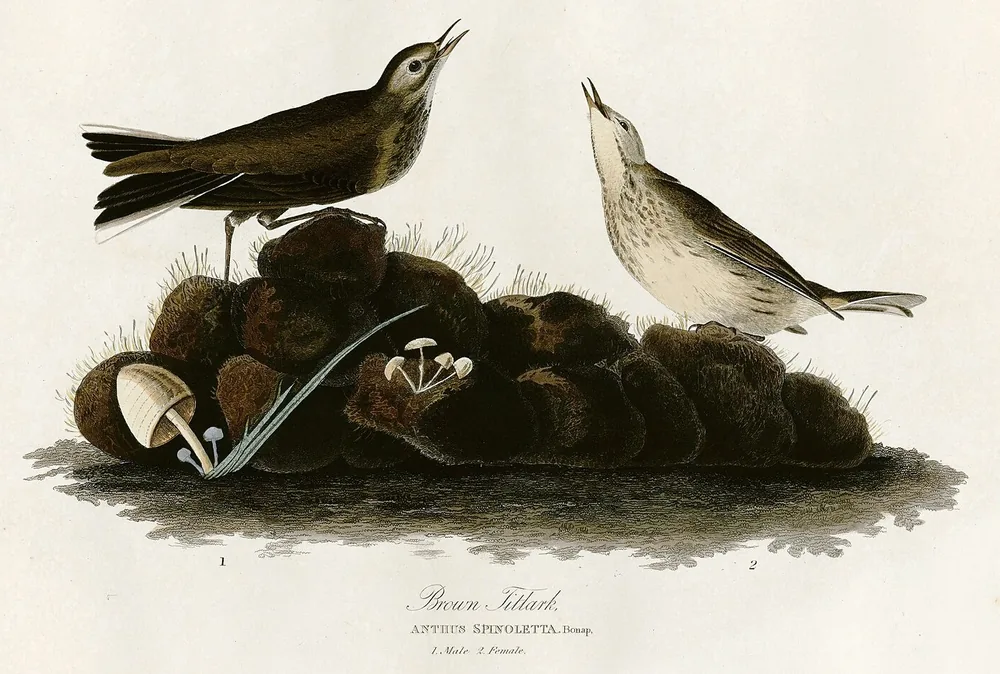
Audubon's plate already has the Water Pipit's name on it. His plate 10, shown here, is engraved “Brown Titlark, Anthus spinoletta,” and in 1831 he wrote that he was “inclined to consider the Brown Titlark identical with the Water Pipit of Europe.” The AOU came round to his view in 1931 and dropped it in 1989.
Tired pipits landed on his ship. Crossing from France, Audubon caught some on the Grand Banks off Newfoundland. They were so hungry that they picked up the biscuit crumbs thrown to them at once.
Its official name flipped four times. American Pipit in 1886, plain “Pipit” in 1910, American Pipit again in 1931, Water Pipit in 1957, and American Pipit once more since 1989.
It sings on the way down. In display a male flies up 100 feet or more, then glides or parachutes back to earth on open wings, singing all the way, says Audubon's field guide.
Why it changed
Because the pipit of Europe and Asia was set apart, and the American bird needed a name of its own. The 37th Supplement lists the change as a name altered “because of the splitting of a species from outside the Checklist area.” New Mexico's bird society put it plainly that year: the Water Pipit of 1983 “has been split into Old World and New World species.”
It was a return more than a new idea. The union's first check-list, in 1886, called the bird the American Pipit, number 697. In 1931 the committee made it a race of the Old World Anthus spinoletta, still under its American name, and in 1957 the whole species took the European name, Water Pipit.
The 1983 check-list kept that one species from Alaska to the Alps, and noted that its birds on the rocky coasts of northern Europe were called Rock Pipits there. The 1989 split gave the American bird back the scientific name Anthus rubescens, first given in 1771 to a bird from Pennsylvania.
The federal list of protected birds caught up later. In May 1995 the U.S. Fish and Wildlife Service proposed changing its entry from Water Pipit to American Pipit; that list had last been revised in April 1985.
Who decided, and when
- American Ornithological Society (AOS): the 37th Supplement to its Check-list, printed in its journal The Auk when the society was still the American Ornithologists' Union (AOU)
- AviList, the shared world checklist: keeps the two apart, and also counts the pipits of eastern Asia as a species of their own, the Siberian Pipit
When was the Water Pipit split?
In 1989, in the 37th Supplement to the AOU's Check-list of North American Birds, printed in The Auk (volume 106, pages 532 to 538). It holds the changes the committee had adopted by March 1, 1989.
It was a busy supplement. It added five species by splitting birds already on the list, among them the Cordilleran Flycatcher (see what became of that split) and the California Towhee, from the old Brown Towhee. It changed the English names of twelve species to match worldwide use and brought the North American list to 1,945 species.
Is the American Pipit the same as the Water Pipit?
Not any more: they were one species on the AOU's check-lists from 1931 to 1989, and they have been two since.
The old Water Pipit was a big species. The 1983 check-list stretched it from Alaska and Newfoundland across Europe and Asia to Kamchatka. AviList, today's shared world list, counts four species in that space: the American Pipit, the Siberian Pipit, the Water Pipit and the European Rock Pipit.
How can I identify a Water Pipit?
In North America you are looking at an American Pipit: a slim bird, gray-brown above and whitish to buff below with a streaked chest, says Audubon's field guide.
Its legs are usually blackish, its tail has a narrow white edge, and the tail bobs almost all the time. In summer it turns a richer pinkish buff below, with fainter streaks. It is 5.9 to 6.7 inches long and weighs about an ounce. Often you hear it first: a sharp pi-pit from birds flying over high.
In Europe, the Water Pipit itself is a large, stocky pipit, grayish-brown above and pale below with a streaked breast, a pale stripe over the eye, a slender bill and dark legs, says the RSPB, Britain's bird society.
What are the differences between a Water Pipit and a meadow pipit?
Size and color: the Water Pipit is the larger, stockier, grayer bird, with a pale stripe over the eye and dark legs, while the Meadow Pipit is small, brown and streaky, says the RSPB.
They live differently, too. The Meadow Pipit is the commonest songbird of Britain's uplands. The Water Pipit nests high in the Alps and other mountains and reaches Britain only in winter. The Meadow Pipit breeds there, with a fluttering display flight and a high, piping call.
For an American birder the question rarely comes up. The Meadow Pipit is a bird of Europe and Asia that nests in Greenland, which is why older AOU check-lists carried it; the 1983 edition moved it to an appendix.
Where can you see an American Pipit in the US?
In winter, look on bare ground across the southern half of the country: plowed fields, short-grass prairie, mudflats, beaches and river sandbars, usually in flocks, says Audubon's field guide. Audubon found that they reached Louisiana about the middle of October and left at the beginning of March.
In summer, go high or far north. It nests on tundra in Alaska and northern Canada and above treeline on western mountains, and in the East on a few peaks, Maine's Mount Katahdin among them, the 1983 check-list says.
Audubon met it in every part of the country he visited, in fields, on riverbanks and on the Atlantic shore, but never in summer. He noticed that the birds liked cattle and walked almost under them to catch insects.
What does an American Pipit sound like?
Its call is a paired, high-pitched pip-pip, and its flight song a weak, tinkling trill, says Audubon's field guide.
The song goes with a show. The male starts singing on the ground, rises 100 feet or more and floats back down with his wings held open, still singing.
Where do American Pipits nest?
On the ground, on tundra in the far north or high above treeline, tucked under overhanging grass, a small rock ledge or a piece of sod. The female builds a cup of grass and sedges, sometimes lined with hair or feathers, says Audubon's field guide.
She lays 4 to 6 eggs, whitish and heavily spotted, and sits on them for 13 to 16 days while the male brings her food. The young leave the nest at about 14 days, and their parents feed them for another two weeks.
Which one did you see?
In North America, it's an American Pipit. Any Water Pipit on a list kept in the US, Canada or Mexico is today's American Pipit.
In Europe, it's still a Water Pipit. That bird kept the name and the scientific name Anthus spinoletta.
Watch the tail: an American Pipit bobs it almost constantly as it walks, and shows narrow white edges when it flies.
Listen overhead for the sharp pi-pit of a flock going over a field in winter.
What it does to your list
Usually only the name changes: a Water Pipit seen in North America is an American Pipit, and your total stays as it was.
If you also saw Water Pipits in Europe and kept them on the same line, you gain a species: they are two now.
In a Birdfolio, a Water Pipit seen in the Americas, or with no place given, is filed as an American Pipit, with a note that your list used an older, broader name; one seen anywhere else stays a Water Pipit.
How a split far away can change a name at home: splits and lumps, explained.
Have a Water Pipit from winter fields long ago? Turn the list into a book: it comes back as an American Pipit, with a note on the name your list used.
Check your own list. Drop your eBird download or type your birds: the free checker shows which of them the changes since 2018 touched.
Check my list