2002 split
Common Snipe: in North America, now Wilson's Snipe
Common Snipe is the old North American name of Wilson's Snipe, the long-billed, striped bird of wet fields and marshes. The American Ornithologists' Union, the forerunner of today's American Ornithological Society (AOS), split it from the snipe of Europe and Asia in July 2002 and gave it back its old name. If you saw yours in North America, only the name changes.
Updated
What changed
Marshes, bogs and wet meadows across Alaska, Canada and the northern US in summer; in winter, wet fields, pastures and marsh edges from the Pacific Northwest, Utah, the central states and Virginia south through Mexico and the West Indies to South America.
Europe and Asia, from the British Isles and Scandinavia across Russia and Siberia, wintering south to Africa and southern Asia. In North America it turns up in Alaska's Aleutian Islands, where it has probably nested.
What is a common snipe called now?
In North America, Wilson's Snipe, Gallinago delicata: since July 2002 the name Common Snipe belongs to the snipe of Europe and Asia. The Old World bird, Gallinago gallinago, “retains the name Common Snipe,” the 43rd Supplement says.
Common Snipe was the American bird's name on the check-lists of 1957 and 1983. Before that, from 1886 to 1931, it was already Wilson's Snipe, so the split brought the old name back.
Surprising facts about the Common Snipe
It was Wilson's Snipe first. The union's first check-list, in 1886, listed Wilson's Snipe as a species of its own, and so did the editions of 1910 and 1931. The 1957 edition made it a race of the Common Snipe; the 2002 split undid that.
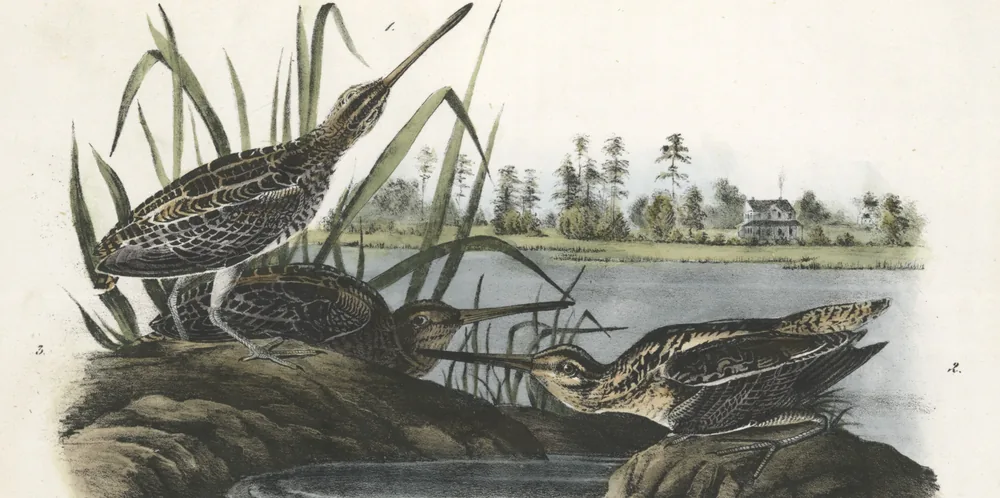
Audubon named it for Wilson too. His plate 243 is the “American Snipe,” Scolopax Wilsonii, and he praised the European naturalists who had named it after Wilson.
In Louisiana it was “cache cache.” That was its Creole name, Audubon wrote, and in the rice fields near Charleston he flushed snipe “by fifties and hundreds” from a few acres.
The snipe hunt is a prank on a real bird. The joke, sending someone into the middle of nowhere with a bag to catch an imaginary creature, dates back to the mid-1800s, says the Illinois Department of Natural Resources' Outdoor Illinois Journal.
Thirty in a row made a marksman. “He who shoots thirty snipes in succession, without missing one,” Audubon wrote, “is a good hand at any kind of shooting.”
Why it changed
It came down to the sound of the tail. The 43rd Supplement set Wilson's Snipe apart for “differences in winnowing display sounds” and in the outer tail feathers that make them, differences it found comparable to those between other close species of snipe.
Winnowing is the male's display flight: he circles high, often at night, and dives, and his vibrating outer tail feathers make a hollow, whinnying hum, Audubon's field guide explains. In 1839 a reader wrote to Audubon that he could not tell whether the sound came from the snipe's voice or its wings.
The two had been merged on their general likeness. The supplement traces that to Oberholser in 1921, and by the 1957 check-list the American bird was a race of the Common Snipe.
Audubon had argued the other side a century before. In 1835 he credited Wilson with first showing the difference from the European snipe, and wrote that the notes of the two differ as much as an American Crow's from a Carrion Crow's.
Who decided, and when
- American Ornithological Society (AOS): the 43rd Supplement to its Check-list, printed in its journal The Auk when the society was still the American Ornithologists' Union (AOU)
When was the common snipe split?
In July 2002, in the 43rd Supplement to the Check-list of North American Birds, printed in The Auk. It covers the committee's decisions from January 1, 2000 to December 31, 2001; that issue of the journal came out in September 2002.
Wilson's Snipe was one of four species it added to the list by splitting birds already on it. Its scientific name goes back to Ord in 1825, in his reprint of Wilson's American Ornithology, with Pennsylvania as the place.
Is the snipe bird found in North America?
Yes: Wilson's Snipe nests across Alaska, Canada and the northern states and winters through much of the US and south to South America. The true Common Snipe of Europe and Asia reaches North America only in Alaska's Aleutian Islands, where the 1983 check-list said it probably nests on Attu and Shemya.
Audubon found snipe nesting from Pennsylvania north to Maine and Nova Scotia, and wintering in Kentucky, Louisiana and the Carolinas. Birds banded in Canada have reached the Lesser Antilles and South America, says Audubon's field guide.
Where do common snipes live?
In Europe and Asia: the Common Snipe nests from the British Isles and Scandinavia across Russia and Siberia and winters south to Africa, India and the Philippines, the 1983 check-list says.
In the Americas the old name now means Wilson's Snipe. South American snipe once counted as Common Snipe are now generally treated as species of their own, the 43rd Supplement notes.
What's the difference between a snipe and a woodcock?
Where they live and how they are striped: a snipe is a bird of open marshes and wet fields, with stripes running lengthwise on its head and back. The American Woodcock hides in forest thickets by day and has crosswise black bars on its crown and an orange-buff belly, says Audubon's field guide.
Both probe soft ground for worms with long bills, and both court in the air: the snipe with its winnowing dives, the woodcock with a twisting, twittering “sky dance” on spring and summer nights.
What kind of noise does a snipe make?
Two kinds: a sharp, rasping scaip! when it is flushed, and in the breeding season the hollow, whinnying winnowing of the male's display flight. That one comes from his outer tail feathers, not his voice, says Audubon's field guide.
The male also yammers from the top of a fencepost or a dead tree. Audubon wrote the flush call as wau-aik.
Can a snipe bird fly?
Yes, fast and well: flushed from the marsh, it dashes off in a zigzag a few feet above the ground, then climbs and circles, Audubon wrote, and it migrates long distances, probably alone.
The young fly at about 19 or 20 days old, says Audubon's field guide.
Is the snipe a rodent?
No. A snipe is a real bird, a sandpiper of wet places 10 to 12 inches long, though the old snipe-hunt prank leaves some people thinking it is made up.
Illinois's wildlife journal says that people shown a photo of a snipe sometimes answer that they thought snipe were fake.
Why would you hunt snipes?
Because it is a game bird with a hunting season: a fast, erratic flier of wet places, hunted in fall along with ducks and upland birds, Illinois's wildlife journal explains. The US Fish and Wildlife Service estimated that 21,300 people hunted snipe in 2019 and took 92,700 birds; North Carolina, Florida and Michigan were the most popular states.
Few people do it. Illinois's harvest estimate for 2019 was zero, and the journal calls snipe hunting almost nonexistent in much of the country.
Where do snipe nest?
On the ground, usually well hidden in a clump of grass or tundra plants: a shallow hollow lined with fine grasses, leaves and moss, sometimes with plants woven over it like a canopy, built by the female. She lays 4 eggs, sometimes 3, and sits on them alone for 18 to 21 days, says Audubon's field guide.
The downy young leave the nest soon after hatching, and the parents may split the brood, each caring for one or two chicks. The oldest Wilson's Snipe in the US Geological Survey's banding files was banded as a young bird in Newfoundland and Labrador in 1964 and shot there in 1973, at 9 years and 3 months.
Which one did you see?
In North America, it's Wilson's Snipe. A Common Snipe in a US or Canadian notebook is today's Wilson's Snipe.
In Europe or Asia, it's still a Common Snipe. The name stayed with Gallinago gallinago.
Alaska's far islands are the one overlap. The Eurasian bird visits the Aleutians; anywhere else in North America, a snipe is a Wilson's.
The field marks are close. Both are round sandpipers with very long bills, short legs and striped heads and backs; the split rests on the winnowing sound and the tail feathers that make it.
What it does to your list
Usually only the name changes: a Common Snipe seen in North America is a Wilson's Snipe, and your count stays as it was.
If you also saw snipe in Europe or Asia and counted them as the same bird, the split gives you one more species.
In a Birdfolio, a Common Snipe seen in the Americas, or with no place given, is filed as a Wilson's Snipe, with a note that your list used an older, broader name. One seen in Europe or Asia stays a Common Snipe. In Alaska, a record that says only "Common Snipe" is filed as a Wilson's Snipe too, since the Eurasian bird reaches only the far Aleutians; a record that names Gallinago gallinago, as eBird's own downloads do, stays a Common Snipe.
More on why one name can become two: bird splits and lumps.
Keep your Common Snipe sightings in Merlin? Here's how to get your list out of Merlin and into a book with today's names.
Check your own list. Drop your eBird download or type your birds: the free checker shows which of them the changes since 2018 touched.
Check my list