2025 split
Elegant Trogon split: Arizona's bird is now Coppery-tailed Trogon
The Elegant Trogon of Arizona is now called Coppery-tailed Trogon: eBird and its Clements Checklist split Elegant Trogon in two in October 2025, after the AviList world checklist did in June 2025. The name Elegant Trogon now belongs to the Central American bird. For US birders it's a new name, not a new bird, and an old name back: Coppery-tailed Trogon was its official name for decades, until 1983.
Updated
What changed
The one trogon that regularly nests in the US, in the mountain canyons of southeast Arizona such as Madera Canyon. It also lives in Mexico.
Central America, from Guatemala to Costa Rica.
Is Coppery-tailed Trogon the same as Elegant Trogon?
For US birders, yes: the Coppery-tailed Trogon is the bird of southeast Arizona's canyons that birders called Elegant Trogon until 2025. Since the split, Elegant Trogon is the name of the Central American bird, found from Guatemala to Costa Rica, says the Tucson Bird Alliance.
They are separate species in eBird and in AviList, the shared world checklist, but not for the American Ornithological Society (AOS), whose Check-list still had one Elegant Trogon when we checked in October 2026. So you will see both names in Arizona for a while: the survey page of the state's Important Bird Areas program, updated in May 2026, still speaks of Elegant Trogons.
What is the new name for the Elegant Trogon?
Coppery-tailed Trogon, which is really its old name. The Check-list of North American birds called the Arizona bird Coppery-tailed Trogon in 1895, and still did in 1957, after merging it with the Central American Trogon elegans. Only the 1983 edition switched to Elegant Trogon, noting that the northern birds had sometimes been treated as a separate species.
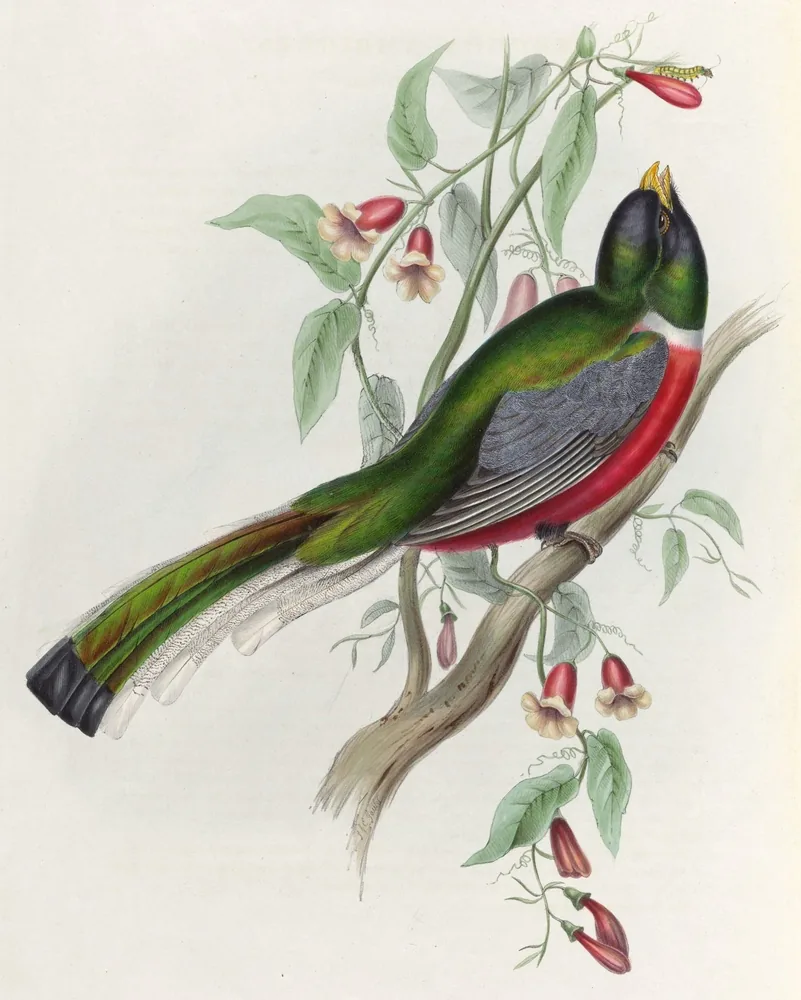
The name fits: the tail shows a coppery sheen above, says Audubon's field guide. The painting at the top of this page comes from Gould's own book of trogons.
Surprising facts about the Coppery-tailed Trogon
It barks. Its call is “rather like a small dog barking, but drier,” say the Friends of Madera Canyon; Audubon's field guide writes it as a loud ko-ah ko-ah ko-ah that is hard to locate.
Its feet are one of a kind. Trogons are the only birds whose second toe is permanently turned backward, and a fossil trogon that lived in what is now Britain some 55 million years ago already had that foot, Sci.News reported in 2023.
Its name means “gnawer.” Trogon is a Greek word for gnawer, for its diet and hooked bill, says the Tucson Bird Alliance.
The parents take shifts. The female sits on the eggs at night and at midday, the male in the early morning and late afternoon, for 22 to 23 days, says Audubon's field guide.
Arizona protected it early. Around 1940 it became one of the first non-game birds in the US to get special protection, when Arizona banned collecting it, says New Mexico's Department of Game and Fish.
The first proof it nested here came in 1885. A young bird taken in Arizona's Huachuca Mountains on August 24, 1885, showed that the trogon not only reached Arizona but bred there, The Auk reported in 1888.
Why it changed
Mostly looks and voice. AviList, which split it first, points to differences in plumage and calls, backed by modest differences in their DNA, and says a formal study of their sounds is still needed to confirm the split.
The difference was seen long ago. John Gould, the English bird artist, described the Elegant Trogon in 1834, from Guatemala, and the northern bird in 1835 as Trogon ambiguus, according to AviList. He told them apart by the tail: faint, finely dotted markings on the outer tail feathers of the northern bird, against strong black bars on the Elegant's.
Who decided, and when
- AviList, the shared world checklist: agrees, with the same names
- American Ornithological Society (AOS): had not made this split as of its 66th Supplement, its latest (checked October 2026): its Check-list still has one Elegant Trogon
- eBird and the Clements Checklist: its 2025 taxonomy update
How rare is the Elegant Trogon?
Rare in the US, and scarcer lately. Volunteers counted only 31 in Arizona's May survey in 2025, the lowest since the surveys began in their current form in 2013; the previous low was 68, in 2021, says the Arizona Important Bird Areas program. Some routes had no trogons at all for the first time.
Numbers swing with the rain. The count was 201 in 2020, 183 in 2023 and 119 in 2024. The ups and downs are driven largely by the previous year's monsoon rains, the Tucson Bird Alliance says: in poor years, fewer birds likely complete the trip north to nest. A 2011 wildfire burned more than 75 percent of its range in the Chiricahua Mountains.
New Mexico has listed it as endangered since 1975; its only known nesting place there was a single canyon in the Peloncillo Mountains. Worldwide, AviList lists both trogons as of least concern on the IUCN Red List.
What is an Elegant Trogon?
A tropical bird, about a foot long, that sits upright and still for minutes at a time. The Coppery-tailed Trogon of Arizona is 10.6 to 12.2 inches long, with a red belly, a white band across the chest and a yellow bill; the male's head and back are golden green, the female's brownish, says Audubon's field guide.
It eats big insects, such as katydids, cicadas, walking sticks and large caterpillars, and small fruits like chokecherries and wild grapes, often plucking them while hovering.
What type of bird is a trogon?
One of a family of colorful, mostly tropical birds, the Trogonidae, which includes the quetzals. AviList counts 47 species in Africa, tropical Asia and the Americas. The Coppery-tailed is the only one that regularly nests in the US.
Trogons nest in tree holes, and this one can't dig its own: it uses old woodpecker holes, usually a Northern Flicker's, often in a sycamore 8 to 50 feet up, say Audubon's field guide and the Tucson Bird Alliance.
Where can I find an Elegant Trogon?
In the canyons of southeast Arizona's mountain ranges, the Santa Ritas, Huachucas, Chiricahuas, Patagonias and Atascosas, at 3,650 to 6,300 feet. It nests almost always where sycamores grow along flowing streams, says Audubon's field guide, and nearly all known US nesting sites are in the Coronado National Forest, says the Sonoran Joint Venture.
In Madera Canyon, the Friends of Madera Canyon suggest the lower Carrie Nation Trail, with its creekside sycamores, and say trogons are seen most reliably from April to early October. Cave Creek Canyon, in the Chiricahuas, became the place for trogon seekers by the late 1970s, says the Tucson Bird Alliance.
Most arrive in April and May and leave in September and October; one or two sometimes stay the winter along low streams, says Audubon's field guide. Please keep your distance and skip recorded calls: New Mexico's wildlife agency lists disturbance by photographers and by birders playing recordings among the threats to nesting birds.
Which one did you see?
Go by country. A trogon seen in Arizona or Mexico is Coppery-tailed Trogon. Only birds seen from Guatemala to Costa Rica are Elegant Trogon.
What it does to your list
For US birders it's a new name only: the Elegant Trogon you saw in Arizona is now Coppery-tailed Trogon.
If you have also seen Elegant Trogon in Central America, your total goes up by one. Birders call a species gained from a split, without a new sighting, an “armchair lifer.”
Other familiar birds split the same year: see the Whimbrel split and the Yellow Warbler split. In 2026 two more birds of Arizona's mountain canyons changed: the Painted Redstart, now Painted Whitestart, and the Tufted Flycatcher.
Once your list calls your Arizona trogon a Coppery-tailed Trogon, you can see your list as a book, free, with the date and place you first saw each bird.
Check your own list. Drop your eBird download or type your birds: the free checker shows which of them this and other recent changes touched.
Check my list