1997 split
Solitary Vireo: now the Blue-headed, Cassin's and Plumbeous Vireos
The Solitary Vireo is now three birds: the Blue-headed Vireo in the East, Cassin's Vireo in the Pacific states and the Plumbeous Vireo of the Rockies and the Southwest. The American Ornithologists' Union, the forerunner of today's American Ornithological Society (AOS), split it in July 1997. Where you saw the bird usually tells you which one it was.
Updated
What changed
The East and the North: it nests in mixed woods of conifers and broadleaf trees across Canada, in New England, the Great Lakes states and the Appalachians. It winters farther north than other vireos, many of them in the southeastern states.
The Pacific states and parts of the northern Rockies in summer: oaks near the coast, ponderosa pines and Douglas-firs inland. Small numbers winter in the Southwest.
The Rocky Mountain region and the Southwest in summer, in middle-elevation woods of ponderosa pine, pinyon and juniper, often with oaks below; in Texas it nests in the Davis and Guadalupe Mountains. Small numbers winter in the Southwest.
What is a solitary vireo called now?
It depends on where the bird was: a Blue-headed Vireo in the East, a Cassin's Vireo along the Pacific, a Plumbeous Vireo in the Rockies and the Southwest. Audubon's field guide says of each that it “was formerly lumped” with the other two “under the name Solitary Vireo.”
Solitary Vireo was the species' name on the check-list by its 1957 edition, and stayed until 1997. In the East the bird is the same as before; it only lost the old name.
Surprising facts about the Solitary Vireo
It was named for keeping quiet. Alexander Wilson named it the Solitary Flycatcher in 1810. He had seen only three, one of them shot in Mr. Bartram's woods near Philadelphia in October, and wrote: “It is a silent, solitary bird.” Audubon heard nothing more from it than “a querulous low murmuring sound.” Today Audubon's field guide says the male “sings frequently throughout the day.”
The new names were the old names. The 1886 check-list listed the Blue-headed Vireo as number 629, Cassin's Vireo as 629a and the Plumbeous Vireo as 629b, all forms of one species. By 1910 there were five names under it, with the Mountain Vireo of the Appalachians and the San Lucas Vireo of southern Baja California. AviList, the shared world list, files those two under Blue-headed and Cassin's today.
One Ontario vireo ended up in Guatemala. A Blue-headed Vireo banded in Ontario on May 15, 1962, was shot in Guatemala on November 1, 1968, six and a half years later. It is the species' age record in the US Geological Survey's banding files.
Its nest may carry paper. Both parents build a cup that hangs by its rim from a forked twig, and the outside may be decorated with moss, pine needles or pieces of paper, says Audubon's field guide.
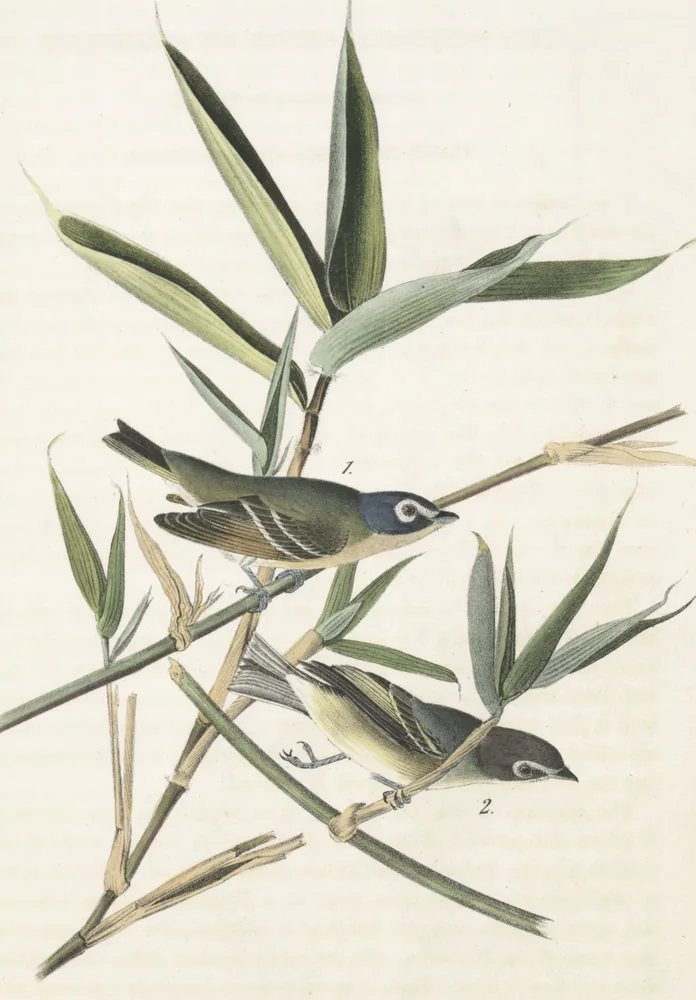
Audubon painted a pair in a canebrake. His chapter on plate 28 of The Birds of America is headed “The Solitary Fly-catcher, or Vireo.” The smaller edition of the 1840s, shown on this page, titled it the “Solitary Vireo, or Greenlet.”
Why it changed
The union's own check-list saw it coming. Its 1983 edition still listed one Solitary Vireo, but the entry ended with a warning: “more than one species may be presently included under V. solitarius.” Drawing the lines, it said, would have to wait for the evidence to be published.
The evidence came from the birds' proteins. In November 1995 the ornithologist Ned K. Johnson published, in The Condor, a study of allozymes, variant forms of the same enzyme made by different versions of a gene, in Solitary Vireos across the contiguous United States. His range maps, drawn from that genetic work, show only one likely place where Cassin's and Plumbeous Vireos nest side by side, the southern tip of California's Sierra Nevada, a 2020 study in Western Birds notes.
In July 1997 the union made the three forms species. New Mexico's bird society summed it up for its members that year: “the former Solitary Vireo is divided into three species.”
It was a return more than a discovery. The union's first check-list, in 1886, already gave the three forms the names they carry today, Blue-headed, Cassin's and Plumbeous Vireo, as races of one species.
Who decided, and when
- American Ornithological Society (AOS): the 41st Supplement to its Check-list, printed in its journal The Auk when the society was still the American Ornithologists' Union (AOU), the last before the check-list's seventh edition of 1998
When was the solitary vireo split?
In July 1997, in the 41st Supplement to the Check-list of North American Birds, printed in The Auk. It covers what the union's committee decided between March 15, 1995 and March 15, 1997, says its record in the US Geological Survey's publications database, and it was the last supplement before the check-list's seventh edition, which followed in 1998.
The same supplement made the Plain Titmouse two species as well, and announced that the check-list would move the vireos next to the tyrant flycatchers in its order of bird families. New Mexico's bird society dated its own list “as amended through the 41st Supplement (July 1997).”
Is a solitary vireo the same as a blue-headed vireo?
In the East, yes: the Blue-headed Vireo is the eastern Solitary Vireo under its new name, and it kept the old scientific name, Vireo solitarius. In the West, no: a Solitary Vireo seen there was a Cassin's or a Plumbeous.
The two western birds took back names first given in the 1800s. Cassin's Vireo is Vireo cassinii, described by Xantus in 1858 from Fort Tejon, California; the Plumbeous is Vireo plumbeus, described by Coues in 1866 from Fort Whipple, Arizona, the 1910 check-list records.
How do you tell Blue-headed, Cassin's and Plumbeous Vireos apart?
By the color of the head and sides, then by place. All three wear white “spectacles” and two white wing bars. The Blue-headed has a blue-gray head that stands out against a white throat, a greenish back and yellow sides. The Plumbeous is gray and white, with only a tinge of color in fresh fall feathers. Cassin's is like a duller Blue-headed, says Audubon's field guide.
Cassin's is the hard one. The guide says it is best told by range and that where the birds overlap, some may not be identifiable; it often flicks its wings nervously, and the Plumbeous is a little larger and less active. Cassin's Vireos in faded spring and summer feathers can be quite pale, a 2020 study in Western Birds notes, which makes some birds impossible to name in that season.
What does a solitary vireo sound like?
A slow string of short phrases, different in each of the three. The Blue-headed sings sweet, slurred phrases like a Red-eyed Vireo's, but slower and more musical. The Plumbeous is burry, slower and rougher than Cassin's, and Cassin's falls in between, says Audubon's field guide. All three call with a husky chatter.
Pitch can separate the two western birds, on average. Edward Pandolfino and Chris Ray measured five features of songs recorded where only one of the two nests, and only pitch differed: Cassin's sings higher. A cutoff of about 3,215 hertz named the right bird for about 84 percent of the songs they measured.
Where do Blue-headed, Cassin's and Plumbeous Vireos live?
The Blue-headed nests in mixed woods of conifers and broadleaf trees in the East and across Canada, and in parts of the East it has spread south in recent decades. Cassin's is a summer bird of the Pacific states and parts of the northern Rockies. The Plumbeous nests in the Rocky Mountain region, in ponderosa pine and pinyon-juniper woods, says Audubon's field guide.
In Texas the Plumbeous nests in the Davis and Guadalupe Mountains of the Trans-Pecos, says the Texas Breeding Bird Atlas; the other two only pass through. In New Mexico all three have been recorded: the Plumbeous as a fairly common nesting bird of the mountains, Cassin's as a migrant, the Blue-headed as a very rare one.
Do solitary vireos migrate?
Yes, all three, and they tend to travel early in spring and late in fall. The Blue-headed comes back earlier in spring and leaves later in fall than the other vireos where it lives, and winters farther north, with good numbers staying in the southeastern states, says Audubon's field guide. Small numbers of Cassin's and Plumbeous winter in the Southwest.
Some go much farther. The Ontario bird of the banding record above was in Guatemala on November 1, and the 1910 check-list already gave the Blue-headed's winter range as reaching from the Gulf States to Guatemala.
Where do solitary vireos nest?
In a tree, in a bulky open cup slung by its rim in a horizontal fork of a branch. The Blue-headed's nest is often only 3 to 12 feet up, the Plumbeous's 6 to 12 feet, and Cassin's usually near the tip of a branch, often 15 to 20 feet up, says Audubon's field guide.
Both parents build the nest, sit on the 3 to 5 eggs for about 12 to 14 days and feed the young, which leave about two weeks after hatching. In some areas cowbirds often lay their eggs in these nests; the Plumbeous is “extensively parasitized,” says the Texas Breeding Bird Atlas.
Which one did you see?
Start with the place. In the East and across Canada's forests it was a Blue-headed Vireo. Along the Pacific, from British Columbia to California, a Cassin's Vireo. In the Rockies and the Southwest, in summer, most likely a Plumbeous Vireo.
In migration it could be any of them. Cassin's Vireos pass through the Southwest, and New Mexico's list has all three.
Then look at the head and sides. Blue-gray head, white throat, yellow sides: Blue-headed. Gray and white with hardly any color: Plumbeous. In between and duller: Cassin's.
A worn summer bird may not be identifiable at all. Song pitch helps with the two western birds, but only on average.
What it does to your list
One old name, three birds today. If your list has a Solitary Vireo from the East and another from the West, that one line can now be two species, or three.
If you saw it in one part of the country only, your count stays the same and the bird takes its new name.
In a Birdfolio, a Solitary Vireo that comes with a place is filed by it: seen in the eastern states and provinces, it is a Blue-headed Vireo; seen in Washington or Oregon, a Cassin's Vireo. Anywhere else, where two or three of them nest or pass through, or with no place, we ask you which one it was.
Read more about how bird splits and lumps work, and why names change.
Is a Solitary Vireo still on your list? Turn it into a book with each bird under today's name, and see the opening pages free.
Check your own list. Drop your eBird download or type your birds: the free checker shows which of them the changes since 2018 touched.
Check my list