2024 split
Herring Gull split into four species
The Herring Gull is now four species: eBird split it in October 2024, and the American Ornithological Society (AOS) made it official on August 14, 2025. The Herring Gull of the US and Canada is now the American Herring Gull, and Europe's is the European Herring Gull. For most US birders it's a new name, not a new bird: your total goes up only if you have also seen one of the others.
Updated
What changed
The Herring Gull of North America, the one to expect almost everywhere in the US and Canada.
Nests in northeastern Siberia and on St. Lawrence Island in the Bering Sea, and winters in East Asia. In North America it is mainly a bird of western Alaska.
Europe. In North America only a very rare stray: the ABA added it after a bird in Newfoundland.
Nests in Mongolia and nearby, and winters in East Asia. Not a North American bird.
Is the American Herring Gull a new species?
It's a newly recognized species, not a newly found bird. The American Herring Gull is the same gull North Americans have always called Herring Gull. What changed is that the checklists now count it as a species of its own, apart from the Herring Gulls of Europe and Asia.
Its scientific name is Larus smithsonianus. The old name, Larus argentatus, now belongs to the European Herring Gull alone.
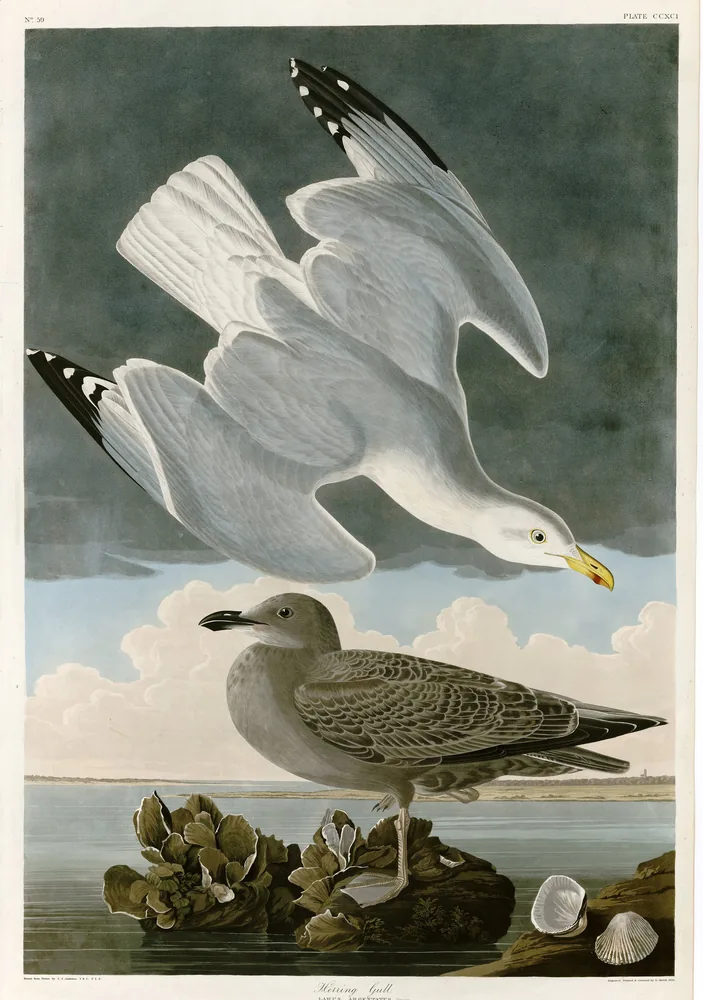
The main checklists agree, with the same English names: eBird in 2024, the AviList world checklist in June 2025 and the AOS in August 2025. John James Audubon painted the bird as plate 291 of The Birds of America, titled simply "Herring Gull." That is the painting at the top of this page.
Surprising facts about the Herring Gull
The red spot on its bill is a feeding button. A chick pecks at the red spot on its parent's bill, and that makes the parent bring up food for it, says John Morton, a biologist at Kenai National Wildlife Refuge in Alaska. A BirdNote piece on Audubon's website calls the spot a crucial signal when a chick begs to be fed, and so for its survival.
That spot helped win a Nobel Prize. In the summer of 1946, the scientist Niko Tinbergen and his students showed gull chicks dummy heads, from flat cutouts to plaster models. They changed the color, the contrast, the shape of the head and bill, and how low the bill was held. What made the chicks peck was the red spot against the yellow bill, and no one had to teach them: it is instinct. Tinbergen shared the 1973 Nobel Prize in Physiology or Medicine with Karl von Frisch and Konrad Lorenz.
A red stick beat the real thing. Tinbergen's team painted three white rings at the end of a long red rod. It got 26 percent more pecks than a lifelike plaster model of a gull's head and bill. Scientists call a fake like this, which works better than the real thing, a "supernormal" stimulus.
It bombs its shellfish. An American Herring Gull may carry a crab or another hard-shelled meal high into the air and drop it on rocks to break it open, says Audubon's field guide.
It made a big comeback. Hunting for its eggs and feathers made its numbers fall sharply in the 1800s. Under protection, it increased greatly in the 1900s and spread its nesting range far south along the Atlantic Coast. Audubon's field guide puts its population at 3,900,000 birds.
Why it changed
For years, experts had suggested that the bird called Herring Gull was really more than one species, Kenn Kaufman wrote in Audubon magazine in August 2025.
The AOS based its split on four kinds of differences: in the birds' genes, in their looks, in how and where they live, and in their calls. The four gulls are closely related and only recently went their separate ways, and they still sometimes interbreed. But studies of their family tree suggest they are not each other's closest relatives.
Who decided, and when
- eBird and the Clements Checklist: its 2024 taxonomy update
- American Birding Association (ABA): added Vega Gull to the ABA Checklist (and European Herring Gull in September 2025)
- AviList, the shared world checklist: agrees, with the same names
- American Ornithological Society (AOS): the 66th Supplement to its Check-list of North American birds, in the journal Ornithology
How do you tell an American Herring Gull from a European Herring Gull?
Mostly by where you see it. In North America almost every Herring Gull is American; in Europe, it's the European Herring Gull. Picking out a stray by its looks is hard, even for experts: in 2025 the American Birding Association's checklist committee wrote that telling European, American and Vega Gulls apart is difficult, and will stay that way.
Adults look much alike. An adult American Herring Gull has black wingtips with white spots, pale eyes, pink legs and a yellow bill with a red spot, says Audubon's field guide.
Young birds give the best clues. Gull experts Pat Lonergan and Killian Mullarney describe first-year American Herring Gulls as darker overall, many with smooth, evenly dark brown underparts that a European bird probably never quite matches. The rump and the feathers just above the tail are thickly barred or spotted with dark brown, and the feathers under the tail are heavily marked too. On a young European Herring Gull, those under-tail feathers look mostly whitish.
Many birders look for an all-dark tail on a young American bird. The same experts note that only a minority really have one, so it's a clue, not proof.
Vega Gull is just as close. Kenn Kaufman says an adult Vega Gull has a darker gray back than an American Herring Gull, but the two look very similar. Picking out a Vega or a European Herring Gull away from its usual range is, in his words, "an extreme ID challenge."
Why are gulls so hard to identify?
Because a young gull looks nothing like its parents, and it takes years to grow up. An American Herring Gull starts out all dark brown, with a blackish bill, and reaches adult plumage only in its fourth winter, says Audubon's field guide. So the big brown gulls in a flock are often Herring Gulls too, just young ones. Audubon's painting at the top of this page shows both: a gray-and-white adult in flight above a brown young bird.
Even adults change with the seasons. An adult's head is white in spring and summer and heavily streaked with gray-brown in winter.
And the four former Herring Gulls are close kin. The AOS notes that they are closely related, separated only recently, and still sometimes produce hybrids.
For a life list, the easy answer is usually the right one. Kaufman calls the American Herring Gull the one to expect almost everywhere in North America.
Do European Herring Gulls come to North America?
Yes, but only as very rare strays. Kenn Kaufman calls the European Herring Gull a very rare visitor to eastern Canada, with a few records in the eastern US. The AOS lists it as accidental in eastern Canada, on the US East Coast and in Bermuda.
In September 2025 the American Birding Association (ABA) added European Herring Gull to the ABA Checklist, its official list of the birds of the US and Canada, by a vote of 7 to 1. The decision rested mainly on a well-documented adult in Newfoundland on January 1, 2006.
Vega Gull is mainly a bird of western Alaska on this side of the Bering Sea. Kaufman says it turns up only rarely in southern Alaska and along the Pacific Coast. The fourth species, Mongolian Gull, hasn't been found in North America yet.
The American Herring Gull is the common one. Audubon's field guide says it lives all year as far north as New England, the Great Lakes and southern Alaska. Some go south as far as Mexico, and a few to the West Indies and Panama. Look for it on ocean coasts, bays, beaches, lakes and piers, and at farm fields and dumps.
Which one did you see?
Go by where you saw it. In the lower 48 states and across Canada, it's American Herring Gull. In Europe, it's European Herring Gull.
Vega Gull is the one to think about only in western Alaska, where it is common in parts.
A gull that seems out of place is a job for experts with good photos: see the clues above.
What it does to your list
For most birders in the US and Canada, nothing changes but the name: your Herring Gull now counts as American Herring Gull, and your total stays the same.
You gain one only if you have also seen one of the others: a European Herring Gull on a trip to Europe, or a Vega Gull in Alaska or Asia. Seen both? That's two more. Birders call a species gained from a split, without a new sighting, an "armchair lifer."
Another familiar gull went the same way: see the Mew Gull split. And read more about how bird splits and lumps work.
When your list reads American Herring Gull, you can print your bird life list from eBird's own page, a spreadsheet, a free printable or a bound book.
Check your own list. Drop your eBird download or type your birds: the free checker shows which of them this and other recent changes touched.
Check my list