2022 split
Chihuahuan Meadowlark: the Eastern Meadowlark split
The Chihuahuan Meadowlark is the meadowlark of the desert grasslands of Arizona, New Mexico and west Texas: the American Ornithological Society (AOS) split it from the Eastern Meadowlark on August 3, 2022, and eBird followed in October 2022. Eastern Meadowlark keeps its name in the East. If you have seen meadowlarks in both places, your list goes up by one.
Updated
What changed
Grasslands and fields of the eastern US and southeastern Canada, and from Mexico south to northern South America. Also in Cuba.
Desert grasslands of Arizona, New Mexico and west Texas, and south into northern and western Mexico.
How is the Chihuahuan Meadowlark different from the Eastern Meadowlark?
Mostly by where it lives. In North America the Eastern Meadowlark lives only east of the Rockies, and the Chihuahuan in the dry grasslands of the Southwest, so range is the best way to tell them apart, says Audubon's field guide.
Up close, the Chihuahuan is somewhat paler on the back and has much more white in its tail, best seen when it spreads its tail to land. Its song averages lower, with the highest note more often at the start, where the Eastern's comes near the end, writes Michael Retter of the American Birding Association (ABA); it has been rendered as tortilla con chile.
Eastern vs. Western Meadowlark: what's the difference?
Mostly the song: they look almost alike, says Audubon's field guide. The Western's song is a rich, gurgling, flute-like tumble; the Eastern's, a few clear whistles: see-you, see-yeeeer. The Western calls a throaty chook, the Eastern a buzzy dzzhrrt.
An Eastern can look slightly darker, with less yellow on the face; where both live, in the Midwest, they almost never interbreed, Audubon's guide says.
Surprising facts about the Chihuahuan and Eastern Meadowlarks
Naming it took a poll. The AOS committee couldn't agree on a name, so it polled eBird's reviewers, twice: 283 answered the second poll, and Chihuahuan won with 124 first-place votes. “Madrean” lost partly because the word has vulgar connotations in Mexican Spanish, and “Lilian's” partly because the committee had stopped giving newly split species people's names.
Lilian was a real person. The scientific name, lilianae, honors Lilian Hanna Baldwin, who gave the Cleveland Museum of Natural History the specimens it was described from in 1930. She was the widow of Samuel Prentiss Baldwin, whose careful bird banding helped revolutionize the practice, says the Encyclopedia of Cleveland History.
Meadowlarks aren't larks. They are blackbirds, says the Texas Breeding Bird Atlas; Audubon's field guide files them with the blackbirds and orioles, and Audubon himself called this one the “Meadow Lark or American Starling.”
One ate its cagemates. In 1834 a Charleston doctor told Audubon that a meadowlark bought at the market had killed two finches with clipped wings in his aviary, and eaten them.
Its grassland starred in westerns. Red River, Duel in the Sun and Winchester '73 were filmed on or near the Empire Ranch, now in Arizona's Las Cienegas National Conservation Area, says the Bureau of Land Management. The state's Important Bird Areas program lists the meadowlark there all year, under its pre-split name.
Why it changed
Genes and songs. A 2021 study by Johanna Beam and two colleagues compared 81 songs and 31 whole genomes. A statistical test assigned songs to the right species 90.33 percent of the time, and the genes showed no sign of interbreeding, past or present, says Beam's proposal to the AOS.
The genes held a surprise. “Eastern and Western Meadowlarks are more closely related to each other than to the newly split Chihuahuan Meadowlarks,” the AOS committee's chair, Terry Chesser, explained. An older study, with just three genetic markers, had pointed the other way; the new one used 484,816.
It was the second try: the AOS committee had turned down a proposal to split them in 2016.
Who decided, and when
- American Ornithological Society (AOS): the 63rd Supplement to its Check-list of North American birds, after its committee passed proposal 2022-C-2
- eBird and the Clements Checklist: its 2022 taxonomy update
- AviList, the shared world checklist: agrees, with the same names
Is an Eastern Meadowlark rare?
Not yet, but it is getting scarcer. It is still common in much of the eastern US, but its numbers have declined significantly over the past few decades as grassland disappears, says New York's Department of Environmental Conservation. Audubon's field guide gives its global status as Near Threatened.
Are meadowlarks in decline?
Yes. The Eastern Meadowlark, counted before the split, has lost three-quarters of its North American population since 1970, about 74 million birds, according to a 2019 study cited by the Outdoor Illinois Journal. In Illinois the Breeding Bird Survey shows a drop of 3.4 percent a year from 1966 to 2019.
The Chihuahuan Meadowlark is falling by more than 4 percent a year in New Mexico and 6 percent across the Chihuahuan Desert, though it is increasing in Arizona, says the Sonoran Joint Venture. Partners in Flight lists it among its Common Birds in Steep Decline.
What does a female Eastern Meadowlark look like?
Much like the male. Females are slightly smaller, but otherwise the sexes look similar, says South Carolina's Department of Natural Resources; New York's conservation department adds that she is slightly duller, with a smaller black crescent on the chest. Audubon wrote in 1834 that the female “differs little from the male … but is smaller.”
Where are Eastern Meadowlarks found?
East of the Rocky Mountains, in native meadows and prairies, hayfields, pastures and grassy roadsides, says Audubon's field guide; other populations live in Cuba and from eastern Mexico to northern South America. In the Midwest it prefers taller, lusher grass than the Western Meadowlark.
Are meadowlarks good to eat?
It's not allowed: all three US meadowlarks are on the federal list of birds protected by the Migratory Bird Treaty Act, which makes it unlawful to hunt, kill, possess or sell them.
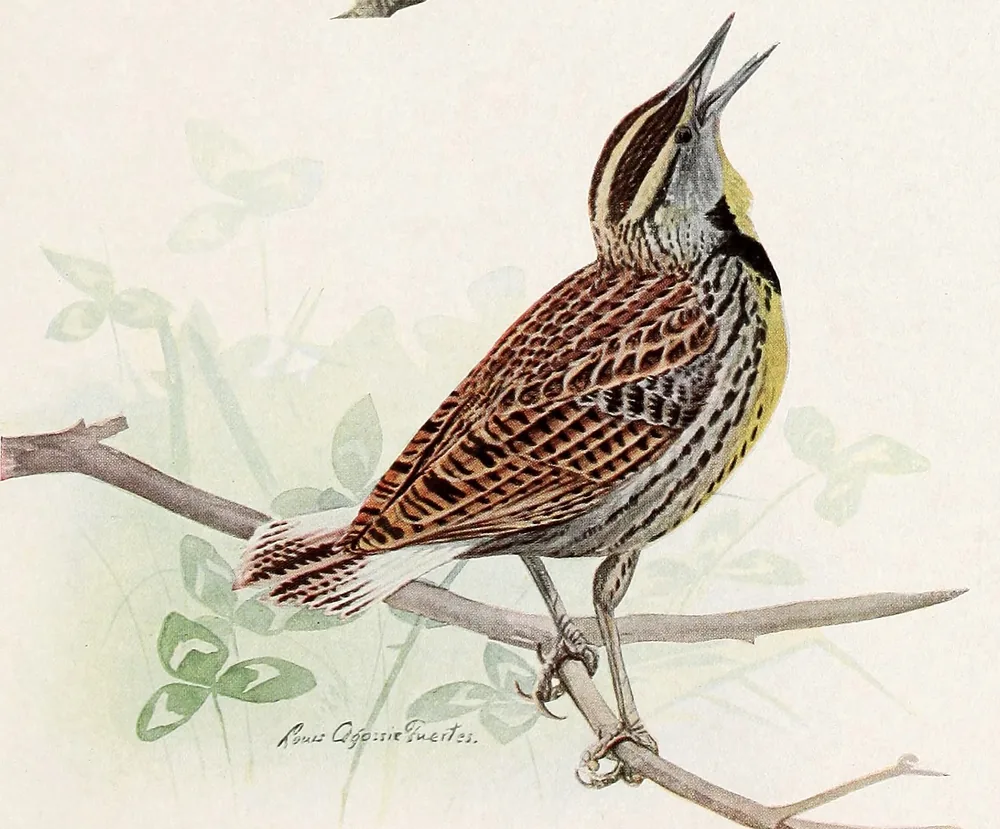
It was not always so. Audubon wrote in 1834 that the old birds' tough flesh smelled strongly of insects, yet they were “offered for sale in almost all our markets.” Elon Howard Eaton's Birds of New York (1914), the book with the painting at the top of this page, says the meadowlark was formerly hunted for game through most of the north central states.
Where can you see a Chihuahuan Meadowlark?
In Arizona, in grasslands above 3,500 feet in the southeast and center of the state, along the upper Little Colorado River, and in the Chino Valley and on the Coconino Plateau between Prescott and the Grand Canyon, says the Sonoran Joint Venture. Las Cienegas protects more than 45,000 acres of rolling grassland southeast of Tucson. In Texas it lives in the Trans-Pecos and on the southern High Plains, says the state's breeding bird atlas.
In winter, when Western Meadowlarks flock in farm fields, most Chihuahuan Meadowlarks stay in natural grassland, says Audubon's field guide.
Which one did you see?
Go by where you saw it. In the East, it's Eastern Meadowlark. In the grasslands of Arizona and New Mexico, it's Chihuahuan, unless it's a Western Meadowlark, which lives there too.
To tell a Chihuahuan from a Western: the Chihuahuan has much more white in its tail, and the pale stripe below its cheek stays separate from the yellow throat, while a Western's yellow throat spreads onto it, the Oklahoma Ornithological Society notes.
Don't rely on song alone. The three meadowlarks sometimes learn each other's songs, says Nathan Pieplow, author of the Peterson field guide to bird sounds, so you need a recording of the call or good photos of the face and tail.
What it does to your list
If you have seen meadowlarks both in the East and in the grasslands of the Southwest, your total goes up by one. Birders call a species gained from a split, without a new sighting, an “armchair lifer.”
If an old sighting just says “Eastern Meadowlark” and comes from a place where both live, such as parts of Texas, it may not say which one you saw. When eBird can't tell which of the new species an old record was, it keeps the sighting as a “one or the other” record. Those stay in your records but don't count as a species.
The painting at the top is by Louis Agassiz Fuertes; Audubon painted the Eastern Meadowlark too, as plate 136.
An armchair lifer belongs on paper too: once Chihuahuan Meadowlark is on your list, print the updated list.
Check your own list. Drop your eBird download or type your birds: the free checker shows which of them this and other recent changes touched.
Check my list