2021 new name
Thick-billed Longspur: the new name for McCown's Longspur
Thick-billed Longspur is the new name for McCown's Longspur: the American Ornithological Society (AOS) renamed it in August 2020, and eBird's checklist took up the new name in its next update, in August 2021. It is the same small bird of the shortgrass prairie, so your life list doesn't change: a McCown's Longspur on it counts as Thick-billed Longspur.
Updated
What changed
Nests on the shortgrass prairie of western Canada and the northwestern US. Winters farther south, as far as northwestern Mexico.
Is the Thick-billed Longspur the same bird as McCown's Longspur?
Yes. They are one species, Rhynchophanes mccownii, under two names: only the English name changed. The AOS, which sets the official English names of North American birds, adopted the new one in August 2020.
eBird's checklist adopted it in August 2021, and AviList, the shared world checklist, and BirdLife International use it too.
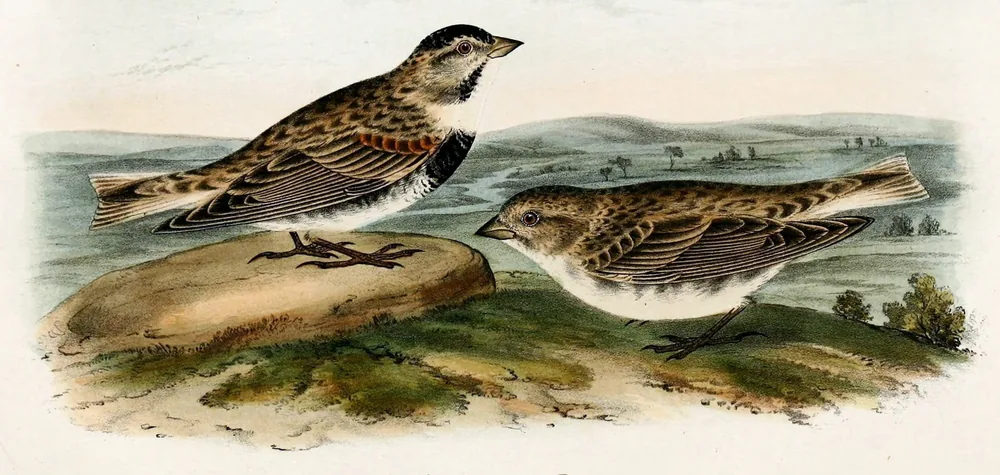
You will still meet the old name: parts of the Montana Field Guide still say McCown's, and the painting at the top of this page, from John Cassin's book of 1853–56 (reissued in 1862), calls it McCown's Bunting.
Surprising facts about the Thick-billed Longspur
It was discovered in Texas. The first two known to science were collected by Captain McCown on the high prairies of western Texas, feeding with Horned Larks, Lawrence wrote in 1851. Today it nests far to the north, on the prairies of Montana and Canada.
McCown owned an Audubon. His home in Arkansas had a “room of relics” with firearms from various wars, a Confederate flag and an original edition of John James Audubon's The Birds of America, the AOS proposal notes.
He later turned on the Confederacy. After a court-martial in 1863, McCown threatened to resign and go home to plant potatoes, and called the Confederacy a “damned stinking cotton oligarchy.” He served a six-month suspension and returned to action anyway.
“Buffalo Longspur” was on the list. The names put forward included Shortgrass, Bay-winged and Buffalo Longspur, for the bison herds of its range. One committee member called Thick-billed “an ultra-boring name”: by that member's count, 21 other birds were already called Thick-billed something.
Its scientific name was about the bill all along. Rhynchophanes, the genus name given in 1858 for its stout bill, means “showing the bill,” a committee member noted. The new English name says the same thing.
It sings while parachuting. In summer the male flies up about 30 feet and glides down, wings outstretched and tail fanned, singing, says Audubon's field guide. It nests on the ground, often beside a grass clump, a prickly pear or a dried cow pie.
Why the name changed
The bird was named in 1851 by George N. Lawrence, a New York ornithologist, for his friend Captain John P. McCown of the US Army, who collected it in Texas. Ten years later McCown left the US Army for the Confederate army, where he rose to major general, the AOS notes.
The AOS committee that rules on names turned down a first proposal to rename the bird, 7 votes to 1, with one abstention. It had no rule then for judging a name on grounds of offense, the AOS explained in June 2020, and it weighed McCown's substantial contributions to ornithology, the fact that the name came before the war, the lack of evidence that he held slaves, and his strong criticism of the Confederacy.
In 2019 the committee wrote new guidelines, which allow a name to be changed if it causes enough offense. A new proposal followed on July 24, 2020, by the committee's chair, Terry Chesser, and Robert Driver, who wrote the first one. It pointed to “heightened awareness of racial issues, and widespread retirement of overt Confederate symbols.” In August 2020 the committee voted, unanimously, for a new name.
The new name describes the bird: its thick bill sets males and females apart from the other longspurs all year, the proposal says, which also offered “Shortgrass Longspur”. The scientific name, Rhynchophanes mccownii, still honors McCown: the AOS leaves scientific names out of its renaming plans.
Who decided, and when
- American Ornithological Society (AOS): its committee voted, unanimously, to rename it Thick-billed Longspur, and published the change in January 2021
- eBird and the Clements Checklist: its 2021 taxonomy update (eBird had no update in 2020)
- AviList, the shared world checklist: agrees, with the same name
What bird names are being changed?
Birds named after people, in time. On November 1, 2023, the AOS committed to changing the English names of all birds in its area that are named directly after people, along with other names it deems offensive and exclusionary. The effort focuses first on 70 to 80 species found mainly in the US and Canada.
A pilot with six species was announced in May 2024: Inca Dove, Townsend's Solitaire, Maui Parrotbill, Bachman's Sparrow, Scott's Oriole and Townsend's Warbler. When we checked on October 8, 2026, no new names had been announced; the AOS's latest update, in May 2025, said it was still forming the pilot committee.
The Thick-billed Longspur came first: the AOS's 2023 announcement cites it as a name already changed because of the person it honored.
Not every new name is about a person. In 2019 the AOS renamed the Blue-throated Hummingbird Blue-throated Mountain-gem, so that all seven hummingbirds in its genus share one group name.
Why is Steller's Jay being renamed?
Because it is named after a person, though it hasn't been renamed yet. It honors Georg Wilhelm Steller, the German naturalist whose discovery it was, in 1741, says the National Park Service, and the AOS plans to change every English bird name in its area that is named directly after someone.
It is not among the six pilot species, and no new name had been announced when we checked in October 2026, so Steller's Jay is still its official name.
Is a longspur a sparrow?
No, though it looks like one. A Thick-billed Longspur is a chunky, sparrow-sized bird, says the Montana Field Guide, but AviList puts the longspurs in a family of their own with the snow buntings, the Calcariidae.
The name comes from the foot: “longspur” refers to the long claw on the hind toe. There are four longspurs, all found in North America: Thick-billed, Chestnut-collared, Lapland and Smith's.
What does a Lapland Longspur look like?
In summer the male Lapland Longspur has a black face and a chestnut nape. Females and winter birds usually show black mottling on the sides of the chest and rich reddish chestnut in the wings, and the tail has only narrow white edges, says Audubon's field guide.
That tail tells it from a Thick-billed Longspur, whose tail is mostly white with a black inverted T. Lapland Longspurs nest on the Arctic tundra and winter mostly on the Great Plains, in flocks of thousands.
What kind of bird has a thick beak?
Mostly birds that crack hard seeds. Thick, cone-shaped beaks evolved in more than one group of birds, BirdNote explains: grosbeaks, cardinals and finches have them. The Thick-billed Longspur fits: seeds make up more than half of what adults eat in summer and most of their winter diet, says Audubon's field guide.
It is no relation of the Thick-billed Parrot, which feeds on pine cones in the mountains of Mexico and last invaded Arizona and New Mexico in numbers in the 1920s, Audubon's field guide says.
Where can you see a Thick-billed Longspur?
On dry shortgrass prairie in summer, and on bare ground in the Southwest in winter. In Montana it is relatively common in the dry grasslands across the north and center of the state, says the Montana Field Guide.
It likes very short grass and open ground, even overgrazed pastures. In winter look in plowed fields and dry lake beds, often with Horned Larks, and at the edges of ponds: like other longspurs, it is drawn to water, says Audubon's field guide.
Is the Thick-billed Longspur declining?
Yes, steeply. Its population has fallen 94 percent since 1970, says the North Dakota Game and Fish Department, which lists it as possibly gone from the state, where it was once rather common in the west.
In Canada, home to about 120,000 of them (some 14 percent of the world's population), numbers have fallen 98 percent since 1970, and the Canadian population was assessed as threatened in 2016, says The State of Canada's Birds.
The main cause is the plowing and development of native shortgrass prairie, along with pesticides and the suppression of the fires that keep it short, says the Montana Field Guide; grazing may actually help.
Which bird is it?
There is nothing new to tell apart: McCown's Longspur and Thick-billed Longspur are the same bird.
The bird itself is about 6 inches long and chunky, with a big bill. The breeding male is gray with a black crown, a black breast patch and a chestnut shoulder; the female is plainer, with a pale bill. In every plumage the tail is mostly white with a black inverted T, say Audubon's field guide and the Montana Field Guide.
Its closest look-alike is the Chestnut-collared Longspur; the Thick-billed has a larger, paler bill and longer wingtips, says the Montana Field Guide.
What it does to your list
A new name only: your McCown's Longspur now counts as Thick-billed Longspur.
The eBird/Clements Checklist had no update in 2020: in November 2020 eBird still offered only McCown's Longspur, San Diego Field Ornithologists noted, and the new name came with the update of August 2021. If an older list or download says McCown's Longspur, it's the same species: nothing to add or remove.
Working from an old printout that still says McCown's Longspur? Print a fresh copy of your life list with today's names.
Check your own list. Drop your eBird download or type your birds: the free checker shows which of them this and other recent changes touched.
Check my list