1995 split
Scrub Jay: now the Florida, Island, California and Woodhouse's Scrub-Jays
The Scrub Jay of older field guides is now four birds: the Florida Scrub-Jay, the Island Scrub-Jay of Santa Cruz Island, and in the West the California Scrub-Jay and Woodhouse's Scrub-Jay. The American Ornithologists' Union, the forerunner of today's American Ornithological Society (AOS), split it into three in July 1995, then split the western bird in two in July 2016. Where you saw yours tells you which one it was.
Updated
What changed
Florida only, in low scrub of small oaks on sandy soil, which grows in scattered patches. A family stays on its own patch all year and almost never moves even a short distance.
Santa Cruz Island only, one of the Channel Islands off southern California, in oak woodland and chaparral. It is not known to leave the island.
The Pacific side: from southwestern Washington through western Oregon and California to western Nevada and Baja California, in oak woods, oak scrub, riverside woods, well-wooded suburbs and parks. It stays all year.
The interior West: from southeastern Oregon, southern Idaho and southern Wyoming south through the Great Basin and the Rockies to Arizona, New Mexico, western and central Texas and the highlands of Mexico, in pinyon-juniper woods and oak scrub. It stays all year.
What is a scrub jay called now?
It depends on where the bird was: a Florida Scrub-Jay in Florida, a California Scrub-Jay on the Pacific coast, a Woodhouse's Scrub-Jay in the interior West, an Island Scrub-Jay on Santa Cruz Island. All four were one species, the Scrub Jay, on the check-lists of 1957 and 1983.
The old name lives on inside each new one, now with a hyphen. When the bird was split in 1995 the group name stayed but “now must be hyphenated,” New Mexico's bird society noted. AviList, the shared world list, drops the hyphen again today: Florida Scrub Jay, California Scrub Jay.
Surprising facts about the Scrub Jay
Audubon's caged pair drank wine. In New Orleans he watched two Florida Jays that had been kept for two years. After dinner their cage was opened, he wrote in 1831, and they flew onto the table, ate the almonds they were given and “drank claret diluted with water.”
It was several species long before it was one. The 1886 check-list had three: the Florida Jay, Woodhouse's Jay and the California Jay. The 1910 edition had more, among them the Santa Cruz Jay and a Texas Jay first collected near the head of the Nueces River in Edwards County. By 1957 every one of them was a single bird, the Scrub Jay.
Texas still has its own kind. AviList counts that Texas bird today as a race of Woodhouse's Scrub-Jay, texana.
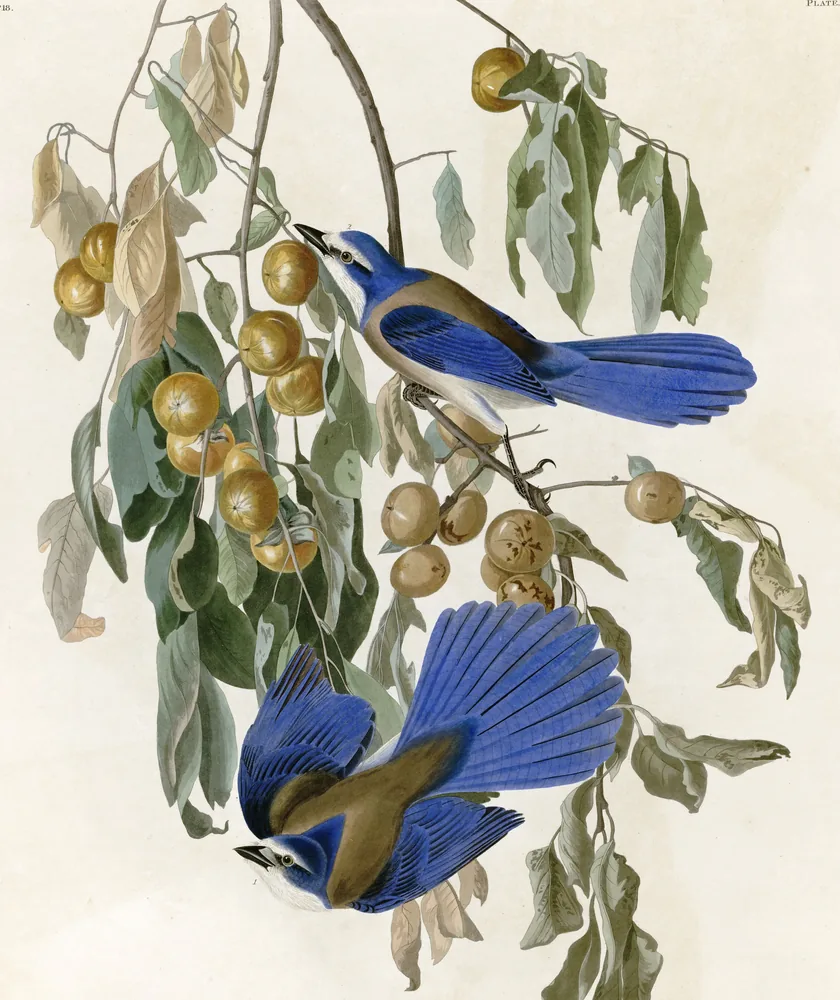
Audubon painted it among persimmons. His plate 87 of The Birds of America, shown on this page, is titled “Florida Jay.” His chapter on it says the bird lived in southwestern Florida and seldom if ever went far from it, and he never saw one in Georgia.
Some live past 15. A Florida Scrub-Jay banded as a young bird in 2001 was caught again, alive, in 2017, at 15 years and 10 months, and an Island Scrub-Jay reached 16, say the US Geological Survey's banding files. Those files still call the California bird by its 1995 name, Western Scrub Jay: one banded in 1932 lived 15 years and 9 months.
Why it changed
The union's own check-list half expected it. The 1983 edition listed one Scrub Jay but noted that a few authors counted four species in it: the California Jay, the Santa Cruz Jay, Woodhouse's Jay and the Florida Jay.
In July 1995 the union made three of them species. New Mexico's bird society told its members the next spring that published studies of genetic, physical and behavioral differences “support recognition of at least three species”: the Florida, Island and Western Scrub-Jays.
The western bird still held two kinds, the coastal birds and those of the interior, which might “be split further,” the same report said. In 2010 the committee reported turning down a proposal to divide the Western Scrub-Jay into three. In July 2016 it split it in two, citing differences in ecology, shape, genes and voice: the two do interbreed, but the hybrid zone is narrow, and there is evidence that hybrids do less well.
It was a return more than a discovery. The union's first check-list, in 1886, already listed the Florida Jay, Woodhouse's Jay and the California Jay as three species of their own.
Who decided, and when
- American Ornithological Society (AOS): the 40th Supplement to its Check-list, printed in its journal The Auk when the society was still the American Ornithologists' Union (AOU): the Florida, Island and Western Scrub-Jays
- American Ornithological Society (AOS): the 57th Supplement split the Western Scrub-Jay into the California Scrub-Jay and Woodhouse's Scrub-Jay
When did the scrub jay split?
Twice. In July 1995 the 40th Supplement to the union's Check-list of North American Birds, printed in The Auk, made the Scrub Jay three species: Florida, Island and Western. It covers what the committee decided between March 1, 1993 and March 15, 1995.
In July 2016 the 57th Supplement split the Western Scrub-Jay into the California Scrub-Jay and Woodhouse's Scrub-Jay. The 1995 supplement also split the Rufous-sided Towhee into the Eastern and Spotted Towhees.
Why is it called a scrub-jay?
For where it lives: scrub, the low, thick growth of small oaks, pinyon pine, juniper and brush. The 1983 check-list gave its habitat as “Scrub (especially oak, pinyon and juniper), brush, chaparral.”
The Florida bird fits the name best. Audubon's field guide says its name “is appropriate, for it lives only in Florida scrub”: short, scrubby oaks growing on sandy soil, mostly in isolated pockets.
Why are scrub-jays only in Florida?
They aren't: Florida has its own species, and the West has three more. The Florida Scrub-Jay is the only one in the East, and it lives nowhere in the world except Florida, says Audubon's field guide.
It stays because nothing else will do. Florida's Department of Environmental Protection calls it the state's only endemic bird and the only bird species that requires a sandy, scrubby habitat to survive. A family holds a permanent territory of about 22 to 24 acres. There is more about it on our Florida state bird page.
What is the difference between a scrub jay and a blue jay?
The crest and the white: a Blue Jay has a pointed crest, a black necklace and white bars and corners on its wings and tail, and a scrub-jay has none of them. Other blue jays “lack the white pattern in wings and tail,” Audubon's field guide says.
Scrub-jays are smooth-headed and long-tailed, blue on the head, wings and tail, with a grayer back and pale underparts. Audubon heard the difference too: the Florida Jay's notes were softer than the Blue Jay's, he wrote, and more often heard.
How rare are Florida scrub-jays?
Rare enough to be federally listed as threatened: Florida's Department of Environmental Protection put the population at about 7,700 to 9,300 birds in 2016. It names two causes: building on their habitat, and decades of putting out fires, which let the scrub grow too dense and tall.
Audubon's field guide gives about 4,000 pairs in the early 1990s, probably more than 90 percent fewer than there once were, and the bird's world status as Vulnerable. The 1983 check-list had already called its range “now much reduced.”
Where can you see a Florida scrub-jay?
In protected scrub, often in Florida's state parks. The Department of Environmental Protection names Lake June-in-Winter Scrub State Park near Lake Placid, Jonathan Dickinson State Park, with the most protected scrub-jay habitat in Southeast Florida, Allen David Broussard Catfish Creek Preserve State Park in Central Florida, and the scrubby flatwoods of Oscar Scherer State Park.
Look for a family. A nesting pair often keeps one to six “helpers,” usually its own young from earlier years, which help defend the territory and feed the chicks, and pairs with helpers raise more young, says Audubon's field guide. The western scrub-jays nest as single pairs.
How do you tell a California Scrub-Jay from a Woodhouse's Scrub-Jay?
By place first, then by color: the California Scrub-Jay is the brighter blue, with a white throat edged by a streaked necklace. Woodhouse's is duller blue, grayer on the back, with only a hint of a blue band across a light gray chest, says Audubon's field guide.
Their calls sound alike in the guide's words: a loud, throaty jayy? and, in flight, a long run of check-check-check notes. Woodhouse's is named for Samuel W. Woodhouse, a doctor and naturalist on expeditions to the Southwest between 1849 and 1852; the bird was described in 1858 from Fort Thorn, New Mexico.
Where does the Island Scrub-Jay live?
Only on Santa Cruz Island, a little over 20 miles long, off southern California. It is larger, darker and more richly colored than the California Scrub-Jay, with a heavier bill, and it is the only jay on the Channel Islands, says Audubon's field guide.
It has been a species before. The 1910 and 1931 check-lists listed it as the Santa Cruz Jay, described by Henshaw in 1886; the 1957 edition folded it into the Scrub Jay. Removing feral sheep from most of the island in the 1980s seems to have improved its habitat.
What do scrub-jays eat?
Acorns above all, which they gather and bury to dig up later, with insects in summer, spiders, snails, berries and seeds, and now and then a lizard, a mouse or another bird's eggs, says Audubon's field guide.
Audubon saw a Florida Jay hold its food under its feet and break it to pieces, as a Blue Jay does. He found it eating live oak acorns and snails, and the seeds of the sword palmetto as soon as they turned black.
Which one did you see?
Start with the place. In Florida it was a Florida Scrub-Jay. In California, Oregon or Washington, a California Scrub-Jay. From Idaho and Wyoming south to Arizona, New Mexico and Texas, a Woodhouse's Scrub-Jay. On Santa Cruz Island, an Island Scrub-Jay.
A few places hold two kinds. Woodhouse's Scrub-Jays live in the desert mountains of eastern California, and where the two western birds meet they interbreed in a narrow zone.
Then look at the throat and back. Bright blue with a white throat and a streaked necklace: California. Duller, grayer on the back, with a faint blue chest band: Woodhouse's. The Florida bird has a paler forehead.
No crest, no white in the wings. A blue jay with either is a Blue Jay.
What it does to your list
One old name, four birds today. A Scrub Jay from Florida and another from the West are two species now; with one from the Pacific states, one from the interior and one from Florida, they are three.
If you saw it in one region only, your count stays the same and the bird takes its new name.
In a Birdfolio, a Scrub Jay that comes with a place is filed by it: seen in Florida, it is a Florida Scrub-Jay; in California, Oregon or Washington, a California Scrub-Jay; in Nevada, Idaho, Utah, Wyoming, Colorado, Arizona, New Mexico, Texas or Oklahoma, a Woodhouse's Scrub-Jay. With no place, we ask you which one it was. A bird from Santa Cruz Island was an Island Scrub-Jay: type that name instead.
Names come and go for reasons, and our guide to bird splits and lumps explains them.
Have a Scrub Jay from years of trips? Make it into a book, each bird under its name today, and leaf through the first pages free.
Check your own list. Drop your eBird download or type your birds: the free checker shows which of them the changes since 2018 touched.
Check my list