1989 split
Brown Towhee: now the California Towhee and the Canyon Towhee
The Brown Towhee is now two birds: the California Towhee of California and southwestern Oregon, and the Canyon Towhee of the Southwest, from Arizona and Colorado to Texas. The American Ornithologists' Union, the forerunner of today's American Ornithological Society (AOS), split it in July 1989. Their ranges don't meet, so where you saw the bird tells you which one it was.
Updated
What changed
Southwestern Oregon, California west of the Sierra Nevada and the deserts, and Baja California, in chaparral, coastal sage scrub, streamside thickets, gardens and city parks. It stays all year.
Arizona, New Mexico, southeastern Colorado, the far northwest of Oklahoma and western and central Texas, south into the highlands of Mexico, in dry foothills and canyons, brushy grassland and pinyon-juniper woods. It stays all year.
What is a brown towhee called now?
A California Towhee or a Canyon Towhee, depending on where it was: the California Towhee in California and southwestern Oregon, the Canyon Towhee from Arizona and Colorado to Texas. The two “were once regarded as the same species, under the name of ‘Brown Towhee,’” says Audubon's field guide.
Brown Towhee was the species' name on the check-lists of 1957 and 1983. Since 2010 neither bird is even in the old genus: both are Melozone now, not Pipilo, the genus of the Eastern and Spotted Towhees.
Surprising facts about the Brown Towhee
Two, one, then two again. The 1886 check-list had one species, with a Cañon Towhee and a Californian Towhee among its races. The 1910 edition made the California Towhee a species; the 1931 edition merged them again; the 1989 split parted them once more.
The 1931 check-list named brown towhees by place. Its races included the Oregon Brown Towhee, the Sacramento Brown Towhee and the San Francisco Brown Towhee.
A California Towhee will fight its reflection. The male defends his territory so hard that he attacks intruding males “or even his own reflection,” says Audubon's field guide.
Canyon Towhees feed under parked cars. They forage on the ground, often under logs, bushes or parked cars, the same guide says.
Pairs may stay together for life. Both towhees may mate for life and keep the same territory all year, and mated California Towhees give squealing duets.
One lived almost 13 years. A California Towhee banded as a young bird in July 1973 was caught again, alive, in April 1986, a male of 12 years and 10 months, say the US Geological Survey's banding files.
Why it changed
Voice and looks had long divided them. The union's 1983 check-list kept one Brown Towhee but noted that, “because of differences in vocalizations and morphology,” some authors counted two species, the California Towhee and the Brown Towhee.
In 1989 the union agreed. Its 37th Supplement, with the changes adopted by March 1, 1989, added the California Towhee to the list by splitting a species already on it, the US Geological Survey's record of the supplement shows. New Mexico's bird society reported that year that the Brown Towhee “has also been split into two full species.”
For the bird of the Southwest it was a return. The name Canyon Towhee had been used before, the same report noted: F. M. Bailey used it in her classic Birds of New Mexico of 1928.
It had happened once already. The 1910 check-list listed the California Towhee as a species of its own, apart from the Cañon Towhee; by 1931 the two were one species again, thought to differ only as races.
Who decided, and when
- American Ornithological Society (AOS): the 37th Supplement to its Check-list, printed in its journal The Auk when the society was still the American Ornithologists' Union (AOU)
- American Ornithological Society (AOS): the 51st Supplement moved both towhees from the genus Pipilo to Melozone, after a study of their mitochondrial DNA
When was the brown towhee split?
In July 1989, in the 37th Supplement to the Check-list of North American Birds, printed in The Auk, with the changes the committee had adopted as of March 1, 1989. It was the third supplement after the 1983 edition of the check-list.
The same supplement split the Western Flycatcher into the Pacific-slope and Cordilleran Flycatchers (see what became of that split), and the Water Pipit of North America became the American Pipit, New Mexico's bird society reported.
What is the difference between a California Towhee and a Canyon Towhee?
Place and voice: their ranges don't overlap, and their songs are very different, says Audubon's field guide. The California Towhee sings a series of squeaky chips on one pitch that speeds into a trill; the Canyon Towhee sings a musical chili-chili-chili-chili.
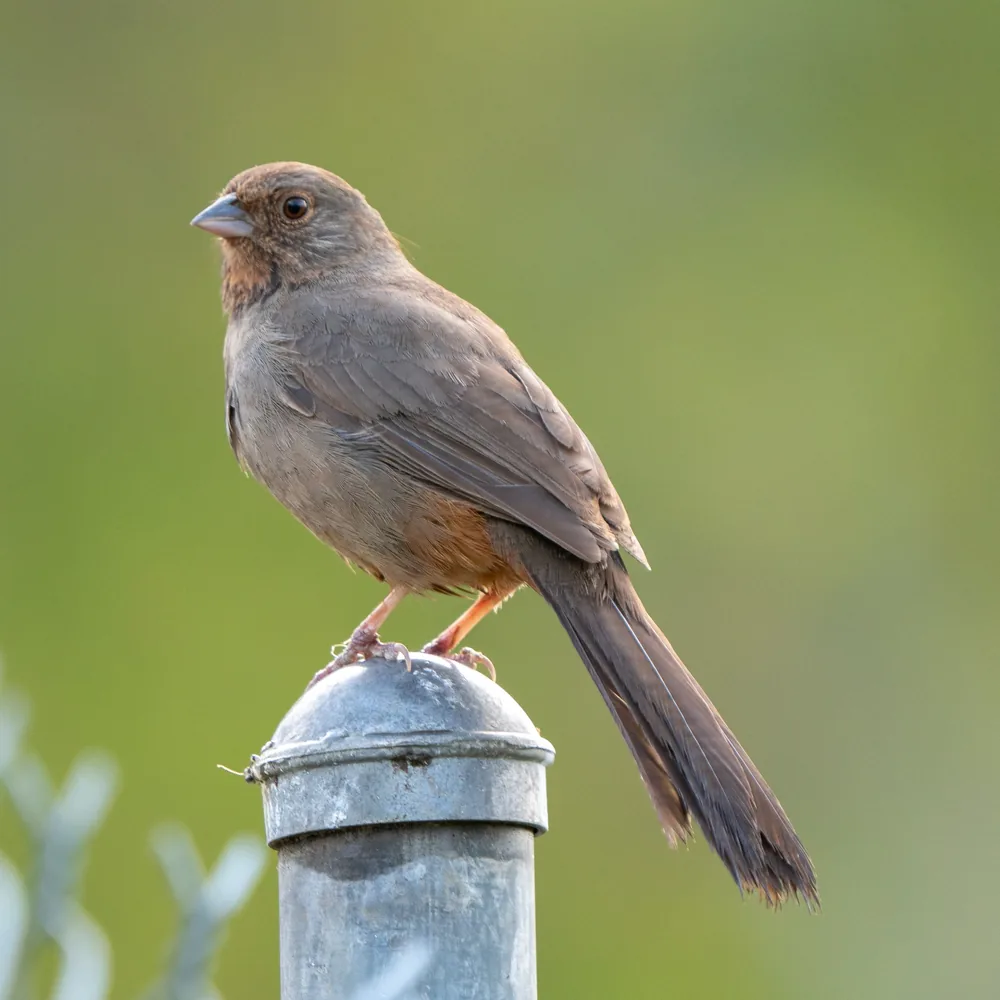
To look at, the Canyon is usually paler and grayer, with a dark spot in the middle of the chest and a more reddish-brown cap. The California is plain dusty brown, buffier under the tail and on the throat, with fine streaks around the throat.
Where do brown towhees live?
In the brushy West: the California Towhee from southwestern Oregon through California to Baja California. The Canyon Towhee lives from Arizona and New Mexico to southeastern Colorado, the far northwest corner of Oklahoma and western and central Texas, and on through Mexico. Both stay in one place all year and rarely move even a short distance.
They like low, dense cover: chaparral, coastal sage scrub, streamside thickets and well-planted gardens and city parks for the California Towhee; dry foothills, canyons, pinyon-juniper woods and grassland with cholla and mesquite for the Canyon, which avoids forest and open desert alike.
Are towhee birds rare?
No, both are common. The California Towhee is still very common in much of its range, though it has probably declined locally as the California coast has been built up; the Canyon Towhee is widespread and common, though surveys show declines in recent decades, says Audubon's field guide.
What does a brown towhee sound like?
Each half has its own voice. The California Towhee's call is a sharp chink and a thin tseeee, and its song of squeaky chips changes from region to region; the Canyon Towhee calls a clear chud-up.
Voice was one of the two differences the 1983 check-list named, and Audubon's field guide still calls it, with range, the plainest way to tell the two apart.
Do towhees come to bird feeders?
Yes: the California Towhee often comes to feeders, though it may do much of its feeding on the ground under the tray, says Audubon's field guide. Both towhees eat mostly seeds in winter and more insects in summer, and feed their young almost entirely on insects.
Where do California and Canyon Towhees nest?
Low, in thick cover. The California Towhee builds a bulky, loosely made cup of twigs, grass and strips of bark in a dense shrub or low tree, usually 4 to 12 feet up; the Canyon Towhee sets its nest in a small tree, a dense shrub or a cactus, 3 to 12 feet up, often against the trunk.
The female lays 3 or 4 eggs and sits on them for about 11 days. The young may leave the nest before they can fly well, and a pair may raise two or three broods a year.
Is the brown towhee related to the Eastern Towhee?
Yes, both are New World sparrows, but since 2010 they sit in different genera. Genetic data moved the California and Canyon Towhees into Melozone, while the Eastern and Spotted Towhees, once the Rufous-sided Towhee, stayed in Pipilo.
Which one did you see?
Start with the place. In California or Oregon it was a California Towhee. In Arizona, New Mexico, Colorado, Oklahoma or Texas, a Canyon Towhee.
The two never meet, so the place settles nearly every sighting.
Listen if you can. Squeaky chips that run into a trill: California. A musical chili-chili-chili: Canyon.
Look at the chest. A dark central spot and a reddish cap point to a Canyon Towhee.
What it does to your list
One old name, two birds today. A Brown Towhee from California and another from Arizona or Texas are now two species on your list.
If all your Brown Towhees came from one side, the count stays the same.
In a Birdfolio, a Brown Towhee that comes with a place is filed by it: seen in California, Oregon or Baja California, it is a California Towhee; seen in Arizona, New Mexico, Texas, Colorado, Oklahoma or elsewhere in Mexico, a Canyon Towhee. With no place, we ask you which one it was.
Why such splits keep happening: what birders mean by splits and lumps.
Is a Brown Towhee still on your list from a trip out West? See it as a book, each bird under today's name, with the opening pages free to look through.
Check your own list. Drop your eBird download or type your birds: the free checker shows which of them the changes since 2018 touched.
Check my list