2024 new name
Audubon's Shearwater is now Sargasso Shearwater
Audubon's Shearwater is now called Sargasso Shearwater: the American Ornithological Society (AOS) split it into five species in July 2024, giving the one off the southern US Atlantic Coast this new name, and eBird followed in October 2024. It is the same bird you saw, so your list doesn't change: a new name, not a new species.
Updated
What changed
At sea in the warm western Atlantic, including the Gulf Stream off the southeastern US, and in the Caribbean. The new name comes from the Sargasso Sea.
What are the five new species?
The Sargasso, Boyd's, Tropical, Bannerman's and Persian Shearwaters. Only the Sargasso Shearwater is known from North American waters, says Retter. Where each one nests, according to AviList:
Sargasso Shearwater: islets of the Bahamas and the Caribbean, from off northern Cuba to the Lesser Antilles. It used to nest on Bermuda too.
Boyd's Shearwater: only the Cape Verde Islands, off West Africa.
Tropical Shearwater: islands of the western Indian Ocean, such as the Seychelles and Réunion, and of the tropical Pacific.
Bannerman's Shearwater: the Bonin and Volcano Islands of far southern Japan. AviList lists it as Endangered.
Persian Shearwater: islands off Oman and Socotra; it ranges over the Arabian Sea.
Surprising facts about the Sargasso Shearwater
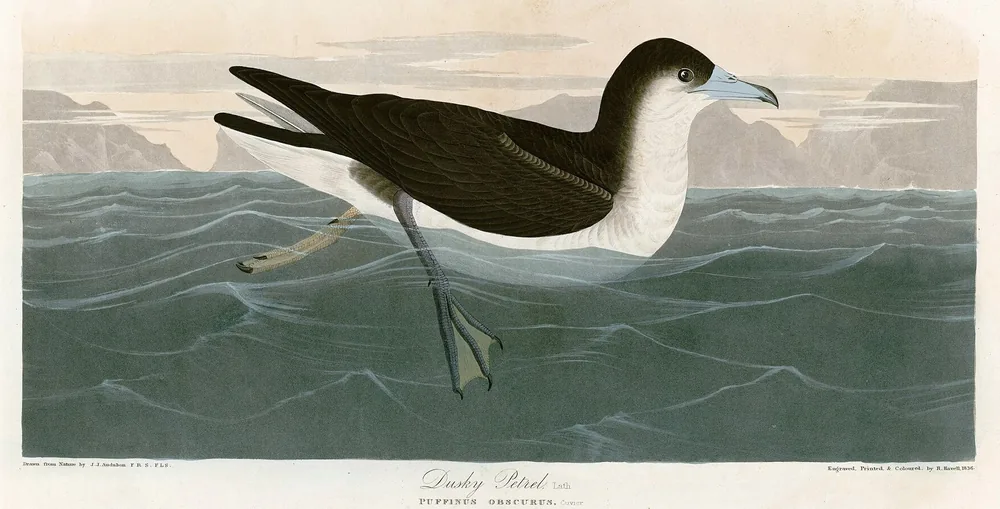
Audubon painted it under another name. The painting at the top of this page is plate 299 of The Birds of America, which Audubon titled "Dusky Petrel." The word petrel probably comes from Saint Peter, who walked on water: some small petrels patter their feet on the sea as they feed, as if walking on it.
On Saba it is the national bird, and it asks "where do we go?" On the Dutch Caribbean islands of Saba and Sint Eustatius, people call it the "Wedrego," after a mating call that sounds like "where do we go?" It is Saba's national bird and appears on the island's coat of arms, says the Dutch Caribbean Nature Alliance.
It comes home only in the dark. Adults feed far out at sea by day and fly back to their burrows and rock crevices at night. To count them, researchers on Saba used marine radar after sunset and recorded more than 450 birds in seven nights.
Its chick's first flight starts from the highest rock around. The parents raise a single chick and visit only at night. About 70 days after hatching the feeding stops; 3 to 5 days later, the young bird climbs to the highest point nearby and makes its first flight out to sea, at night, says Audubon's field guide.
It rows underwater. It dives and swims after small squid and fish, rowing with its wings, and may be quite agile underwater.
Why the name changed
The old Audubon's Shearwater turned out to be several species. Until recently, about ten subspecies were recognized across the world's tropical oceans, says Birds of the World, and studies of their voices and DNA have since rearranged them.
In 2024 the AOS split it into five species, Kenn Kaufman reported in Audubon magazine, and to avoid confusion all five got new English names. None of them kept the name Audubon's Shearwater.
The one in North American waters became the Sargasso Shearwater, named for the Sargasso Sea, where it spends much time, notes Michael Retter of the American Birding Association (ABA). The sea itself is named after Sargassum, a brown seaweed that is home to hundreds if not thousands of kinds of sea life.
The scientific name, Puffinus lherminieri, stays. It dates from 1839, when the bird was described from the French West Indies, according to the AviList world checklist.
Who decided, and when
- American Ornithological Society (AOS): the 65th Supplement to its Check-list of North American birds
- eBird and the Clements Checklist: its 2024 taxonomy update
- AviList, the shared world checklist: agrees, with the same name
Is the Barolo Shearwater the same as Audubon's Shearwater?
No. The Barolo Shearwater is a separate species of the eastern Atlantic, and not one of the five new ones. But the mix-up is understandable: Barolo and Boyd's Shearwaters were once treated together with Audubon's Shearwater as a single species, says Birds of the World.
Barolo Shearwater nests on the Azores, Madeira, the Desertas, the Salvages and the Canary Islands. Its closest relative is Boyd's Shearwater, AviList notes: all genetic studies pair the two, even though Boyd's looks more like the Sargasso Shearwater. Telling Barolo and Boyd's apart at sea is difficult.
Barolo Shearwater does reach US waters, rarely. AviList lists it near the edge of the continental shelf off New England, and the Massachusetts Avian Records Committee has accepted three records, all far offshore from Nantucket, in August 2007, July 2011 and August 2012.
What bird is called a shearwater?
A shearwater is a seabird of the petrel family, which AviList calls the petrels, shearwaters and diving petrels. Shearwaters live at sea and come to land to nest, often in burrows on islands.
Some are record travelers. Sooty Shearwaters tagged in New Zealand flew some 64,000 kilometers (about 40,000 miles) in a year, in giant figure eights across the Pacific that reached as far north as Alaska, Science News reported in 2006.
The Sargasso Shearwater is a homebody by comparison. Its travels are quite limited, Audubon's field guide says, compared with the long migrations of some shearwaters.
Why are they called shearwaters?
Because they fly with the tip of one wing just cutting, or shearing, the surface of the sea, most easily seen on calm days. The name goes back to the 1600s, says the Agreement on the Conservation of Albatrosses and Petrels.
How do you identify a Sargasso Shearwater?
Look for a small shearwater, dusky brown above and white below, that flies with fast wingbeats and short glides. It is 11 to 12 inches long with a wingspan of about 28 inches, says Audubon's field guide.
The bird to compare is the Manx Shearwater. A Sargasso has a distinctly longer tail, more dark under the tail, somewhat less white under the wing, and white that may come up higher on the face.
Behavior helps. At sea it is usually alone or in small groups, and it doesn't ordinarily follow ships. For telling other shearwaters apart off the East Coast, see the Cory's Shearwater split.
Where can you see a Sargasso Shearwater?
From a boat, over warm water off the southeastern US. It is regular over the warm Gulf Stream, follows it north in late summer and fall, and very seldom comes near land in North America, says Audubon's field guide. Some also move into the Gulf of Mexico.
Its northernmost visits, off New England, tend to come when the water is warmest.
What is the bird in the Audubon logo?
A Great Egret, not a shearwater. In 1953 the National Audubon Society adopted a flying Great Egret as its symbol, one of the chief victims of the plume hunters of around 1900, its history page says.
Great Egrets were nearly wiped out in the US in the late 1800s, when their plumes were used in fashion, and came back after early conservationists stopped the slaughter, says Audubon's field guide. The society carries John James Audubon's name: read more about the painter and his Birds of America.
Which bird is it?
There is nothing new to tell apart in North American waters: the only one of the five off the US is Sargasso Shearwater.
The real look-alike is the Manx Shearwater, and far off New England in late summer a rare Barolo Shearwater is possible: see the clues above.
What it does to your list
A new name only: your Audubon's Shearwater now counts as Sargasso Shearwater, and your total stays the same.
You gain a species only if you have also seen one of the other four, for example a Boyd's Shearwater off the Cape Verde Islands or a Persian Shearwater in the Arabian Sea. Birders call a species gained from a split, without a new sighting, an "armchair lifer."
Another shearwater changed the same year: see the Cory's Shearwater split. And read more about how bird splits and lumps work.
Once your list reads Sargasso Shearwater, preview it as a book, free, with the date and place you first saw each species.
Check your own list. Drop your eBird download or type your birds: the free checker shows which of them this and other recent changes touched.
Check my list