The best free sources of public-domain bird illustrations are the libraries that scanned the old books: the Biodiversity Heritage Library, Wikimedia Commons, the Internet Archive, the New York Public Library and Smithsonian Open Access. For Audubon, add the University of Pittsburgh. They share free high-resolution scans of the original plates, and name the book each one came from.
We use these archives every day: most of the paintings in a Birdfolio reached us through them. Here is where to look, why the old plates are free, and the traps that catch people out. This page is general information, not legal advice.
Key facts
- In the US, as of 2026, works published before 1931 are in the public domain (Cornell University Library).
- A faithful scan of a flat public-domain artwork adds no new US copyright, following Bridgeman v. Corel (1999).
- The Smithsonian released 2.8 million images under CC0 in February 2020, and the New York Public Library opened 180,000 public-domain items for free high-resolution download in January 2016.
- The National Audubon Society's own Audubon scans are for non-commercial, educational use only, although the artwork is in the public domain.
Facts checked: September 30, 2026.
Why old bird illustrations are public domain
Two rules do the work in the United States.
- Age. As of 2026, works published before 1931 are in the public domain, according to Cornell University Library's copyright chart. That covers the golden age of bird plates, from the 1700s to the 1920s. The Biodiversity Heritage Library gives a handy rule of thumb: "Public Domain = Current Year – 95".
- Scans. A faithful photo or scan of a flat public-domain artwork does not create a new copyright in the US. That follows a 1999 US federal court case, Bridgeman v. Corel. Wikimedia Commons marks such files with a "PD-Art" tag. It warns that some other countries see it differently, so check local rules if you live outside the US.
"Public domain" means nobody owns the copyright. Anyone may copy, print or adapt the work, without asking.
The best free archives, and what each is good for
| Archive | What you'll find | Good to know |
|---|---|---|
| Biodiversity Heritage Library | Whole natural history books and journals, page by page | Says it holds no copyright on its files. Its Flickr account had 319,661 images when we checked. |
| Wikimedia Commons | Single plates, often cropped and named by species | Each file page shows its source and license. Read it. |
| Internet Archive Book Images | Pictures pulled from millions of old scanned books | Launched in 2014 with 2.6 million images, searchable by the text printed near each one. |
| NYPL Digital Collections | Library scans, including Audubon's smaller octavo edition | Opened its public-domain images for free high-resolution download in 2016. |
| Smithsonian Open Access | Museum and library images across the Smithsonian | 2.8 million images released under CC0 in February 2020. |
| University of Pittsburgh: Audubon | Pitt's complete set of Audubon's big Havell edition | The whole set is online, with a zoom for detail. |
Biodiversity Heritage Library
The Biodiversity Heritage Library (BHL) is a free online library of nature books, run by a group of libraries around the world. It is the best place to see a whole book: you can turn the pages of John Gould's five-volume hummingbird monograph, for example. You can download single pages or whole books.
BHL asks, but does not require, that you credit it when you reuse a public-domain image. Its suggested line names BHL and the library that contributed the book.
Wikimedia Commons
Commons is the free media library behind Wikipedia. Search a bird's name plus "illustration", or a painter's name. Each file has its own page, which usually names the artist, the book, the date and the library that made the scan. Most of the plates in our books reached us this way.
Internet Archive Book Images
In 2014 a researcher at Georgetown University extracted more than 14 million images from 2 million public-domain books at the Internet Archive. The first 2.6 million went onto Flickr, each with the text printed around it in the book, so you can search by the words near each picture.
Four traps to avoid
- Website terms can be stricter than copyright. The National Audubon Society lets you download all 435 plates of The Birds of America at Audubon.org. Its terms of use say the artwork itself is public domain, but its own files are for non-commercial, educational use only. For anything else, it says to source the images elsewhere. Pitt's scans on Wikimedia Commons are one option.
- Paying for what's free. Some sites sell downloads, bundles or licenses for plates that libraries share for nothing. Look for the library scan before you pay.
- Checking the wrong date. What counts is when the picture was first published, not when the painter was born or died. In the US, a book first published in 1931 or later may still be in copyright; Cornell's chart explains the cases.
- Losing the source. Save the link to the library's page when you download a plate. It records the book, the date and the library, which is what you need to credit it or to prove its age later.
How we use these archives
Every plate in a Birdfolio comes with a record: the artist, the book, the year, the library that scanned it and the page we took it from. The Picture Credits pages at the back of each book name the artist and the book for every plate, and we never use AI-generated birds.
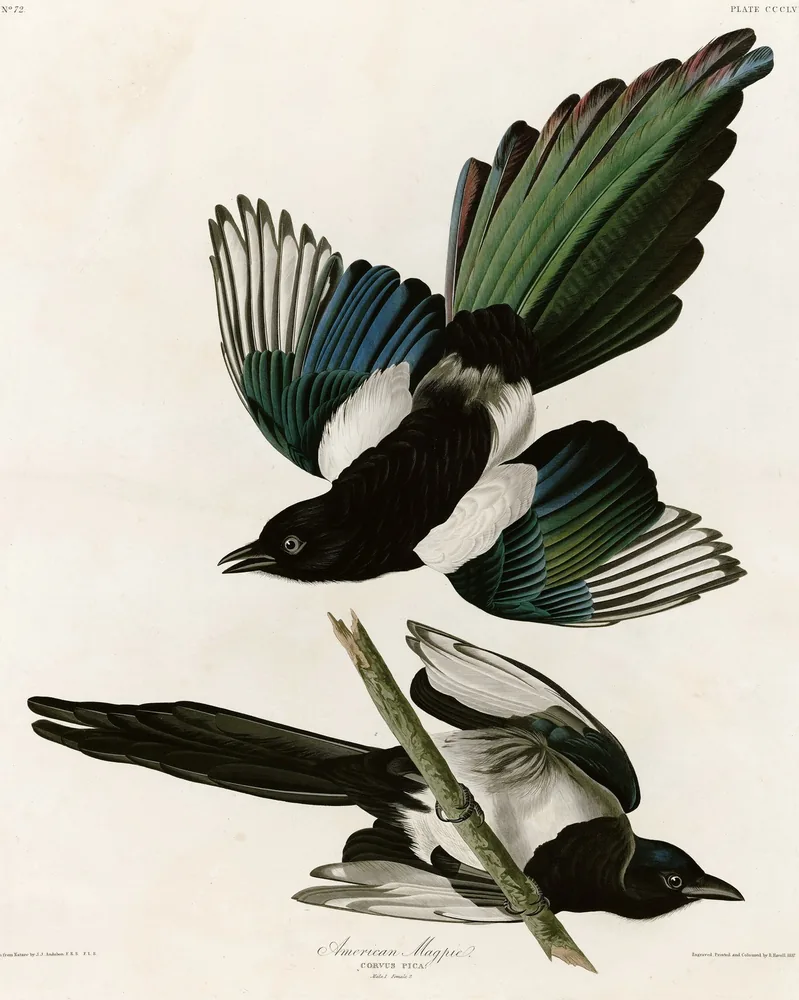
Want to know who painted the plates you'll find? Meet the famous bird painters, or read about John James Audubon, John Gould and Louis Agassiz Fuertes.
Questions people ask
Are Audubon's bird paintings public domain?
Yes. The National Audubon Society's own terms say so. The plates were published from 1827 to 1844. Free scans are online at the University of Pittsburgh, the New York Public Library and Wikimedia Commons.
Do I have to credit a public-domain image?
Public domain means you don't need permission. Many libraries still ask for a credit line, and it helps others find the original. We credit every plate.
Where can I find high-resolution vintage bird prints for free?
Start with the Biodiversity Heritage Library for whole books, and Wikimedia Commons for single plates. For Audubon, use the University of Pittsburgh and the New York Public Library.
Can I use public-domain bird art on things I sell?
In the US, public-domain works may be reused by anyone, including commercially. But check the terms of the site you download from, and the license on each file page. If in doubt, ask a lawyer.
See how these plates look in a finished book → /sample