Free printable
Bird Study field notebook (free printable)
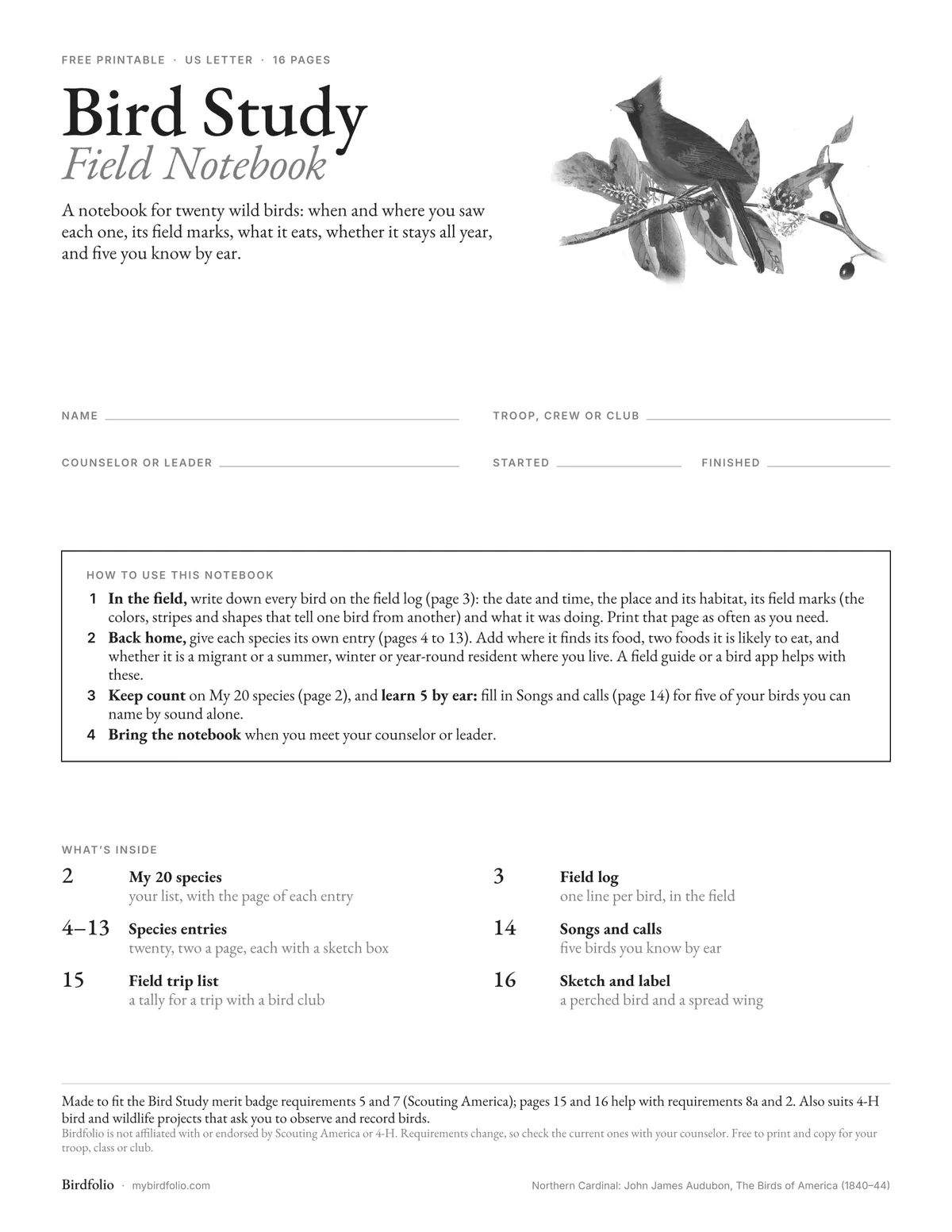
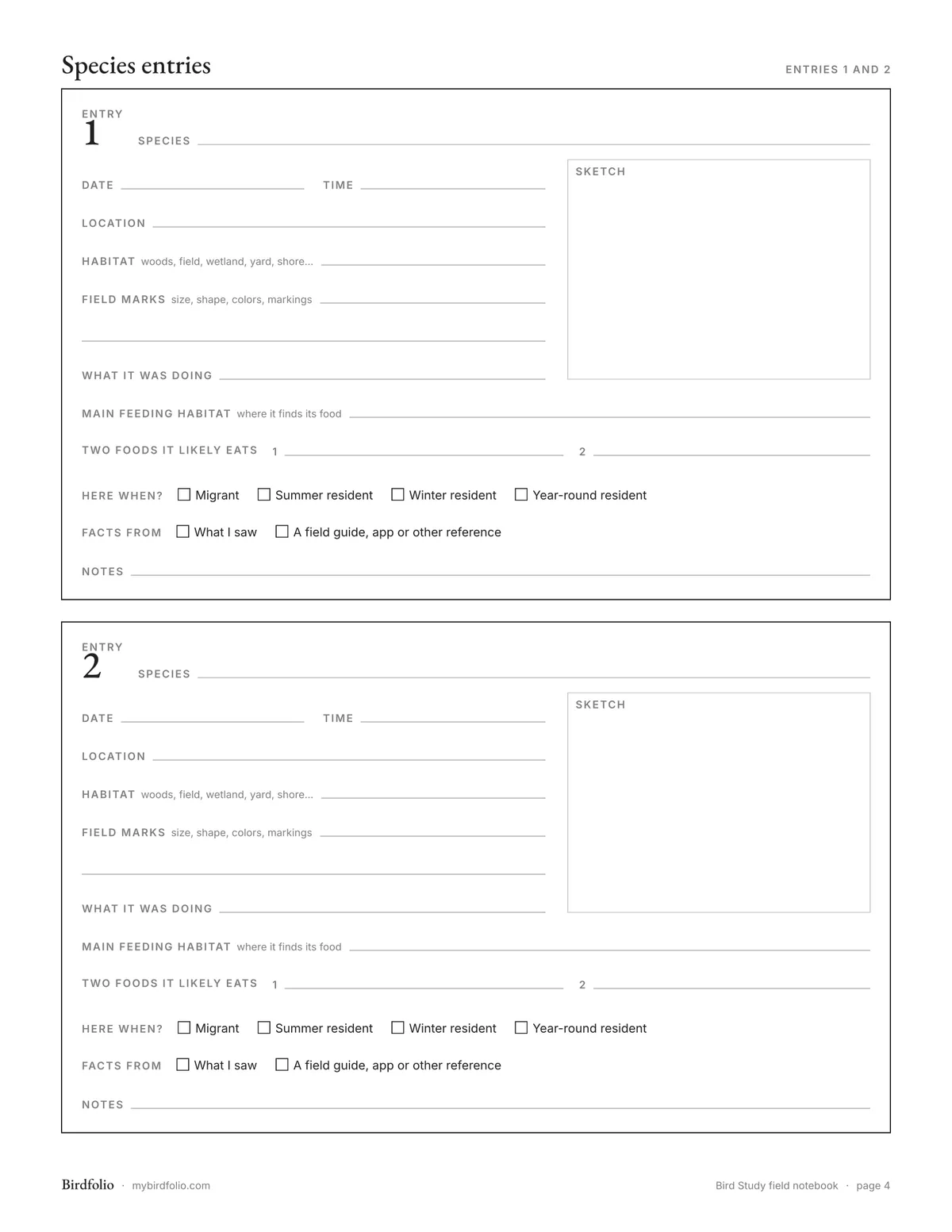
A free printable field notebook for the Bird Study merit badge: 16 US Letter pages with a separate entry for each of 20 species (date and time, place and habitat, field marks, feeding habitat and two foods, migrant or resident), a field log for notes outdoors, and five boxes for songs and calls. It prints in black ink only, and there's nothing to sign up for.
Updated
Download the notebook
Made to fit the Bird Study merit badge requirements 5 and 7 (Scouting America). Print it at home or at school, punch three holes, and it goes in a binder or on a clipboard. Free to print and copy for your troop, class or club.
US Letter, 16 pages, about 420 KB. Black and white. No sign-up needed.
Birdfolio is not affiliated with or endorsed by Scouting America or 4-H.
What’s inside the notebook?
Sixteen pages, in the order you’ll use them:
- Page 1 Cover: your name, troop or club, counselor, the dates, and how to use the notebook.
- Page 2 My 20 species: one line per species, the page of its entry, and a box for each bird you can name by ear.
- Page 3 Field log: quick notes outdoors, one line per bird with the date and time, place and habitat, field marks, behavior and food, and when it's here (print it as often as you need).
- Pages 4–13 Species entries 1 to 20: two a page, each with a sketch box, the bird's main feeding habitat, two foods, and migrant or summer, winter or year-round resident.
- Page 14 Songs and calls: five boxes for the sound in words, song or call, what the bird was doing, and why you think it sang or called.
- Page 15 Field trip list: a tally of every bird your group finds on a trip with a bird club.
- Page 16 Sketch and label: a perched bird with 15 parts, and a spread wing with six kinds of feathers.
Which Bird Study requirements does it cover?
Requirements 5 and 7, the two that ask for a field notebook, and it has pages for parts of requirements 2 and 8 too. Here is what each one asks, in short:
- Requirement 5
- Observe 20 species of wild birds and identify them, and keep a separate notebook entry for each: the date and time, the location and habitat, where the bird mainly feeds and two foods it likely eats, and whether it's a migrant or a summer, winter or year-round resident where you live. Pages 2 to 13 (the field log, page 3, is for notes outdoors).
- Requirement 7
- Name five of your 20 species by song or call alone, and for each one describe the sound, what the bird was doing, and why you think it was singing or calling. Page 14.
- Requirement 2
- Sketch or trace a perched bird and label 15 of its parts, then a spread wing with six kinds of wing feathers. Page 16.
- Requirement 8a (one of three choices)
- On a field trip with a bird club or other birders, list every bird your group sees, then think about why some were common and others few. Page 15.
Field marks (the colors, stripes and shapes that tell one bird from another) aren’t on the requirement’s list, but they’re how you tell 20 species apart, so the field log and every entry have a line for them. The notebook also suits 4-H bird and wildlife projects that ask members to observe and record birds.
Checked against Scouting America’s Bird Study merit badge page on October 22, 2026. Requirements change, so your counselor has the final word.
How many birds do you need for the Bird Study merit badge?
Twenty species of wild birds, each with its own notebook entry, and five of those you must also be able to name by song or call alone. A backyard feeder, a park and a pond are good places to start. A field guide or a bird app fills in what each bird eats and when it’s around.
How do I print it?
On US Letter paper at actual size (100%), one side of the page, so there’s room to sketch. Everything is in black ink, so it prints the same on a black-and-white printer. Print the field log (page 3) as often as you need, and a few more entry pages if you see more than 20 species.
After the badge
Twenty species is a start. Many birders keep going and write down every species they ever see, with the date and place: that’s a life list. Here’s what a life list is and how to start one.